

























































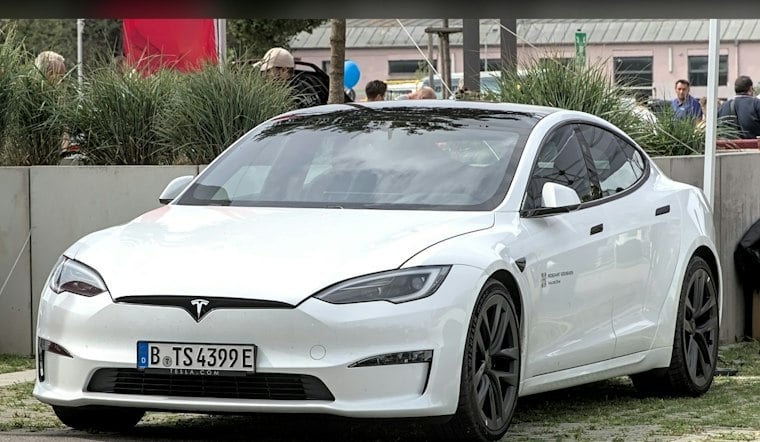
A dashcam clip circulating online appears to show a Tesla pulling aside just seconds before a speeding car slams into another vehicle in Utah, and the poster says the car's driver-assistance system was active at the time. The driver of the speeding vehicle was reportedly killed in the crash, though the full circumstances remain unconfirmed.
The footage was shared by a user posting as @RepubliKate, identified as Kathleen Anderson, who uploaded three clips showing the incident from different camera angles, according to News18. Anderson said the Tesla belonged to a friend of her brother and claimed its driver-assistance system was active as the speeding vehicle approached, according to the same report. In her account, the Tesla detected the oncoming car and moved aside just before the white sedan passed it on the left and struck another vehicle near an intersection.
News18's report stressed that the crash circumstances and the role Tesla's software may have played have not been independently confirmed. No police report or statement from Tesla was available at the time of reporting, and the date and exact location of the crash remain unclear.
What the Footage Does — and Doesn't — Prove
The cause of the Tesla's movement in the clip is simply unknown. It may have resulted from a driver's own maneuver or from the vehicle's driver-assistance software, and the viral footage alone does not resolve which. Online, a Korean-language account separately claimed the Tesla slowed near an exit ramp before moving toward the edge of the road, while another Tesla owner claimed their own vehicle moved toward the median after detecting a vehicle approaching from behind on a Portland freeway — but none of these secondhand social media accounts establish what actually caused the Tesla to move in the Utah footage.
The clip still drew plenty of attention, with viewers praising the Tesla's apparent reaction and debating the underlying safety technology. Some social media users questioned whether the vehicle was running Hardware 4 and whether older hardware could have responded the same way — a technical detail that, like the rest of the footage's backstory, has not been verified.
Tesla's Own Description of the System
Tesla describes Full Self-Driving (Supervised) as a driver-assistance system that still requires an attentive driver ready to take control, a characterization echoed in reporting from Reuters noting the system requires drivers to pay attention and intervene if needed. Tesla has also said it does not attribute fault in its own collision reporting, per the company's safety report. Under its own methodology, Tesla counts a collision as occurring with FSD engaged if the system was active at any point in the five seconds before the crash, using a federal threshold that includes airbag deployment or a velocity change of at least 8 km/h within 150 milliseconds.
Tesla has published figures comparing miles driven with FSD engaged against broader U.S. driving statistics. Its February 2026 safety report recorded one major collision for every 5.3 million miles driven with FSD active, compared with one for every 660,000 miles for the U.S. average, according to figures cited by News18. Any comparison between those numbers should be read carefully, since driving conditions, vehicle types, reporting methods and other factors can differ substantially between the two populations.
Scrutiny From Federal Regulators
The Utah footage surfaces against a backdrop of federal scrutiny of Tesla's FSD system. Reuters reported in March 2026 that the National Highway Traffic Safety Administration opened an engineering analysis of Tesla vehicles equipped with FSD, a required step before the agency could seek a recall. NHTSA identified nine incidents that may be tied to a visibility issue, including one fatal crash and two injury crashes, and said it was examining whether six additional crashes were related. In many of the crashes under review, the agency said FSD lost track of or never detected a lead vehicle in its path.
None of that federal scrutiny establishes what happened in the Utah footage now circulating online — it only underscores why dashcam clips like this one tend to spark immediate debate. A similar pattern played out in an earlier Utah case covered by the Los Angeles Times, in which a Tesla Model S in Autopilot picked up speed for 3.5 seconds before crashing into a stopped firetruck, injuring two people. Police in that case suggested the car may have accelerated back to its preset 60 mph after the vehicle it was following changed lanes, without detecting the stopped vehicles ahead.
For now, the viral clip remains just that — viral. Without a police report, an official statement from Tesla, or confirmation of even the crash's date and location, the claims attached to the footage are, at best, one witness's account of a tragedy that killed someone on a Utah roadway.




