

























































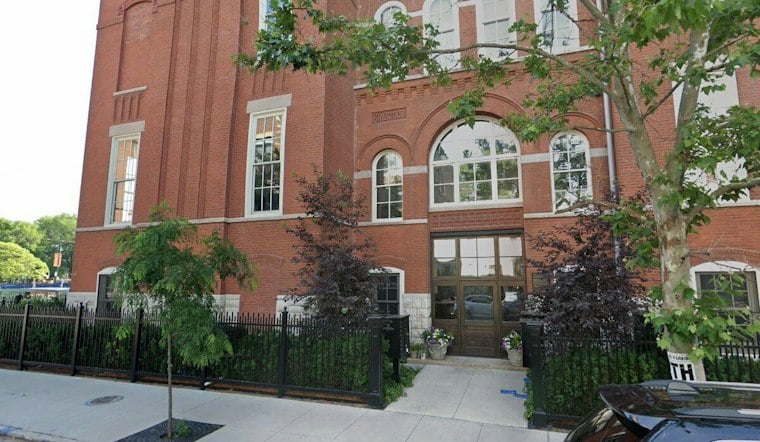
For nearly 130 years, the building at 739 N. Ada St. in West Town rang with the sounds of Chicago schoolchildren. Today, it rings with the hum of rooftop deck chatter and in-unit washing machines, after a developer turned the shuttered John Lothrop Motley School into 34 apartments where some living rooms still have the original classroom chalkboards bolted to the wall.
From Special Education Classrooms to Luxury Living
The school opened in West Town in 1884 and was later known as Near North Elementary, according to Block Club Chicago. In its final years, the school served exclusively special-education students, and it was serving 88 students in need of those services when Chicago Public Schools closed it in 2013. Block Club Chicago describes Motley as one of 50 Chicago schools shuttered that year, while Preservation Chicago puts the number at 49. A separate Chicago Tribune accounting specifies that the Chicago Board of Education approved a plan that year to close 49 elementary schools plus one high-school program.
Svigos Asset Management bought the empty building in 2015 for $5.1 million and set about turning it into housing, per the same Block Club Chicago account. The result, as reported by The Economic Times, is a 34-unit building where many apartments sit inside the footprint of former classrooms, with original hallway dimensions and 14-foot ceilings left intact.
Chalkboards, Gym Floors and a Painstaking Restoration
The conversion kept sections of the old gym flooring, classroom chalkboards and transom lights above doorways, the report notes. Modern touches were layered in around those relics, including exposed ductwork, tiled bathrooms, stone countertops, oversized windows and in-unit laundry, along with building amenities like an elevator, a rooftop deck, a garden, storage units, bike storage, dry-cleaning service, security cameras and a mobile buzzer system for phones.
Some of the heaviest lifting went into the woodwork. Nick Vittore said each classroom cupboard preserved in the building could require 30 to 40 hours of work, and that saving the original wood cupboards was a labor of love rather than a money-making effort. The project also leaned on historic tax credits, and Svigos followed guidance from Chicago's Commission on Landmarks throughout the renovation after the city granted the building landmark status in 2016 — a designation that helped guide the restoration work, per the same account. A City of Chicago preservation report lists the Motley School at 739 N. Ada Street as officially designated on November 16, 2016.
Residents Split on the Building's Second Life
One-bedroom apartments start at $2,300 a month, while two-bedroom units run from $3,200 to $4,200, the report states. Twenty parking spots come with the building, nine of them covered. Holly Huth praised the renovated kitchen in her unit, while Eric Schultz Saindon criticized turning a former public school into expensive apartments. Block Club Chicago reported the redevelopment fits a wider pattern of former Chicago school buildings finding new life as residential housing.
A Citywide Pattern of School-to-Apartment Conversions
Motley is not an outlier. In 2013, Chicago Public Schools unveiled a three-phase process to repurpose or sell 49 underutilized school buildings across the city, according to WTTW. By September 2016, the city had moved forward with landmark designation and sale for three of those buildings: Motley and Peabody Elementary School in West Town, and Stewart Elementary School in Uptown. The former Stewart school was being restored for a planned 50 apartment units, while the former Mulligan school — which was not among the 49 schools closed in 2013 — was purchased for $4 million and converted into 24 two-bedroom units.
Morningside USA bought the former Graeme Stewart Elementary School in 2016 for $5.1 million, and Stewart School Lofts opened in April 2018, Block Club Chicago reported in a separate account. Svigos also bought the shuttered Peabody Elementary School, paying $3.1 million according to Preservation Chicago, and later converted it into 23 apartments with rents starting around $3,000 a month, Block Club Chicago reported in 2022.
The Human Toll Behind the Closures
The wave of 2013 closures left a lasting mark beyond the buildings themselves. Research from the Chicago Teachers Union found that of the 49 closed elementary schools, 90 percent had a majority African-American student demographic, as reported by In These Times. The same research estimated that roughly 12,000 students were affected by the closures districtwide, and found that only 38 percent of the schools that absorbed displaced students had a librarian on staff, compared with 55 percent of elementary schools across the district as a whole.





