
























































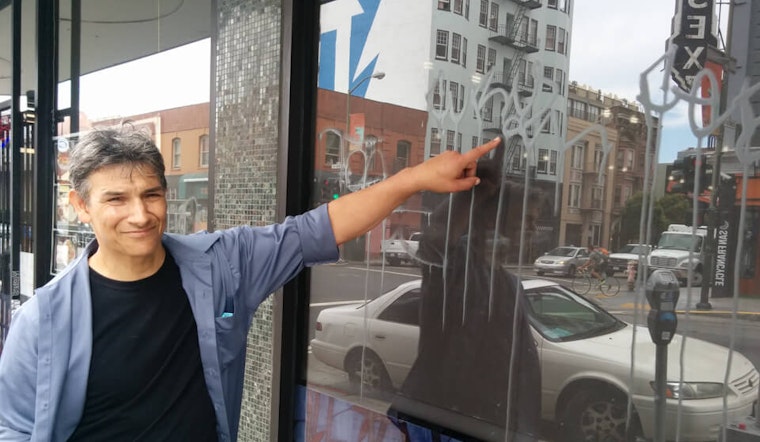
Go window-shopping in the Tenderloin and you’ll notice that you can barely see in or out of many storefront windows. The drawings and carvings etched into windows may be visual in nature, but it’s not graffiti as an art form, 25-year resident Mike Sullivan explains. It’s vandalism and has been nearly impossible to remove — until now.
He's figured out a way to clean it off, and he's been building a strong business in the neighborhood.
Most of the damage is done using hydrochloric acid, Sullivan tells us, so removing these marks is not a ‘wipe on, wipe off’ job.’ Even skilled tradesman find the process too labor-intensive and expensive to bother.
 A neighborhood window, pre-cleaning.
Sullivan, meanwhile, has made a science of the work.
He has been washing the windows of San Francisco's high-end shops and high-rise buildings since the early 90s and set his sights on finding a way to remove the blight plaguing his neighborhood last spring.
He ran some ideas by Roberto Rivera, director of operations at San Francisco Clean City Coalition, and received nothing but positive feedback and a vandalized window to experiment on, he says. After a couple of months of Internet research, countless trips to the hardware store, trial and lots of error, he finally found a solution.
He's keeping his secret for now, except to reveal the following on his site:
I personally have learned my craft from stone polishing masters and french perfume bottle makers who have combined most of the knowledge available to date on advanced glass surfacing techniques. By rare opportunity I have also had the chance to interview extensively two industrial glass innovations engineering scientists who specialize in contemporary silicon carbide based abrasive applications and applied cerium oxide technology . This as well as my experience working every day with store front window damage has given me some in depth insight on the subject of glass and the manipulation of it with heat , friction and composite materials producing variable levels of control under both laboratory and manufactured window scenarios.
One year in, Sullivan’s business — Glassthetix — is growing strong. While merchants widely assume that the marks cannot be removed, each job helps change that perception, he says. His business is literally on display.
As he works on one window, anywhere from five to 20 business owners stop by and ask him to take a look at their windows next and two to three typically result in new contracts.
“When you finish a whole block, it’s really cool. It really makes a difference,” he said while showing off the storefronts on the western side of Jones Street between Geary and O'Farrell, where he’s fixed every storefront, corner to corner.
Sullivan admits that fear of vandals returning does hold some business owners back, and while it worried him at first, it’s generally not a problem, he said. He theorizes that window vandalization spiked last decade, after cash-strapped merchants stopped hiring window washers in favor of assigning the task to employees and simply washing windows less often. Just like anyone who’s ever been tempted to write “Wash Me” on a dusty car, vandals were drawn in.
To ease concerns regarding the cost of return visits, Sullivan offers a warranty: If a client’s windows are vandalized again within the next two years, he’ll remove the fresh blight for free. Of about 60 jobs he’s completed so far, he’s had to honor the warranty just once, Sullivan said, leading him to believe that many of the original vandals are long gone.
 Sullivan in the middle of Jones Street, where he's repaired a block's worth of store windows including the one pictured.
One concern he wasn't prepared for, however, was the discount value of defaced storefronts. At least one merchant has turned him down, saying that while fixing the windows would be great, if the landlord noticed, the rent would likely increase, he said.
Regardless, Sullivan is determined to be part of the neighborhood’s solution, and that includes offering District 6 merchants half-off his rates and creating jobs for residents.
“I'm just like all of these guys out here,” he said. When he first moved to the Tenderloin, he was in singer in a band that played shows at venues like the Warfield and the Fillmore and recorded at Hyde Street Studios. Living the street life was a major part of his artistic approach, but — as he focused on that than his music career — “it wasn’t a wise thing. It took a long time to get out of being one foot in the street and one foot in something respectable.”
Now that he’s in a position to give back — and as soon as he finds the time — he aims to secure funding to get the trade registered with the state and develop a certified apprenticeship program.
“Glass aesthetics are a growing factor in urban areas. As much, if not more visually important than wood in today’s world,” Sullivan said. “I want to see people in this community have a trade that’s urban-oriented.”
In the future, Sullivan envisions expanding his scope beyond the Tenderloin, employing staff of 20 to 30, and securing contracts with the city’s newest developments — which are just as susceptible to hydrochloric acid attacks.





