
























































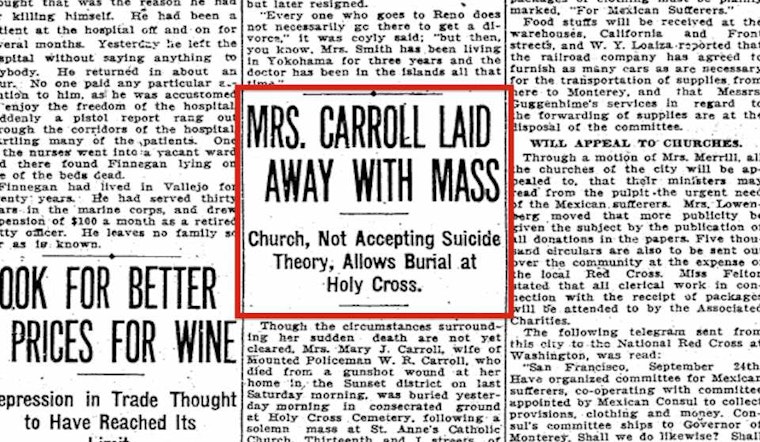
In September 1909, the shooting of an Inner Sunset housewife brought tragedy to the quiet neighborhood—and a mystery that remains unsolved to this day. Did Mary J. Carroll take her own life, or was she a victim of domestic violence?
On the morning of Saturday, September 25th, Mary Carroll was reportedly engaged in an argument with her husband, Walter Carroll, a mounted policeman, in their home at 1260 12th Avenue.
According to the testimony Mr. Carroll gave to the Coroner's jury, his wife had locked herself in their bedroom after "a bitter quarrel," and used his gun to shoot herself in the head. Carroll, who said he was shaving at the time, "forced an entrance after his wife had taken her life," and found her mortally wounded, the San Francisco Chronicle reported.
Witnesses, police and detectives who responded to Carroll's cries for help testified that the gun was under Mrs. Carroll's body, and that the bedroom door's lock had been broken.
At the time, Captain of Detectives Marcellus Anderson declared that investigators were "convinced that she took her own life," but "rumors" and "insinuations" circulated nonetheless, according to reports.
During the inquest, Mrs. Carroll's brother-in-law, Thomas Plunkett, caused "some commotion" when he interrupted the widower's testimony to call him a liar, "but this was quickly suppressed by the court officers." According to published reports, the dead woman's relatives stated their belief that Mrs. Carroll died at her husband's hands, but he was fully exonerated.
The day before the inquest, Mrs. Carroll was laid to rest at Holy Cross Cemetery, following a mass at St. Anne's Church at Thirteenth & I Street (now Irving). Although the official cause of death had yet to be determined, parish priest Father J.J. McCue decided to give her a requiem mass, a rite that would have been denied a suicide victim.
"There is no way to prove the real facts, and as the woman was a devout practical Catholic, we could not decide to refuse her a Christian burial ... It may be that the true details may never become known," said McCue, who also noted "the most strange fact" that he wasn't called to the scene to offer last rites "until an hour and ten minutes after the shooting."
McCue's decision in Mrs. Carroll's favor cast a shadow on her husband's account of her death. After the inquest, Carroll left the police force and found work on the grounds of an estate in Morgan Hill.
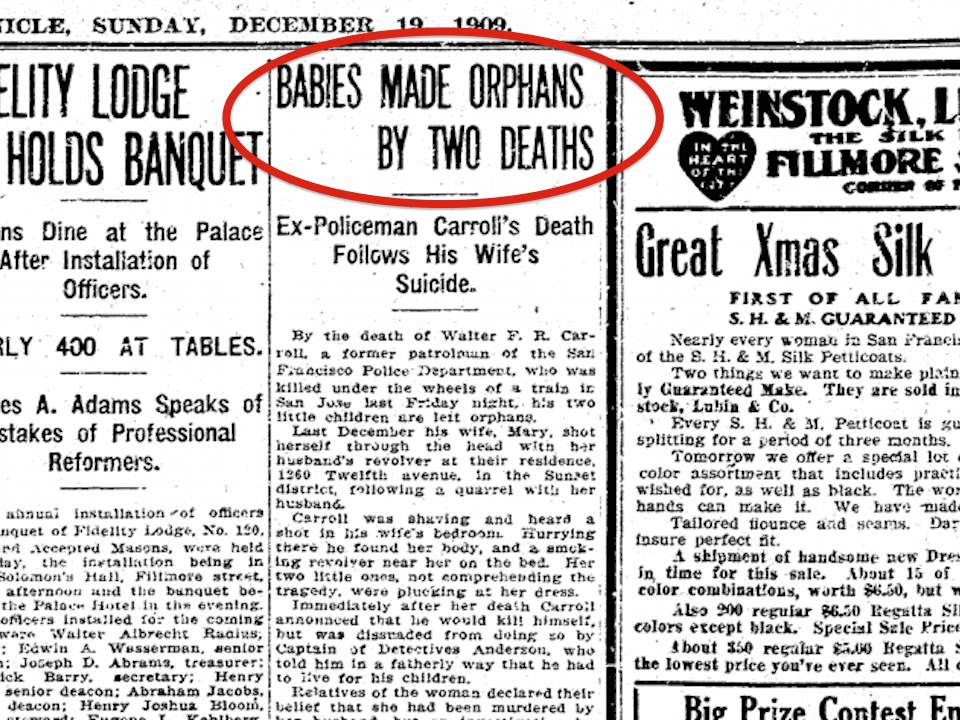
On Friday, December 17th, less than three months after his wife's death, he was "killed under the wheels of a train in San Jose." The Chronicle reported that Carroll had threatened suicide immediately after Mary's death, but was talked out of it by Capt. Anderson, "who told him in a fatherly way that he had to live for his children." (The couple had two children; it's unclear what happened to them.)
107 years later, the circumstances of Mary Carroll's death are still murky. Today, data shows that about a third of all female murder victims are killed by a male partner. Additionally, the Chronicle story that reported Walter Carroll's death stated that the widower had discovered a "smoking revolver" on the bed—and not under his wife's body, as was stated during the coroner's jury.





