

























































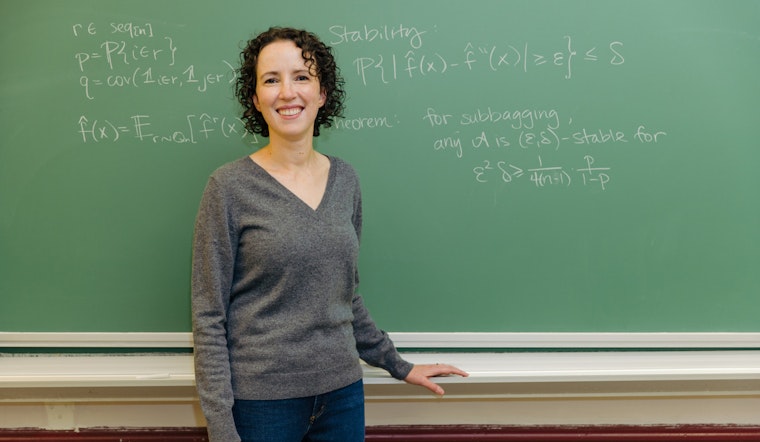
Algorithms and data models play a significant role in our everyday routines, making it essential to assess their function and reliability. Today, the MacArthur Foundation "genius grant," amounting to $800,000, was awarded to Rina Foygel Barber, a Statistics professor at the University of Chicago. The prize comes with no stipulations attached, duly facilitating Barber to delve deeper into her statistical pursuits, as reported by the Chicago Sun-Times.
Barber's specialization lies mainly in theoretical statistics. Analyzing how algorithms and models perform when used with complex data is her key focus. As Barber explained on the MacArthur Foundation's website, her work entails critiquing algorithm assumptions and unearthing potential shortcomings.
In addition to updating statistical theories, Barber has contributed in reducing false discovery rates and implementing machine-learning models. These advancements have implications for various sectors, notably health care, climate science, and astronomical imaging. A notable innovation to prove this is the knockoff filter framework, developed in collaboration with Emmanuel Candès. The framework measures the likelihood of false positive outcomes, offering researchers an invaluable statistical analysis tool, as reported by the Chicago Sun-Times.
A practical application of Barber's work is evident in medical imaging. Her research has marked improvements in the quality of CT scans by filling missing data points that emerge during scanning, as noted in the same Chicago Sun-Times article.
Apart from Barber, 19 other recipients from multiple disciplines like legal scholarship, fiction writing, and environmental ecology have been awarded this "genius grant". Scholars spread across the US, enabled to innovate freely in their respective fields, exhibiting remarkable potential for fresh perspectives and creativity, according to the Chicago Tribune.
Thanks to the financial support by the MacArthur Fellowship, Barber and her fellow recipients can continue their innovative explorations in their respective domains. As they move forward, their unique concepts and perspectives contribute to a more profound comprehension of our world, preparing us better to tackle pressing global issues and explore new frontiers.
This year's MacArthur Fellows include E. Tendayi Achiume, who concentrates on immigration and human rights, and Lester Mackey, a computer scientist and statistician who pioneer statistical and machine-learning techniques. Their work, along with the other recipients', highlights the importance of varied talents in addressing the complicated real-world scenarios of the 21st century, as outlined in the Chicago Tribune.



