

























































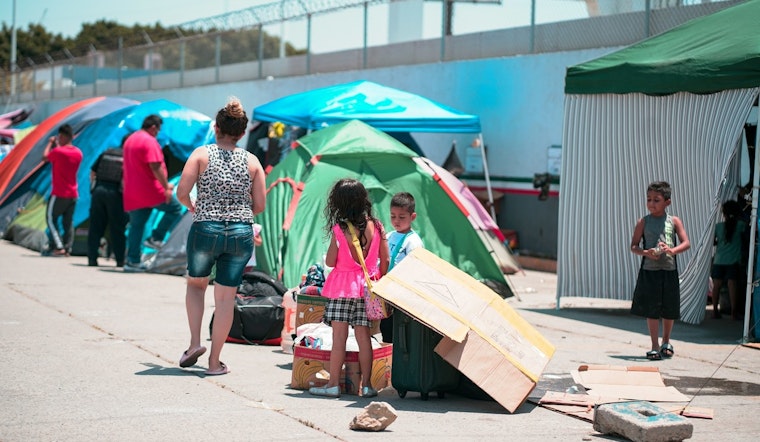
As the city of Chicago grapples with a near-breaking point migrant situation, Gov. J.B. Pritzker and Mayor Brandon Johnson are locking horns over the city's decision to hold off on opening new shelters for the influx of asylum seekers that have been arriving since last August. With nearly 35,000 migrants sent to Illinois, predominantly Chicago, and shelters at capacity for months, state and city officials find themselves in a heated dispute over how to proceed.
Pritzker, voicing his concerns Monday, criticized the mayor's pause in shelter expansion — a move many see as a band-aid that could tear off with the looming migration that shows no sign of stopping. "The city has not told the state where they would like us to put our resources to build new shelters, so we can’t help if they don't identify those locations," Pritzker said during an event unrelated to the crisis.
In response, Johnson's office countered, inferring that the state could take more direct action. "The State has the authority to fund, stand up and operate a shelter in any one of those municipalities at any time that it chooses, including the City of Chicago," Mayor's spokesman Ronnie Reese pointed out in a statement obtained by WTTW News.
The current impasse further complicates matters, as approximately 200 individuals on Monday were left waiting for shelter amidst winter weather advisories. Pritzker's administration noted it has committed to a range of responsibilities, including significant funding while implying Chicago isn't the heavy lifter it claims to be. "The idea that they are shouldering all of this on their own is ridiculous," a state official alleged regarding the city's claim of carrying the "entire weight" of the crisis.
While the governor awaits the Illinois legislature to approve funding replenishments, proposals include a joint city/state plan that will potentially evict migrants from shelters after 60-day stays starting Feb. 1. This looming policy has already been delayed due to severe weather conditions, with close to 3,000 migrants at risk of losing shelter imminently, according to city data. As the influx from Texas continues, available beds are expected to be a rare commodity.
The financial burden weighs heavy on both city and state coffers. City budget allocations for migrant care amount to $150 million, less than the anticipated spend, while state efforts have poured in at least $648 million, including a notable $160 million for direct response to the asylum-seeker crisis. Amid this back-and-forth, the first state-funded shelter with space for 220 people recently opened its doors in a former CVS lot in Chicago's Little Village.
With no clear path forward, tensions rise as federal intervention remains a distant hope. Both Pritzker and Johnson have called on President Biden and Congress to provide national coordination and additional funds for states like Illinois that are at the forefront of this humanitarian challenge. In the interim, a politically charged standstill persists, with migrants caught in the crossfire of a bureaucratic stalemate.





