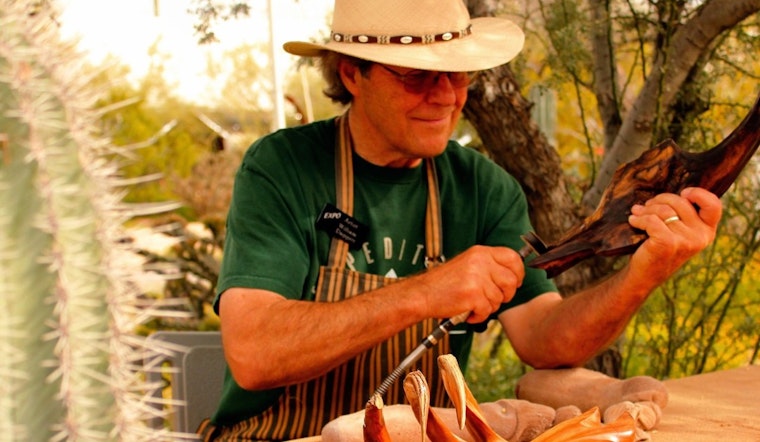
Paradise Valley's own William Daggett, a virtuoso in the art of wood sculpting, has not let a diagnosis of Parkinson's disease silence the whispers of the juniper that have long inspired his work. Known for his ability to find the hidden spirits within twisted pieces of wood, Daggett dubbed the "wood whisperer," told AZFamily how his creative process is akin to "giving birth every time you carve one." Despite the encroaching limitations of his condition, he continues to transform nature into art, finding new ways to express the robust creativity yearning to emerge.
Daggett's determination to adapt in the face of adversity has led him to explore the world of precious metals. While Parkinson's has been, in some ways debilitating, the artist revealed to AZFamily that technology allows him to create molds of his wooden sculptures and reincarnate them in silver and gold. This not only preserves his artistic legacy but also serves as an inspiration for those facing similar battles. "You can get through it," Daggett said, encouraging individuals with disabilities to do their utmost with the tools at their disposal.
Meanwhile, fresh insights into the experience of art by individuals with Parkinson's disease are emerging from the Penn Center for Neuroaesthetics. A recent study, as reported by Penn Medicine, suggests that the way art is valued and experienced can be profoundly altered by neurological conditions. Seeking to understand how our brains interact with art, they discovered that patients with Parkinson's show unique patterns of motion perception in abstract art, potentially reshaping our understanding of aesthetic appreciation.
"People can experience movement in abstract art," stated Anjan Chatterjee, MD, professor of Neurology and director of the Penn Center for Neuroaesthetics, in a Penn Medicine interview. Highlighting the study's exploration of how the motor system decodes static visual cues into representations of movement, the research team delved into the aesthetic judgment made by people with Parkinson’s disease. They found a curious twist – whereas standard motion perception was diminished, their enjoyment of high-motion art was heightened.
The artwork of William Daggett can be viewed and purchased at the Arizona Art Expo, available until March 24 for those interested in experiencing the convergence of creativity and resilience firsthand. His story not only symbolizes the enduring spirit of artistry in the face of personal challenge but also serves as a living testament to the ever-evolving ways we, as individuals and as a society, perceive and value the world of art.