

























































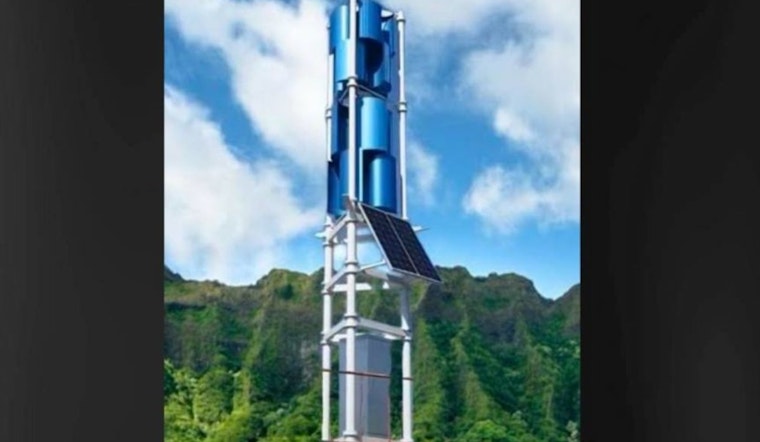
In a recent announcement, the Hawaii Community Development Authority has joined forces with Kanoa Winds Inc. to initiate the testing of a Japanese-developed wind turbine technology in Kaka‘ako Makai, Honolulu, as both sources, Big Island Now and Spectrum Local News, have documented. The Vertical Coaxial Contra-rotating Twin Blades (VCCT) turbine, with its reduced footprint, is being pinpointed as a potential catalyst for Hawaii's transition to cleaner energy.
The objective behind the installation of a 0.5 kilowatt VCCT unit near the Hawaii Technology Development Corporation's Entrepreneur Sandbox is to gauge its capacity at varying wind speeds, its resilience, and its ecological implications in an urban Hawaiian setting, Kanoa Winds aims to demonstrate the turbine's adaptability, which unlike traditional horizontal-axis turbines that cease to generate power beyond wind speeds of around 44 miles per hour, the VCCT technology can adapt to wind speeds ranging from approximately 7 to an impressive 134 miles per hour according to the details shared by Big Island Now.
"These compact vertical turbines are successfully used in densely populated areas throughout Japan," HCDA Executive Director Craig Nakamoto was quoted as saying in a statement obtained by Spectrum Local News. He expressed great enthusiasm over the opportunities for this technology to foster a sustainable clean energy solution for Hawaii. Environmental compatibility is paramount, and Kanoa Winds Inc.’s CEO Kaname Takeya underscored the firm's turbine technology as not only quiet but demonstrably safe for surrounding wildlife, a point of significant interest given the local ecosystem's sensitivity.
Indeed, the VCCT's design allows for bidirectional rotation of its two-tier blades, resulting in a strong torque, characterizing it as a quiet yet potent energy producer. Marking a stark difference from many wind turbines that pose hazards to flying fauna, these devices have even been notably recognized for allowing birds to nest within them, a remarkable testament to their benign nature and safety which Takeya told Spectrum Local News, a fact that has earned them the endorsement of Japan's Falconiformes Center for their minimal environmental impact. With both noise pollution and wildlife conservation considerations taken into account, Kanoa Winds' pilot project stands to potentially revolutionize how wind energy is harnessed in Hawaii's landscapes.





