

























































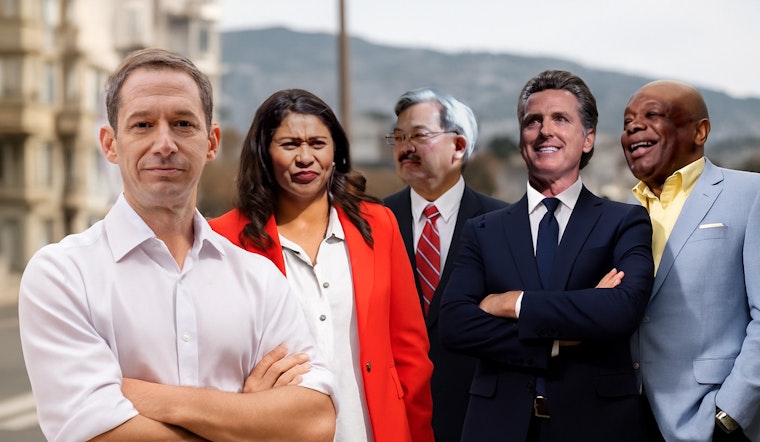
Daniel Lurie just made San Francisco political history. Six months into his tenure, the Levi Strauss heir has achieved a 73% approval rating—the highest documented approval rating for any San Francisco mayor since systematic polling began three decades ago. It's not just good; it's unprecedented in modern SF politics.
The numbers from a new Chronicle poll aren't just good—they're historically exceptional. To put this in perspective, London Breed was sitting at a dismal 28% approval this time last year. That's not a political honeymoon; that's a complete relationship reset with voters who've grown used to being disappointed by City Hall.
[It should be noted that the late Dianne Feinstein once had an approval rating of 86%, though that poll was conducted during her time as U.S. Senator, not when she was San Francisco Mayor.]
When Was the Last Time SF Actually Loved Its Mayor?
You'd have to go back to Willie Brown's heyday in the mid-1990s to find approval numbers even close to Lurie's record-setting performance. Systematic polling data for SF mayors really starts with Brown's era, but Wikipedia shows Brown hit "more than two-thirds" approval in 1996—impressive for sure, but that translates to roughly 67-69%, still short of Lurie's 73%. And Brown was operating during the dot-com boom when money was flowing like cheap wine at a Marina bar.
Gavin Newsom reached "more than 70%" during his 2007 re-election run, as ABC News reported at the time. Newsom had gained national prominence and strong local support for his groundbreaking same-sex marriage initiative in 2004, though his approval ratings fluctuated throughout his tenure as he navigated various personal and political challenges.
Ed Lee? Well, that's a cautionary tale. SF Gate reported he hit 65% approval in 2013, but by 2017 he'd crashed to just 30% as the city grappled with tech money, rising homelessness, and the infamous "Willie Inc." baggage that followed him around like fog in July.
The Outsider Who Actually Delivered
Here's what makes Lurie's success particularly fascinating: he's the first mayor since Brown who doesn't owe his political career to the former speaker's influence. SF Standard laid out the political family tree—Brown mentored Newsom, promoted Lee, and gave Breed her start. But Lurie? He didn't even show up to Brown's legendary Election Day lunch at John's Grill.
Instead of playing the usual SF political games, Lurie has been obsessively focused on the stuff voters actually care about: getting needles off the streets, making downtown feel safe again, and taking a pragmatic approach to homelessness that prioritizes getting people into services and housing. According to KTVU, voters are actually seeing results on the ground.
The Fentanyl Emergency and Other Wins
One of Lurie's first moves was declaring a fentanyl state of emergency. Hoodline San Francisco reported that he got unanimous Board of Supervisors support for streamlining contracts related to homelessness and mental health—something that would have been a months-long political battle under previous administrations.
The Mayor has been methodical about visiting problem areas like 16th Street BART Plaza and actually following up with enforcement. Mission Local tracked his moves and found that 14 of his 42 major policy actions have been public safety-related. When was the last time you could say that about an SF mayor and not immediately follow it with "but..."?
The Numbers Game: Who Loves Him and Who Doesn't
Breaking down the demographics gets interesting. California Globe analysis shows progressives are predictably the holdouts—only 52% approve, probably still bitter that their era of controlling City Council has ended. Meanwhile, moderates and conservatives are practically throwing him a parade with 85% and 78% approval respectively.
Recent SF transplants love him more than longtime residents, which tracks with anyone who's watched longtime San Franciscans become professionally cynical about local government. Asian voters are his strongest supporters across ethnic lines, according to the Chronicle's breakdown—not surprising given his focus on public safety and quality-of-life issues that resonate in communities like Richmond and Sunset, though Hoodline spoke to several officers from the Richmond District Police Station who acknowledged that they felt there has actually been a recent increase in populations of the unhoused in the neighborhood. One officer added, "Just from the people being displaced downtown, you know?"
Strategic Communication Meets Real Results
Part of Lurie's success stems from a sophisticated communication strategy that's as untraditional as it is effective. Chronicle reporting shows his Instagram reached 1.9 million accounts in a recent 30-day period—a 147% increase that most politicians would kill for.
But here's what makes it work: Lurie isn't just posting for the gram. He's documenting real policy work and connecting with constituents in ways that feel authentic rather than manufactured, while also becoming something of an SF hype man. One day he's showing the gritty reality of Market Street drug dealing, the next he's highlighting local businesses in Chinatown, as if he was a TikTok food influencer. The social media presence serves as both transparency tool and economic development strategy, helping reshape San Francisco's narrative from doom loop to comeback story.
The approach reflects a broader understanding that modern governance requires meeting people where they are—and increasingly, that's on their phones. While previous mayors struggled with traditional media relationships, Lurie has essentially bypassed the middleman to speak directly to constituents about both challenges and progress.
The Reality Check
Before we get too carried away, there are some warning signs in the data. Voters aren't thrilled with his housing performance—only 36% approve of his work on affordable housing, and 44% approve of his homeless shelter efforts. Political scientists warn that San Francisco's most entrenched problems could drag down his numbers if people don't see real progress.
He's also got some serious budget math coming up—an $820 million deficit plus potentially $2 billion in federal cuts if Trump follows through on his threats. That's the kind of fiscal reality that can turn a political honeymoon into a very expensive divorce pretty quickly.
What This Actually Means
SF State's Jason McDaniel put it best when he told KTVU that the real test is ahead—"the decision-making that lies ahead" is "the number one sort of iceberg in the future." Translation: it's easy to be popular when you're mostly fixing obvious problems that previous mayors ignored.
But for now, Lurie has achieved something that seemed impossible in modern San Francisco politics: making voters feel genuinely optimistic about their city government. Whether he can sustain it while tackling housing, homelessness, and a budget crisis remains to be seen. One thing's certain though—he's rewritten the playbook on what SF mayoral approval can look like in the 21st century.





