

























































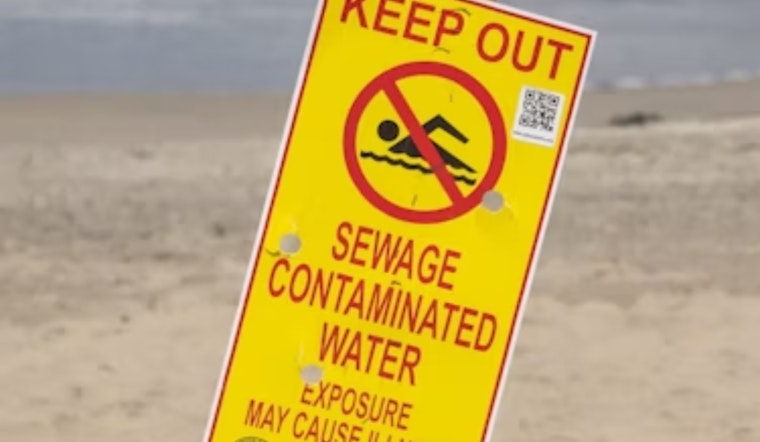
In a notable development for beachgoers concerned about water quality, researchers at UC San Diego's Scripps Institution of Oceanography have launched a user-friendly tool to alert the public to sewage contamination levels along coastlines from Coronado to Playas de Tijuana. The tool, hosted by the Southern California Coastal Ocean Observing System (SCCOOS) at Scripps, provides detailed forecasts of shoreline sewage concentration and the associated risk of illness for ocean swimmers, allowing families to better decide on beach outings.
The Pathogen Forecast Model is designed to predict contamination levels up to five days in advance, according to Scripps oceanographer Falk Feddersen. "The Pathogen Forecast Model has considerable skill in predicting five days into the future the beach water quality measurements made by San Diego County from Imperial Beach to Coronado," Feddersen explained. Despite the model's advancements, he noted that "It is still experimental" and is subject to errors like any forecast model. The tool's development was bolstered by funding from California and further supported by the Fiscal Year 2026 Commerce Justice Science and Related Agencies Appropriations bill, which included additional funds for its expansion.
This technology is a response to the persistent issue of raw sewage from Mexico affecting beaches on both sides of the U.S.–Mexico border. The flows are often transported by ocean currents northward, leading to beach closures and adverse health impacts for coastal communities. Scripps researchers also suggest that pathogens and chemicals from the sewage could become airborne and pose risks further inland.
In a statement obtained by the Scripps Institution of Oceanography, Calif. State Senator Steve Padilla lauded the progress, emphasizing that "Communities like Imperial Beach have been at the epicenter of this crisis for a generation, and they deserve real, science-driven solutions." He foresees the model improving timely beach management decisions and protecting the health of beachgoers while supporting local businesses. In congruence with these sentiments, U.S. Representative Scott Peters highlighted the importance of the predictive model in monitoring conditions during ongoing infrastructure projects to solve the sewage crisis.
It’s important to note that the Pathogen Forecast Model is separate from the official beach advisory or closure tool managed by the County of San Diego Beach & Bay Water Quality Monitoring Program. "The Pathogen Forecast Model is a forecast of the shoreline sewage concentration and our five day forecast has good correlation with the County's sampling data," added Feddersen. This clarification ensures that the public understands the model's role in providing forecasts, while the County reports actual beach water quality conditions daily.
Looking ahead, Scripps researchers plan to continuously enhance the Pathogen Forecast Model. By summer 2026, the model is expected to include a validated forecast of the pathogen norovirus, adding even more precision to swimmer illness risk forecasts. The team behind this initiative includes prominent investigators Jeff Bowman, Andrew Barton, Uwe Send, Bruce Cornuelle, Ganesh Gopalakrishnan, and Clarissa Anderson, collectively driving the scientific exploration and technological development to address coastal health issues.





