

























































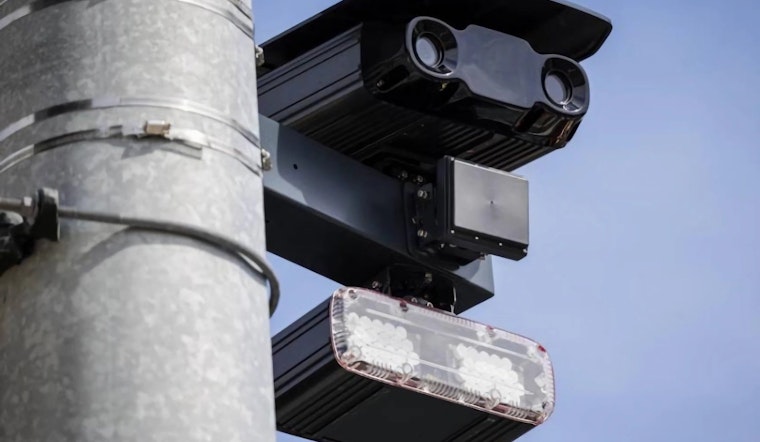
Six months into San Francisco's controversial speed camera experiment, city officials are declaring victory—but the debate over whether this is genuine safety enforcement or a sophisticated revenue scheme is far from over.
The San Francisco Municipal Transportation Agency dropped new numbers this week showing a 72% reduction in speeding at 15 monitored locations since the cameras went live in March. That translates to about 20,000 fewer vehicles breaking speed limits every single day at these spots, according to SFMTA.
But here's where the story gets interesting. Those same cameras have issued a staggering 260,142 warnings and citations between June and August, according to SFGATE. In August alone—the first month of actual fines—drivers received 16,555 tickets that could net the city over $1.2 million if paid in full.
The Money Question Nobody Wants to Answer
Critics aren't buying the city's safety-first narrative. "The pilot program is nothing more than a revenue-generation scheme disguised as a safety initiative," Jay Beeber, executive director of policy for the National Motorists Association, told The Examiner. "The vast majority of tickets will be issued to drivers on roads with unreasonably low speed limits that do not align with the roadway's design."
Consider the numbers at just one location: The camera on Bryant Street between Second and Third generated nearly 4,000 tickets in August—almost a quarter of all citywide citations, as reported by The San Francisco Chronicle. Drivers there were averaging 39 mph in a 25 mph zone, according to The Chronicle.
On Geary Boulevard between 7th and 8th Avenue, cameras reportedly caught 4,440 cars in a single day going at least 11 mph over the limit. The math is simple and damning: at $50 per ticket, that's a potential $220,000 in a single day from one intersection, as one camera generated nearly a quarter of August's citywide fines.
Where's All That Money Going?
SFMTA spokesperson Michael Roccaforte told SFGATE that "it's not a program focused around issuing citations to generate revenue," and that surplus revenue after program costs would fund traffic calming measures and street improvements. Any remaining cash goes to the state's Active Transportation Program, according to The Standard.
But that broad definition of "traffic calming measures" gives the city considerable flexibility in spending, critics note. And the city's selection of contractor Verra Mobility—which was sued in New York for a $1.3 million overbilling settlement in 2020—hasn't exactly inspired confidence, as reported by The Standard.
The Safety Numbers Tell a Different Story
For pedestrian advocates, these aren't just statistics—they're lives saved. San Francisco recorded 42 traffic deaths in 2024, the highest number since 2014 and a complete failure of the city's Vision Zero initiative that aimed to eliminate traffic fatalities by that year, according to KTVU.
"Speed cameras dramatically shift behavior and can reduce the number of severe and fatal crashes by as much as 58 percent," Marta Lindsey from Walk San Francisco told when the cameras began issuing tickets in August. The stakes are personal for families like Jenny Yu's, whose mother was struck by a speeding SUV 14 years ago on Park Presidio and suffered a traumatic brain injury.
The city's own data backs up the safety argument. At Fulton Street between Arguello Boulevard and Second Avenue, daily speeding violations dropped from 1,000 in April to 500 in May, according to The Standard. At San Jose Avenue between 29th and 30th streets, violations plummeted from 200 to 100 daily in the same timeframe.
The Sliding Scale Controversy
Adding fuel to the fire is the program's income-based fine structure, which offers low-income drivers a 50% discount on tickets. Critics have dubbed this a "woke penalty loophole," raising questions about equal treatment under the law, as noted by Lawyer Monthly.
Single-person households earning under $30,120 annually qualify for reduced fines on a sliding scale up to $83,920. Supporters argue this addresses equity concerns in traditional traffic enforcement, while opponents say it undermines the principle of equal justice, according to Lawyer Monthly.
Are Drivers Actually Slowing Down?
The SFMTA insists the answer is yes. Using pneumatic tube measurements—the industry standard for speed testing—the agency found that average speeds dropped 4 mph across all 15 studied locations, as noted by SFMTA. Before cameras, 12 of these locations had average speeds above the posted limit; now all 15 are below it.
Two-thirds of drivers who received a warning or citation haven't gotten a second one, according to KTVU. And violations have declined week-over-week since July, with the average speed of violators dropping each month, as reported by SFMTA.
"What we are seeing at this specific intersection is a reduction of 92% in how many people are speeding through this area," Viktoriya Wise, SFMTA's director of streets, told KTVU.
What Happens Next
San Francisco was the first California city to deploy these cameras under Assembly Bill 645, which authorized a five-year pilot program in six cities. Oakland expects its cameras this fall or winter, while San Jose's installations were delayed to "as soon as fall 2025," and Los Angeles isn't expecting cameras until mid-2026, according to The Standard.
The SFMTA will release an in-depth analysis of the program's effectiveness in late 2026 after a full year of data collection. Until then, the 33 camera locations will continue watching—and the debate over whether they're saving lives or just generating revenue will undoubtedly continue.
For now, the city maintains its position. "It's not about catching people speeding in a 'gotcha' kind of attitude," Wise told The Standard. "We just want people to understand that speeding is not safe on our streets."
Whether you see these cameras as lifesaving technology or the city's newest money machine probably depends on which side of the ticket you're on.



