

























































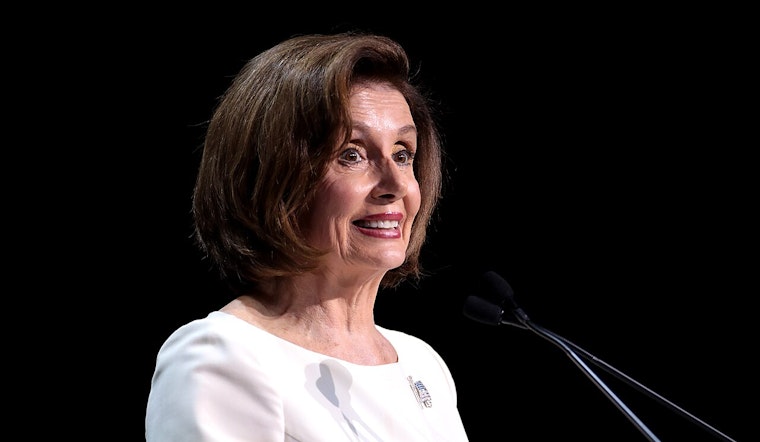
Nancy Pelosi—the iron-fisted legislator who shattered the marble ceiling to become the first female Speaker of the House, the architect behind the Affordable Care Act, and for decades, the most powerful woman in American politics—announced Thursday she will not seek reelection in 2026, ending a historic 20-term congressional career that transformed both San Francisco and national politics.
The 85-year-old Democrat made the announcement in a nearly six-minute video message that doubled as a love letter to the city she has represented since 1987. "I want you, my fellow San Franciscans, to be the first to know," Pelosi said in the video, according to San Francisco Chronicle. "I will not be seeking reelection to Congress. With a grateful heart, I look forward to my final year of service as your proud representative."
The timing of Pelosi's announcement, coming just two days after California voters overwhelmingly approved Proposition 50—a redistricting measure she championed—felt both strategic and symbolic. The ballot measure, which NPR reported passed with about 63% of the vote, will redraw the state's congressional maps to favor Democrats in upcoming midterm elections. Pelosi personally raised tens of millions of dollars for the effort, according to sources familiar with her fundraising.
A Legacy Forged in Pacific Heights
Pelosi's departure marks the end of an era that began when she was hand-picked by the late Rep. Sala Burton to run for the San Francisco seat in 1987. She entered a House chamber that was still very much a boys' club—with only 23 female members out of 435, as noted by San Francisco Chronicle. From her district office at 90 7th Street and her Pacific Heights home on Broadway, Pelosi built a political machine that would eventually make her one of the most consequential legislators in modern American history.
The congresswoman's legacy extends far beyond breaking gender barriers. As ABC News reported, Pelosi was instrumental in passing landmark legislation including the Affordable Care Act during the Obama administration. She became the nation's first female speaker in 2007 and ascended to the top job again in 2019, becoming the first person to win non-consecutive terms as speaker in six decades, according to CNN.
A Complicated Relationship with San Francisco Politics
Her nearly four-decade tenure hasn't been without controversy, particularly in recent years as some Democrats called for generational change. An internal poll released by challenger Saikat Chakrabarti's campaign found that 51% of voters said they had supported Pelosi "in the past but now think it's time for a change," The Hill reported in September.
Pelosi has also faced scrutiny over some of her recent political moves. She rejected accusations that positions she's taken over the last year—including her opposition to an artificial intelligence measure authored by State Sen. Scott Wiener and backing democratic socialist Dean Preston for reelection as San Francisco supervisor—were designed to help her daughter Christine Pelosi's potential candidacy, according to San Francisco Chronicle. "They don't know what they're talking about," Nancy Pelosi told KQED in August 2024 when asked about various moves to help her daughter.
The Battle to Succeed Her Begins
Pelosi's retirement sets the stage for what promises to be one of San Francisco's most contentious congressional races in decades. State Sen. Scott Wiener, who represents San Francisco and northern San Mateo County, officially announced his 2026 bid in October after years of saying he would wait for Pelosi to retire. "San Franciscans deserve a leader who can stand up to Trump's extremist agenda," Wiener said when launching his campaign, as reported by CBS San Francisco.
But Wiener faces a progressive challenger in Saikat Chakrabarti, the 39-year-old tech millionaire and former chief of staff to Rep. Alexandria Ocasio-Cortez. Chakrabarti launched his campaign in February, arguing that the Democratic Party needs "new leadership" to confront today's political realities. His campaign drew more than 600 supporters to The Chapel in the Mission District in October, signaling genuine grassroots enthusiasm despite facing steep odds.
The race also has a potential family succession angle that political observers have been whispering about for years. Christine Pelosi, an attorney and Democratic National Committee member who has never held public office, has long been mentioned as a potential successor. Party officials are now waiting to see whether she will officially enter the race, according to San Francisco Chronicle.
Other potential candidates include Supervisor Connie Chan, who some believe could receive Nancy Pelosi's endorsement. A recent poll conducted by EMC Research showed Wiener with the highest favorability rating at 61%, compared to Chan's 28% and Christine Pelosi's 21%, according to The Standard.
A Target of Political Violence
Pelosi's career has been marked not just by legislative victories but also by her role as a lightning rod for conservative anger and, increasingly, threats of violence. Throughout her tenure, she became one of the most frequent targets in Republican campaign ads, "starring" in one out of every five GOP-made ads in 2018, as San Francisco Chronicle noted.
The threats escalated dramatically during the January 6, 2021, attack on the U.S. Capitol, when insurrectionists ransacked her office and specifically targeted her. "We were looking for Nancy to shoot her in the frickin' brain," one woman said in a self-recorded video during the attack, as reported by San Francisco Chronicle. The woman was later sentenced to 60 days in prison.
The violence wasn't limited to the Capitol. In October 2022, an intruder broke into the Pelosis' Pacific Heights home wielding a hammer and attacked her husband, Paul Pelosi, fracturing his skull. The assailant, who San Francisco Chronicle reported brought zip ties and repeatedly asked "Where's Nancy?", was seeking to kidnap the congresswoman. Paul Pelosi underwent surgery and eventually recovered from his injuries.
Trump's Most Formidable Foe
Perhaps no relationship better defined Pelosi's late-career persona than her combative dynamic with President Donald Trump. As CalMatters noted, she gained a reputation for her "not-so-subtle sass," famously ripping up his State of the Union speech in 2020 and giving him the now-iconic "Nancy clap" of disapproval.
In 2019, CNN reported, she launched the House inquiry that led to Trump's first impeachment. During his first term, Pelosi welcomed Trump to his 2020 State of the Union address with a stripped-down version of the speaker's traditional introduction, omitting the words "high privilege and distinct honor," according to San Francisco Chronicle.
As recently as this week, Pelosi described Trump to CNN as "just a vile creature" before adding that he was "the worst thing on the face of the Earth," as noted by San Francisco Chronicle. Even in announcing her retirement, she made clear her work combating Trump's agenda wasn't finished. "As we go forward, my message to the city I love is this: San Francisco, know your power," she said in her announcement video.
A Fundraising Powerhouse and Political Strategist
Beyond her legislative accomplishments, Pelosi built a reputation as one of the most effective fundraisers and vote counters in congressional history. Party officials told San Francisco Chronicle that she harvested $1.25 billion for Democrats since ascending into party leadership, a staggering sum that helped her party win and maintain power.
Her political acumen was legendary. During the 2008 financial crisis, then-Treasury Secretary Hank Paulson knelt before Pelosi, begging her not to blow up the $700 billion bank bailout package by pulling Democratic support. Pelosi quipped, "I didn't know you were Catholic," before rounding up the reluctant votes for the Troubled Assets Relief Program, as recounted by San Francisco Chronicle.
More recently, she played a crucial role in persuading President Joe Biden to step down as the Democratic Party's nominee in 2024, a decision that San Francisco Chronicle reported generated a rift with the Biden family and strained her long friendship with the president.
The Bay Area's Political Transformation
Pelosi's departure, following the death of Sen. Dianne Feinstein in late 2023 and Vice President Kamala Harris's exit from the White House in 2024, marks the end of a historic chapter for three of the most powerful women on Capitol Hill—all boundary breakers from the Bay Area, as noted by San Francisco Chronicle.
Her legacy locally includes transforming the Presidio into a national park, bringing home billions of dollars to upgrade public transit systems like BART and Caltrain, and expanding affordable housing tax credits—accomplishments she highlighted at length in her retirement announcement. "There has been no greater honor for me than to stand on the House floor and say, 'I speak for the people of San Francisco,'" Pelosi said in her video, according to San Francisco Chronicle.
The Road Ahead
Pelosi's term officially ends on January 3, 2027, giving her more than a year to continue her work in Congress. The filing deadline for California congressional candidates is March 6, 2026, meaning potential candidates have several months to build their campaigns. As ABC 7 reported, the official filing period doesn't open until February 9, 2026.
For San Francisco, the race to succeed Pelosi will likely become a proxy battle over the future direction of the Democratic Party—pitting a moderate with an extensive legislative record against a progressive insurgent promising transformational change, with the possibility of a political dynasty continuing through her daughter. It's a contest that will test whether San Francisco voters prefer experienced pragmatism or revolutionary zeal, and whether one of America's most liberal cities is ready to move beyond the woman who has represented it for nearly four decades.
In her announcement video, Pelosi left San Franciscans with a parting message that encapsulated both her legacy and her hopes for the city's future: "San Francisco, know your power. We have made history. We have made progress. We have always led the way—and now we must continue to do so, by remaining full participants in our democracy and fighting for the American ideals we hold dear."




