

























































A tiny gap between what computers predicted and what lab benches delivered just handed two university teams a carbon-capture upgrade. Their culprit: trace amounts of water hiding inside the pores of a covalent organic framework and quietly blocking carbon dioxide from latching on. Once the researchers made those pores water-repellent during synthesis, the material snapped back to its expected CO2-grabbing performance.
The work comes from a tag team of computational chemists in Professor Laura Gagliardi's group at the University of Chicago and experimental chemists in Omar Yaghi’s lab at UC Berkeley. The study, led by postdoctoral researcher Hilal Daglar, was published Dec. 21 in the Journal of the American Chemical Society and is also detailed in a University of Chicago news release.
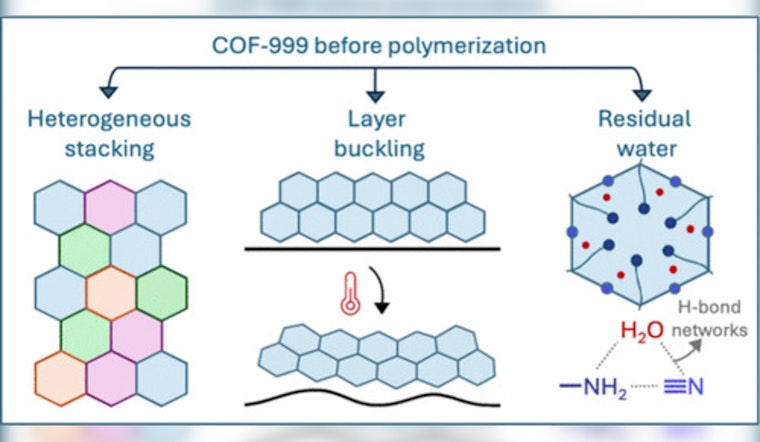
“Mismatches between simulations and experiments are not failures, but opportunities,” Daglar said in the UChicago release. To chase down this particular mismatch, the team leaned on density functional theory, molecular dynamics and grand-canonical Monte Carlo simulations to model COF-999-NH2. Those calculations pointed to stacking heterogeneity, layer buckling and pockets of residual water that can kick off unwanted polymerization chemistry and choke off carbon uptake.
How a Mismatch Pointed to Hidden Water
When theory and experiment refused to agree, the Chicago and Bay Area researchers started asking what piece of reality the models were missing. The Journal of the American Chemical Society paper reports that the predicted water in the pores was later confirmed in the lab, and subsequent coverage explains how adding hydrophobic chemistry to the pores during polymerization keeps adsorption sites open and suppresses water-triggered side reactions. Phys.org offers a plain-language walkthrough of that back-and-forth between theory and experiment.
Why This Could Matter for Direct Air Capture
Omar Yaghi’s group has described COF-999 as a standout candidate for direct-air capture because it can soak up CO2 at room temperature, release it with only modest heating and run through many capture-release cycles without falling apart, according to the UC Berkeley College of Chemistry. The new design rule that emerged from the mismatch, control pore hydrophobicity during formation, could help translate those strong lab metrics into tougher, more scalable sorbent materials.
The authors shared their simulation inputs and supplementary datasets alongside the paper, with the full supplementary archive posted on Zenodo, and they framed the outcome as a concrete design principle for future COF synthesis. Coverage has already spread to outlets including Interesting Engineering, and the journal highlighted the study as an Editor’s Choice selection, underscoring how stubborn theory-experiment mismatches can point straight to real-world improvements.



