

























































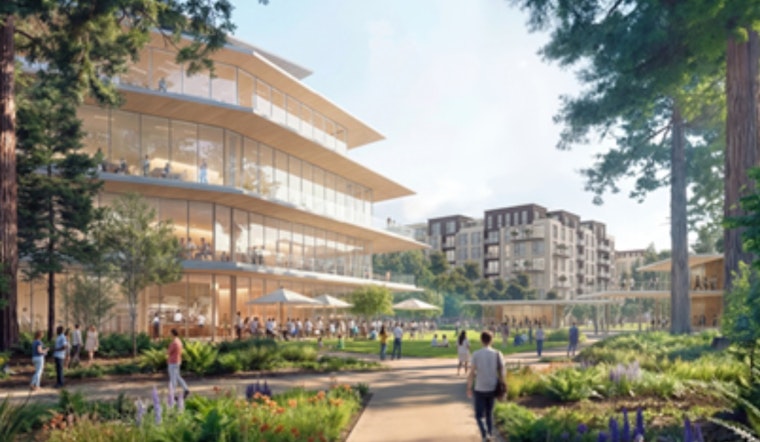
A long-quiet federal outpost on Middlefield Road could soon trade government labs for apartments, offices and cafes, as a San Francisco developer moves ahead with a big swing at remaking the former U.S. Geological Survey campus at 345 Middlefield Road in Menlo Park.
The proposal aims to scrape most of the aging low-rise complex and replace it with three apartment buildings, new office space, neighborhood retail, a childcare center and several acres of public open space, effectively turning the 17-acre site into a dense mixed-use neighborhood.
According to CoStar News, San Francisco-based Presidio Bay Ventures paid roughly $137 million for the property in a sealed-bid federal auction, a deal that picked up a 2026 CoStar Impact Award for Sale/Acquisition of the Year. The purchase and ensuing redevelopment push were led by Presidio Bay co-leads John Meany and Tucker Marshall, with Kabir Seth, K. Cyrus Sanandaji, Matthew Bergland and Charles Daly also listed on the deal team.
What the plan would build
As outlined by the City of Menlo Park, the master plan calls for three apartment buildings with 670 units, including 101 below market rate homes, roughly 740,000 square feet of office space, about 320,000 square feet of that net new, approximately 40,000 square feet of neighborhood-serving retail and amenity space, and a 15,000 square foot childcare facility.
The concept also reserves roughly three acres for publicly accessible open space. That outdoor network would be centered on an approximately 1.5-acre “redwood lawn” and include a neighborhood dog park. To make room, the plan would demolish roughly 253,000 square feet across 16 of the site’s 17 existing structures while retaining and expanding one building.
Urban design work on the project involves Gehl and Gensler, with residential architecture by RG Architecture and landscape plans by Studio MLA, SF YIMBY reports. The application also contemplates parking for more than 2,600 cars, space for roughly 1,265 bicycles and a two story “Pavilion” building near the central lawn, envisioned as a hub for community events.
Permits and timeline
The city says the project will not be a simple rubber stamp. It will require a General Plan amendment, changes to the zoning map and ordinance, a conditional development permit, a development agreement and certification of an environmental impact report, as well as permits for heritage tree removal and a below market rate housing agreement.
As the City of Menlo Park notes, the application was deemed incomplete on Feb. 27, 2026, and the developer must resubmit materials before a formal entitlement review can really get underway.
Presidio Bay’s own project website lists a string of community meetings held last fall and says more outreach is planned as designs evolve, framing 345 Middlefield as a multi-year effort that the company expects to refine alongside neighborhood feedback. Local coverage in The Almanac has also flagged the site’s proximity to other major Menlo Park developments and noted Presidio Bay’s track record with the Springline project downtown.
Developers and planners say this kind of campus conversion is part of a broader Bay Area trend, as cities look to turn underused office and government sites into mixed-use districts that add housing while keeping commercial land productive. Calling the deal an amazing redevelopment opportunity that will create a new neighborhood, broker Michael Sanberg summed up the bullish view of the site, according to CoStar News.





