

























































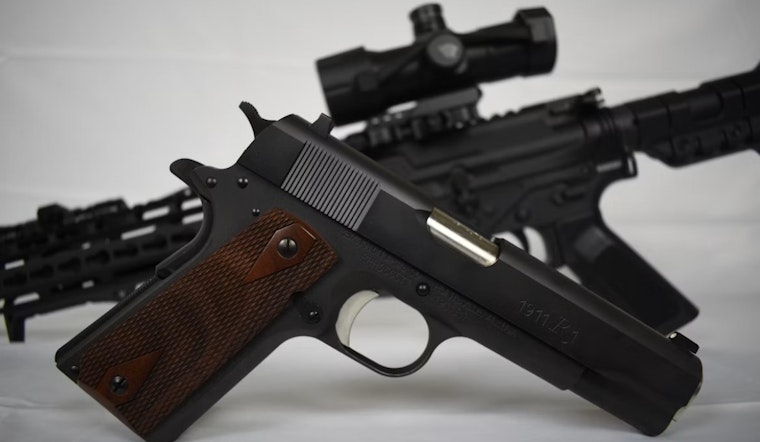
On Tuesday in Ciudad Juárez, a steady line of residents walked up to Mexican soldiers and handed over firearms, ammunition, and even toy guns. Troops stacked the surrendered weapons in a steel container, then destroyed them on the spot as part of the federal "Sí al Desarme, Sí a la Paz" campaign, which offers cash or nonviolent toys in exchange for real or military-style play weapons. Organizers cast the event as a neighborhood effort to pull tools of violence out of homes and give families safer options.
Photographs from the scene show soldiers inspecting rifles and a table crowded with pistols before the destruction, according to Reuters. A local picture gallery from the El Paso Times shows residents voluntarily handing over weapons and children swapping plastic pistols for new toys.
The exchange is one piece of a broader government push that lets people anonymously turn in firearms, ammunition, and toy guns in return for cash payments and access to community services. Segob says the program is coordinated with the Defense Ministry (SEDENA) and the Catholic Church, and reports that thousands of weapons have been surrendered in recent months as authorities pair buybacks with "peace fairs" and social programs.
Border context
On both sides of the U.S.-Mexico border, officials and community advocates tend to see buybacks as one modest tool against a bigger problem: the steady stream of firearms from U.S. sellers into northern Mexico. Recent local reporting highlighted a seizure of dozens of handguns at the Juárez–Lincoln crossing earlier this year, underscoring the cross-border trafficking that authorities say feeds cartel firepower. CBP officers uncovered 44 pistols hidden in a Corvette bound for Mexico, as per Hoodline.
How the program works
Under the official rules, federal teams assign values to surrendered items on a sliding scale and pay cash immediately. Sedena personnel handle verification and destroy most of the weapons on site, while organizers stress that participants can show up without giving their names. Government materials note that an occasional item may be set aside for historical or museum use, but the vast majority are demolished in public events meant to show that those weapons are no longer in civilian circulation. Segob published the implementation outline when the campaign was formalized.
Legal note
Officials advertise the buyback as voluntary and non-punitive, but it does not override criminal law. Prosecutors still have the authority to investigate trafficking or violent acts linked to specific weapons, and the turn-in program does not grant blanket amnesty for other alleged crimes. The government presents the effort as one preventive tool within a wider web of social programs, not a replacement for prosecuting people accused of violence.
For many El Paso-area residents who keep close tabs on Juárez, the images of soldiers destroying surrendered guns land as both cautious optimism and a reminder of a long-running crisis. Mexican authorities say the campaign will roll on to other neighborhoods and cities as part of a broader security strategy, while border communities watch to see whether events like this actually cut into the number of guns ending up in criminal hands.


