

























































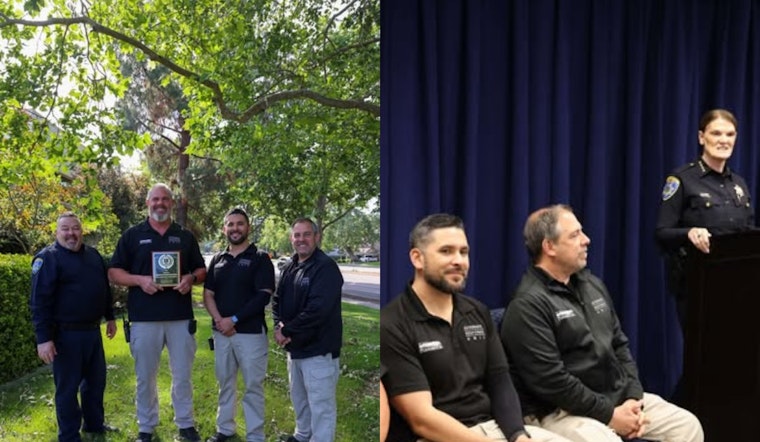
Pleasanton’s alternate-response police team just scored one of Alameda County’s top emergency awards, with the Pleasanton Police Department announcing yesterday that its Alternate Response Unit was named the Alameda County EMS Agency’s Program of the Year. The unit pairs sworn officers with clinicians to respond to mental-health and welfare-check calls, and the department said the team handled more than 1,300 calls in 2024–25 while conducting hundreds of evaluations. PPD also credits the ARU with helping cut the share of student evaluations that end in psychiatric holds and saving families roughly $170,000 in transportation costs over the past 2½ years.
The program traces back to early 2022 and was created to offer a non-uniform, clinically supported alternative to traditional police responses, according to city records summarized in City CAB minutes. Those minutes document early ARU updates and community briefings, while a separate police staffing memo notes the unit was prioritized as recruitment allowed specialty assignments to return. Alameda County EMS memo records the county’s annual EMS awards program, which includes a Program of the Year category.
ARU By The Numbers
The department’s breakdown of recent activity shows the ARU handling 1,346 calls in 2024–25 and 1,008 in 2023–24. Clinicians and officers conducted 251 evaluations in 2024–25 and 212 the previous year. For the current 2025–26 period, the unit has logged 131 evaluations and 47 detentions, following 82 detentions in 2023–24 and 79 in 2024–25. The post also notes that the ARU has saved families more than $170,000 in transportation costs over the past 2½ years, figures detailed in the Pleasanton Police Department’s post on Facebook.
How the Team Works
The ARU is built around a softer, clinically informed response: sworn officers work alongside clinicians or contracted partners to assess situations and connect people to services rather than defaulting to detention. City CAB minutes describe the unit’s launch, its goals and the staffing challenges that have shaped how and when the team can respond in the field.
Impact in Schools and the Community
Within local schools, Pleasanton police say the shift is already visible. According to the department’s post on Facebook, student evaluations that resulted in psychiatric holds dropped from 39.5% in 2023–24 to 27.9% in 2024–25 and to 20.0% so far in 2025–26. Local coverage and advisory-board briefings have previously pointed to similar outcomes and community praise for the gentler approach, which officials say can reduce stigma for students in crisis, as Pleasanton Weekly reported.
City leaders have repeatedly said the ARU is a priority and that the department is working to recruit clinicians and officers to sustain the model as staffing allows, according to the police staffing memo. Officials told advisory boards they plan to keep reporting outcomes as staffing stabilizes and clinicians take on a larger role in front-line responses.





