

























































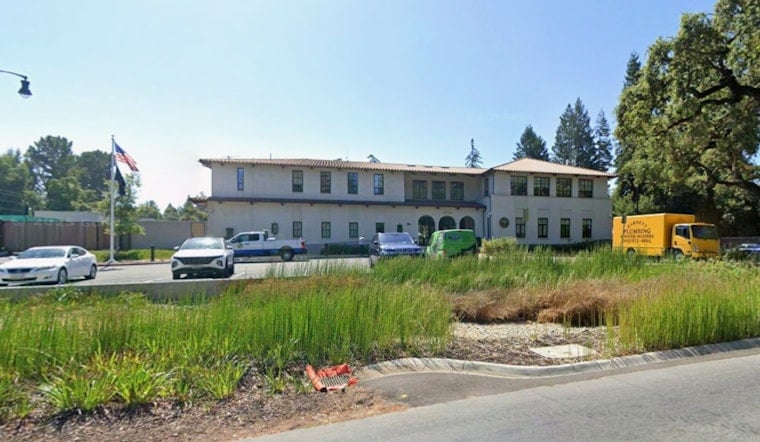
One of California’s priciest enclaves is about to get a very un-Atherton housing test: a 30-townhome proposal on a single acre near Menlo Park’s Caltrain station. The plan would put five three-story buildings where the town’s default development pattern has long been one home on a sprawling lot. Six of the proposed homes are designated affordable, making the project a small but highly symbolic opening salvo under the state’s new transit-housing law.
AlphaX RE Capital, a Cupertino-based developer, has applied to build the project on Glenwood Avenue under Senate Bill 79, which took effect July 1. The site is within a quarter-mile of the Menlo Park Caltrain station, and the proposal is being watched as an early test of whether the law can bring denser housing to Atherton, according to The Real Deal.
The location is the point. Atherton’s own housing materials say SB 79 applies to seven properties around Glenwood Avenue, Laurel Street and Victoria Drive, while the town has no retail district and few of the pedestrian amenities that usually help support higher-density development. The town’s posted framework also says local rules cannot impose a height limit below 75 feet or a maximum density below 120 units per acre, details outlined by Atherton officials.
Why SB 79 Makes This Proposal Different
SB 79 makes qualifying transit-oriented housing an allowed use on residential, mixed-use or commercial sites near specified transit stops in urban transit counties. The California Department of Housing and Community Development says the law took effect July 1 and requires local jurisdictions to process qualifying projects, while the state bill text requires qualifying projects above 10 units to include an affordable component.
Under the statute, at least 13% of units generally must be dedicated to lower-income households unless a local inclusionary rule requires more. Six affordable homes would represent 20% of the Atherton proposal, although the currently reported project details do not list sale prices, rents or income bands.
That leaves plenty of room for a neighborhood fight. Atherton Council Member Bill Widmer, who lives on Glenwood Avenue and supports adding housing, questioned whether the plan strikes the right balance between state mandates and neighborhood character, while Planning Commission Chair Bob Polito warned that multiple SB 79 projects could transform the area, The Real Deal reported.
The affordability question also comes with an enormous Atherton-sized asterisk. A recent Redfin market snapshot put the town’s median sale price above $10 million, meaning the six-unit set-aside could be significant without making the overall development remotely attainable for ordinary Peninsula buyers.
AlphaX Has Already Tested California’s Housing Shortcuts
This is not AlphaX RE Capital’s first Bay Area bet on state housing rules. The company’s six-unit Mercury Lane Townhomes project in Campbell, built under the separate SB 684 starter-home law, was previously described by Hoodline as a test of streamlined small-lot construction.
That earlier project is far smaller and uses a different approval pathway, but it helps explain why AlphaX is moving quickly as new state housing laws open doors that local zoning once kept firmly shut. KQED reported that AlphaX has used new state housing laws across a broader pipeline of Bay Area projects.
The Proposal Still Has To Clear Review
An application is not an approval, and SB 79 does not erase every local review. The law says qualifying projects must be allowed near eligible transit stops if they meet the statute’s requirements, while HCD says local jurisdictions must process those projects once the law is operative. That leaves Atherton with a narrower question than whether to allow townhomes at all: whether this application meets the rules the town and state have already set.
The proposal now puts seven eligible sites, a historically low-density town and California’s housing crisis in one very expensive conversation. If more applications follow, Atherton’s experiment could become a test not just of SB 79, but of whether affordable housing can gain a foothold where a single home’s price tag is already measured in the millions.



