

























































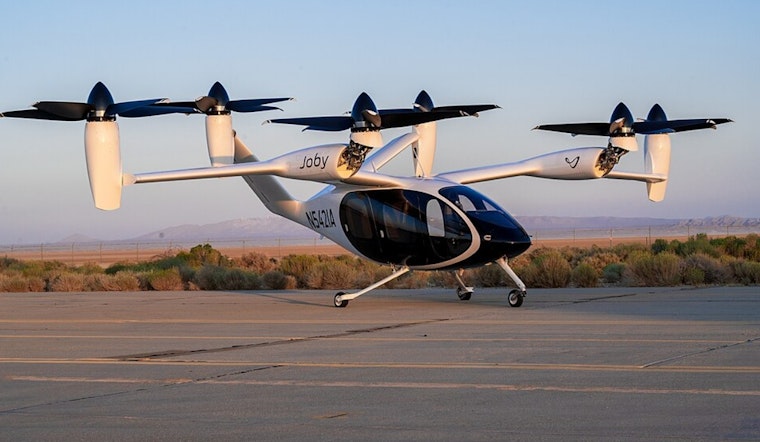
An hour south of Silicon Valley, Hollister Municipal Airport has quietly gone from farm-town backdrop to proving ground for the next generation of short-haul flight. The airport and its surrounding industrial parcels now host flight-test operations, hangars and support warehouses for companies working on electric air taxis and roadable flying cars. What used to be lettuce fields and empty warehouses is becoming a working lab for aircraft that backers say could dramatically cut commute times.
Joby Aviation recently paid $15 million for a 47,500-square-foot vacant warehouse near Hollister Municipal Airport, according to CoStar. The company told the outlet it will use the building to support flight-testing operations and logistics for its California work. The purchase adds to Joby’s footprint on the Central Coast as it moves toward commercial service.
As outlined by the City of Hollister, Joby has applied for an Airport Access Permit that would grant through-the-fence access from adjacent parcels, a step that requires Federal Aviation Administration concurrence. City staff describe the proposed program as modest in scale, with roughly 15 personnel, support equipment and multiple test aircraft. The permit process is meant to thread the needle between airport safety obligations and the city’s economic development goals.
City lease records show Zee.Aero, the predecessor to Wisk Aero, signed a long-term ground lease in 2016 for a 14,000-square-foot hangar at Hollister, according to city lease documents. In May, Wisk completed the first flight of a second Generation 6 autonomous eVTOL at its Hollister flight test site, according to Wisk Aero. Together, those milestones mark the evolution of the airport from a single leased hangar into a full-fledged testbed.
Hollister’s Airpark Business Center
The Airpark Business Center, a cluster of parcels next to the airfield built to give aviation firms runway-side access, has become the practical backbone for testing and light manufacturing. ZeroAvia leased a 15,000-square-foot flex facility in the park in 2022, according to a Newmark announcement that lists the property at 1961C Airway Drive. Developer plans show roughly a dozen parcels with direct taxi access, and several lots are still available to buyers or tenants.
State Funding, Local Bets
Public money has followed the private bets. The Monterey Bay Economic Partnership secured about $7.45 million in state funding to upgrade regional airport infrastructure, a package that explicitly includes Hollister and is aimed at making the Central Coast more attractive to next-generation aviation firms. MBEP says the grant will pay for runway, safety and corridor work intended to support testing and eventual commercial operations. Local officials say the funding has materially changed the conversation with prospective tenants who might once have overlooked the town entirely.
Flying Cars Take a Test Spin
Beyond conventional eVTOL programs, flying-car startup Alef Aeronautics has begun tightly controlled trials of its Model Zero ultralight at Hollister and Half Moon Bay as it prepares larger demonstrations. In a statement to Flying, Alef CEO Jim Dukhovny said, "Alef first and foremost is a car, using the automotive infrastructure," and described the airports as useful, low-traffic places to prove integration concepts. The company says initial hops will be short, choreographed and coordinated with local pilots and airport staff.
“I would fly over this airport all the time, and I’d look down and think, ‘wow, this has a lot of potential,’” developer Ken Lindsay told CoStar. Lindsay, who built out much of the Airpark Business Center, says the mix of hangars, light manufacturing and direct airport access was deliberate and timed for exactly this moment. For Hollister, the emerging aviation cluster is as much an economic development play as it is a technology story.
Regulatory Hurdles
Industry leaders say certification, airspace integration and vertiport rules remain the gating issues before people can buy tickets instead of just watching demos. As noted by SmartCities Dive, manufacturers expect a multi-year run of technical approvals and operational trials before scaled passenger service is plausible. Local access permits and long-term lease terms will be scrutinized to make sure they comply with federal airport grant obligations and FAA policy.
Joby already runs manufacturing and flight-test operations elsewhere on the Central Coast, including facilities in Marina and San Carlos, which the company says will support scaled testing and eventual passenger service, according to its filings. Independent cost models and agency analyses put early air-taxi fares at roughly $6 to $11 per passenger mile, a range that analysts say will keep rides in the premium category during the first commercial years, according to industry reporting. Whether Hollister becomes a long-term cluster or a short-lived testing node will ultimately depend on how quickly the industry clears those regulatory and cost hurdles.



