

























































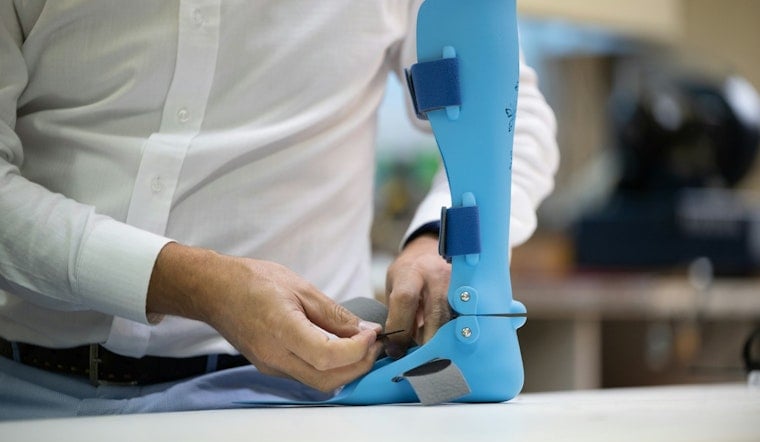
In a downtown Chicago rehab lab, stroke survivors are literally walking in their therapists’ footsteps, thanks to a first-of-its-kind dual exoskeleton system built by Northwestern University and the Shirley Ryan AbilityLab. Early lab tests found that this linked setup delivered measurable gains in joint range of motion, longer and higher steps, and strong patient engagement compared with conventional treadmill therapy.
How TEPI Works
The intervention, called therapist-exoskeleton-patient interaction (TEPI), outfits both therapist and patient with lower-limb robotic exoskeletons that are virtually connected at the hips and knees. That digital tether lets the therapist guide each step in real time through their own leg movements, according to Shirley Ryan AbilityLab.
The study, detailed in Science Robotics, models the virtual connection as spring-damper elements that transmit forces between the therapist’s and patient’s legs. In practice, that means the therapist can physically “share” their gait pattern, while the robot faithfully relays those motions to the patient.
Early Results And Short Trial
In a small comparison involving eight chronic stroke survivors, TEPI training produced larger joint ranges of motion and increases in step length and height relative to conventional therapist-guided treadmill walking, researchers reported. Muscle activation patterns during TEPI were similar to conventional therapy, while participants rated the sessions as motivating and enjoyable, according to News-Medical.
“Therapist-led rehabilitation remains the foundation of recovery for many patients, and this research shows promise for complementing this standard of care,” said José L. Pons, who supervised the work, the press materials note. Co-first authors Emek Barış Küçüktabak and Lorenzo Vianello said TEPI lets therapists guide a patient’s movements through their own leg motions, which could reduce the physical strain on therapists while allowing more adaptive, whole-body training, a major practical hurdle in many clinics, the Shirley Ryan AbilityLab report adds.
Next steps include testing TEPI overground, on stairs and across multiple training sessions, and exploring simpler systems that could extend therapist-in-the-loop care into patients’ homes, according to the press materials. The work unfolds against a backdrop in which nearly 800,000 Americans have a stroke each year, underscoring the demand for tools that can speed functional recovery and ease therapist workload, per the Centers for Disease Control and Prevention.
Local cameras are already rolling on the project: FOX 32 Chicago ran a ChicagoLIVE segment on June 19 that showed the linked exoskeletons in action. Researchers stress that broader clinical trials are still needed before TEPI shows up in everyday rehab clinics, but the early data suggest a therapist-in-the-loop robotic future for gait rehabilitation may be closer than many expected.





