

























































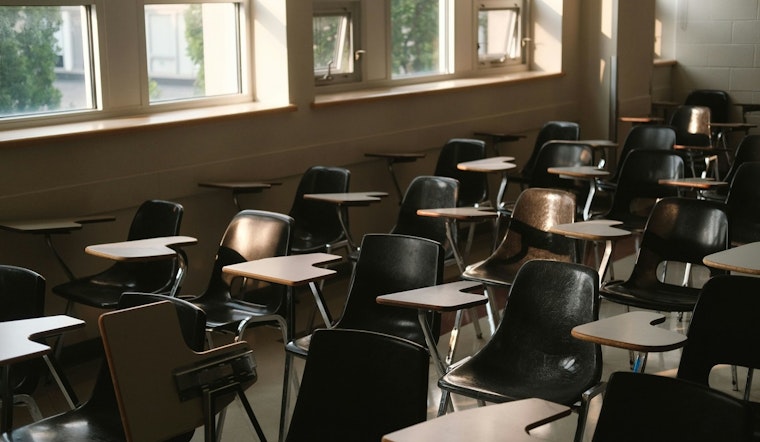
A new academic study has delivered a blunt verdict on Chicago's long-empty public school buildings: when CPS campuses shut down and sit vacant, shootings in the surrounding area go up. Researchers found roughly a 10 percent rise in firearm incidents near long-vacant school properties, a pattern that did not show up when closed campuses were later converted to other uses. The findings push the debate beyond whether schools close to what actually happens to the buildings afterward.
Study Finds a 10% Increase Near Vacant School Sites
The analysis, led by researchers affiliated with the University of Chicago and Johns Hopkins Bloomberg School of Public Health, compared shooting counts around closed CPS buildings with those in similar neighborhoods where schools stayed open. After adjusting for neighborhood demographics and other factors, the team found about a 10 percent increase in shootings near school properties that remained vacant. The results were published in a peer-reviewed paper, according to the Chicago Sun-Times.
Vacancy, Not Closure, Appears to Be the Driver
Lead author Thomas Statchen told local reporters the study looks at closed schools as more than just empty buildings. Before they shut down, these campuses functioned as hubs for play, programming and informal adult supervision, so their long absence can quietly reshape daily life on a block. The researchers did not find a statistically significant rise in shootings where closed campuses were reused for housing, community centers or other purposes, which they say points to reuse as a practical way to blunt harm, as reported by WBEZ.
A Decade of Broken Promises Around Closed Campuses
The 2013 round of mass closures, roughly 49 to 50 public schools taken offline at once, left dozens of buildings across the South and West sides that community advocates have long said were promised new uses. A 2023 Chicago Sun-Times and WBEZ investigation, along with reporting tied to the new paper, documented that only about 20 of those shuttered campuses had actually been put back into community use and that many sales or redevelopment deals stalled, according to the Chicago Sun-Times. The pattern, and the fresh research, echo a separate presentation of similar findings at the Eastern Association for the Surgery of Trauma scientific program, detailed in EAST.
What This Means for Policy and Local Politics
Researchers and elected officials say the paper adds a new data point for a city still wrestling with school capacity and budget shortfalls. Mayor Brandon Johnson, who opposed the 2013 closings as a union organizer and has since pushed for more education funding, has joined local advocates in citing the research while a temporary moratorium on further CPS closures remains in place through next year, according to WBEZ.
Reuse, Not Removal, as a Near-Term Prevention Step
The authors and community leaders say the simplest takeaway is to prioritize reuse. Active buildings provide supervision, services and foot traffic that can help deter violence. University researchers have increasingly pointed to structural drivers such as vacancy, eviction and residential instability as modifiable risks for firearm harm, and they argue that redevelopment tied to community needs should be part of any closure decision. For more detail, see analysis from the University of Chicago. Related conference abstracts are available from EAST.





