

























































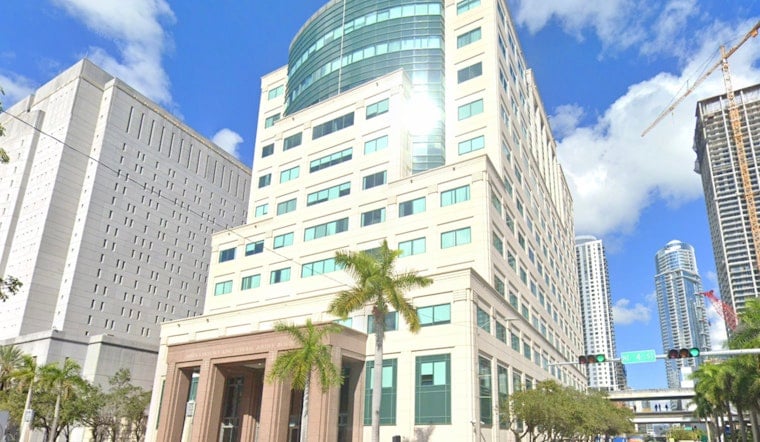
A Coral Springs man accused of plotting to bomb the New York Stock Exchange walked out of federal custody on Tuesday, after a Miami jury cleared him of every charge tied to an alleged holiday-week terror plan.
The 12-person federal jury found Harun Abdul-Hamid Yener, 32, not guilty on a five-count indictment that included an attempted weapon-of-mass-destruction charge. Yener had been held without bond since his November 2024 arrest. The verdict spares him what prosecutors said could have been decades in prison if he had been convicted.
Prosecutors had alleged Yener wanted to “reboot” the U.S. government by planting an improvised explosive device outside the New York Stock Exchange in the week before Thanksgiving 2024. They said he chose the week of November 18, 2024, and stored schematics and bomb-making materials in a Coral Springs storage unit. The superseding indictment accused him of attempting to use a weapon of mass destruction, attempting to use an explosive device against a building used in interstate commerce, and threatening to murder federal law enforcement officers, according to the Miami Herald. The U.S. Attorney’s Office in Miami laid out those charges at his 2025 arraignment in a Department of Justice press release.
Prosecutors’ evidence
Federal agents testified that they pulled a trove of alleged bomb components from a rental storage unit in Coral Springs: spiral notebooks with drawings of landmines and explosives, multiple electronic watches wired with timers, circuit boards and other parts. Yener also allegedly rewired two-way radios to serve as a remote trigger, according to an affidavit filed with the complaint and posted by Miami New Times.
The affidavit records Yener identifying the New York Stock Exchange as his target and fixing on the week of November 18, 2024, as the date. It quotes him describing a device as a “Bouncing Betty-style landmine” and claiming an explosion would be “like a small nuke went off.” Those search-warrant returns, recorded conversations and undercover meetings became the backbone of the government’s case at trial.
Defense argued entrapment
Yener’s public defenders countered that the whole thing was less homegrown terror plot and more government creation. His attorneys argued that FBI sources and an undercover employee steered, pushed and ultimately built out the alleged plan, turning inflammatory talk into a federal case.
Lawyers Abigail Becker and Victor Van Dyke of the Federal Public Defender’s Office pressed a classic entrapment theory, telling jurors that agents effectively created the crime and that Yener was not predisposed to carry it out. The jury bought it, according to the Miami Herald.
The local legal community took notice. The long-running Southern District of Florida blog called the not-guilty verdict a “remarkable result” and tipped its hat to the defense team for a hard-fought win in a type of case where the government usually has the upper hand.
Legal implications
The case turned on the sometimes fuzzy edges of entrapment law. At its core, the doctrine asks two questions: Did the government originate or improperly induce the criminal plan, and was the defendant already predisposed to commit that kind of crime anyway?
Entrapment is an affirmative defense, which means the defendant has to put on evidence showing both government inducement and lack of predisposition, according to legal primers such as the Legal Information Institute. Prosecutors, in turn, have to convince jurors that whatever agents did was more like providing an opportunity than creating the crime.
Here, the verdict signals that jurors were not persuaded Yener was ready and willing to bomb the NYSE without government prodding. It also underscores a practical limit on aggressive undercover operations in national-security-style cases: If jurors see the government as scripting too much of the plot, the whole case can collapse in a hurry.
Where this leaves the case
For now, the not-guilty verdict closes the criminal case. Prosecutors technically retain procedural options, but the U.S. Attorney’s Office has not said whether it will pursue any further review.
Hoodline first reported on Yener’s arrest in November 2024, when he was initially accused of trying to “reboot” the country by bombing Wall Street. That earlier story, Florida Man Charged in Plot, tracked the original charges. This latest chapter closes that loop with an outcome few would have predicted when the case was first announced.





