

























































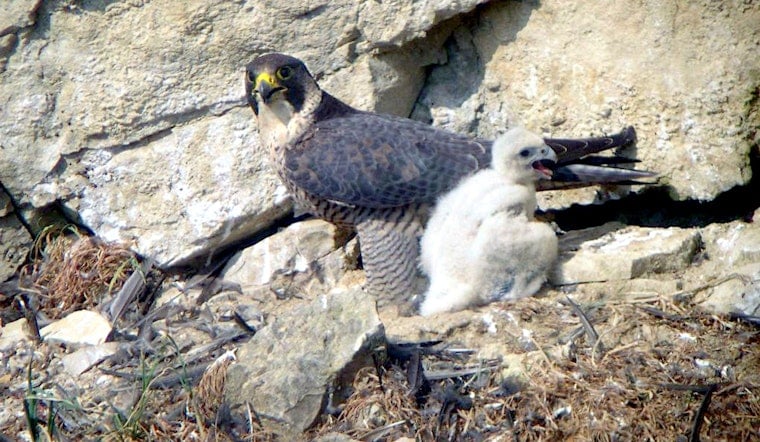
The four peregrine falcon chicks that hatched in early May outside Aurora City Hall have finally left their nest, ending months of livestreamed drama that turned an exterior crevice on the building's second floor into one of downtown Aurora's most-watched attractions. One of the young falcons even took a detour into the Fox River before making it out safely, in a rescue that residents and city staff say captures just how far the river itself has come.
The chicks belong to parent falcons named Vixen and Dave, who nested at Aurora City Hall in April, according to the Chicago Tribune. Aurora city staff set up web cameras so residents could watch the eggs hatch and the chicks grow, with the livestream displayed on screens around City Hall offices and piped in through a Wi-Fi connection donated by the nearby Riverfront Playhouse, which even let the city run an electrical cord through its ceiling for the cameras. The feed drew hundreds of views as residents tuned in to watch the falcons learn to fly and receive food from their parents.
One young falcon's path out of the nest was rockier than the rest. Local residents helped rescue a young falcon that had become trapped in the Fox River, using nothing more than a bucket and a towel, an effort that unfolded in June. Quentin Johnson, an Aurora city animal control officer, was photographed holding the young peregrine after its rescue on June 11. The rescue succeeded in part because of shoreline vegetation planted along the riverbank as part of ongoing restoration work, since water willow restoration helped save the young falcon that fell into the water.
A River That Used To Smell Like Sewage
For longtime residents, the falcons' presence at all is remarkable. Tom Schrader, a lifelong Aurora resident, said that 60 years ago the Fox River smelled like sewage, fish had sores, and birds of prey were scarce. Schrader credits the falcon population's recovery to decades of Fox River cleanup efforts, tying the birds' comeback directly to cleaner water, since clean water brings more fish, and peregrine falcons hunt shorebirds and waterfowl that eat fish.
That cleanup effort has deep roots in the region. A local Illinois teacher who operated covertly as “The Fox” starting in 1969 spent three decades plugging industrial discharge pipes and dumping toxic sludge on corporate executives' desks to protest pollution, according to the Daily Herald. Jim Phillips, as he was later identified, fought polluters throughout the Fox Valley and Chicago area and helped raise public awareness of the river's pollution during an era when the Clean Air Act and Clean Water Act were being enacted under then-President Richard Nixon. Today, Friends of the Fox River carries that mission forward, focusing on river cleanup and education; the group has planted nearly 7,000 native water willow plants along the riverbank and organizes annual spring and fall “Fox Rescue” cleanups.
From Zero Falcons to a Regional Comeback
Peregrine falcons were once rare in the region, and their population dwindled to zero in Illinois at one point, largely because DDT and other pesticides thinned falcon eggshells, causing parents to crush their own chicks before hatching. The species was formally removed from Illinois's list of bird species needing aid in 2015, according to Chicago officials cited by the Tribune. The Field Museum's Chicago Peregrine Program, launched in 1985, reintroduced 46 captive-bred falcons between 1986 and 1990 using a technique called hacking, helping the state's population grow from a single breeding pair in Chicago in 1988 to more than 20 breeding pairs across over 30 nesting territories statewide.
Aurora's own falcon history predates the City Hall nest. Five falcons have nested at Leland Tower, a 22-story building at 7 S. Stolp Ave. on Stolp Island in downtown Aurora, since 2016. Because peregrine falcons tend to be loyal to their nests, Schrader hopes the City Hall falcons return next year, and aurora bird enthusiasts are already holding meetings to prepare support for another round of downtown nesting.
Falcons as Office Family
The birds became more than a curiosity for city employees, who came to refer to the falcons as family members, per the Tribune's reporting. The falcon experience is credited with improving City Hall employee engagement, and residents say the shared experience of watching the chicks hatch, fly, and grow brought people together while sparking renewed interest in the Fox River and nature more broadly.
That renewed local interest comes as the Fox River itself remains at the center of an active policy debate. In September 2023, the U.S. Army Corps of Engineers and the Illinois Department of Natural Resources issued a draft report recommending the removal of nine low-head dams along the river to restore natural connectivity and improve aquatic habitats. Demolition of the Carpentersville Dam wrapped up in late 2024 through a partnership between Kane County and state agencies, marking the first concrete dam removal along the Fox River in suburban Chicago, according to the Forest Preserve District of Kane County. Not every municipality is on board, however: in June, the St. Charles City Council voted to preserve its downtown dam for recreational use rather than remove it, reflecting broader local resistance to full-scale dam removal even as federal and state agencies push for it.
Not Without Risk
Even as their numbers grow, urban-nesting peregrine falcons in the Chicago area continue to face serious hazards. High-speed hunting dives that can exceed 200 mph make clear glass building windows a leading cause of fatal collisions for the birds. Aurora's chicks aren't the only Chicagoland falcons drawing public attention this way: four peregrine chicks hatched in June 2024 atop the University of Illinois Chicago campus, where parent falcons named Mouse and Loop have nested for over a decade with their own live webcam monitoring, as Hoodline reported at the time.
For now, Aurora's City Hall nest sits empty, its young occupants scattered into the wider world the same way generations of falcons before them have since the species clawed back from local extinction. Whether Vixen and Dave return next spring remains to be seen, but for residents like Schrader, the birds' brief residency at City Hall already stands as proof of just how far the Fox River has come from the sewage-smelling waterway he remembers.





![Georges Lignier ([email protected])](https://commons.wikimedia.org/wiki/File:Faucon_pelerin_7_mai.jpg)