

























































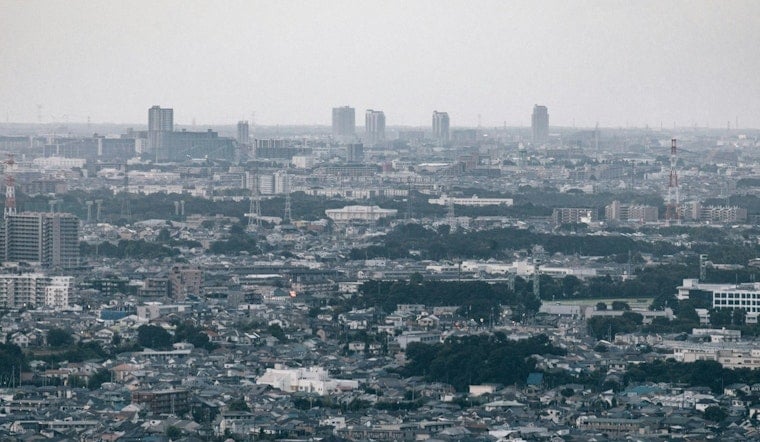
At a Beloit school, 22 girls on a team had just six inhalers between them, according to Brittany Keyes, whose daughter is among 15 youth plaintiffs suing the Wisconsin Public Service Commission and state legislature over air pollution policy. Across the Beloit School District, roughly 436 children carry an asthma diagnosis, and 326 of them lack ready access to medication at school, even though the district keeps 110 inhalers on hand for the roughly 11% of its students with asthma.
The numbers behind those inhalers are stark. As reported by Urban Milwaukee, Rock County recorded 138 asthma-related emergency visits among children in 2024 alone, which works out to roughly one visit every two-and-a-half days. Countywide, asthma emergency department visits ran 23% higher than the Wisconsin average between 2022 and 2024, with a rate of 34.2 visits per 10,000 people compared to the statewide rate of 27.8. Asthma hospitalizations in Rock County were 39% above the state average over that same period, at 3.2 per 10,000 people versus 2.3 statewide, ranking the county sixth-highest in Wisconsin for hospitalizations and eighth-highest for emergency visits. Children ages zero through 17 in the county saw emergency visits about 9% above the state average.
A Ranking That Won't Go Away
The backdrop to those health figures is a 2023 ranking that has haunted Beloit ever since. Per IQAir, Beloit was named the most polluted city in the United States in 2024 based on 2023 data, a designation Urban Milwaukee notes the city still lacks enough comparative data to officially confirm, since it sits outside the reach of a dedicated regulatory monitor. Canadian wildfire smoke was a documented factor in Beloit's 2023 air quality, and Alliant Energy has publicly rejected the IQAir framing, arguing in a March 2024 statement that third-party public sensors lack regulatory oversight and that regional wildfire smoke, not its natural gas facilities, drove the local spikes.
Instead of measuring Beloit directly, the Wisconsin Department of Natural Resources relies on a regulatory monitor across the state line in Rockford, Illinois, which posted a three-year PM2.5 design value of 8.3 micrograms per cubic meter from 2022 to 2024 and an annual mean of 7.3 in 2024 — figures that keep Wisconsin under the current federal PM2.5 standard of 9.0 micrograms per cubic meter set by the U.S. Environmental Protection Agency. The DNR has not committed to expanding regulatory PM2.5 monitoring in Beloit and says it lacks funding to go beyond federally mandated levels, according to Urban Milwaukee. The agency currently operates just one ozone monitor on Beloit's west side, and that instrument runs only six months out of each year.
Community Sensors Fill the Gap, but Carry Less Weight
Into that monitoring void has stepped a patchwork of local nonprofits and health officials. Beloit nonprofits installed PurpleAir monitors in late 2022, and the Healthy Climate Wisconsin coalition has since expanded its Rock County network to more than 20 PurpleAir units, with a companion Beloit monitoring project collecting readings every 10 minutes and securing funding to install three additional monitors in the county. The Rock County Health Department separately received a mini grant for 10 air quality sensors and has installed units at schools around the county, while an EPA community sensor loan program contributed five months of data to the broader Beloit study, as detailed by Urban Milwaukee.
Still, those readings can't substitute for official enforcement data. Federal guidelines note that low-cost sensors like PurpleAir provide accessible community data but do not meet federal reference method standards without local calibration, and Urban Milwaukee's reporting likewise describes regulatory monitors as producing the most reliable data for official decision-making, with PurpleAir units better suited to general public awareness. The Healthy Climate Wisconsin coalition has pushed for more than two years for a permanent regulatory PM2.5 monitor in Beloit, a request the DNR declined to grant when it issued Air Pollution Control Permit No. 24-PSD-168 in June 2025, according to state permitting records.
Industrial Growth Adds to the Pressure
Fueling the concern is Alliant Energy's West Riverside Energy Center, a 730-megawatt combined-cycle natural gas plant that opened in 2020 after a $670 million investment and now supplies power to roughly 550,000 homes. The plant produced about 2.8 million tons of CO2 in 2023, and Rock County's power plants together emitted roughly 2.1 million metric tons of CO2 in 2022, part of an estimated 2.4 million metric tons of CO2 released countywide that year. Rock County's overall CO2 emissions climbed 325% between 2010 and 2019, per figures cited by Urban Milwaukee.
Alliant Energy has also proposed and received approval to build a liquefied natural gas storage and processing facility in Rock County, designed to hold more than 2 billion cubic feet of gas, with construction planned for 2026 and commercial operation targeted for 2029. Taylor Adams of Alliant Energy said the Rock County LNG site was chosen for its proximity to existing infrastructure and customers, and the company says the project will still undergo DNR air-quality review and public comment. Separately, an independent modeling report submitted by Wingra Engineering to regulators in May 2025 concluded that PM2.5 emissions from the Riverside Energy Center and its proposed expansion could cause or worsen exceedances of federal air quality standards in both Rock County and Winnebago County, Illinois, according to Midwest Environmental Advocates.
Environmental Justice and a Legal Fight Over Air Rules
Pablo Toral, chair of environmental studies and political science at Beloit College, has called the city's pollution situation a case of environmental injustice, pointing to Beloit's status as a low-income community of immigrants and people of color. U.S. Census Bureau QuickFacts show Beloit is 14.1% Black with above-average poverty levels, a socioeconomic profile that diverges sharply from surrounding Rock County, which is 89.8% White.
Toral's connection to the region's air crisis runs deeper than academic interest. Wildfires forced his team to evacuate the Boundary Waters by canoe in 2026, giving them just 20 minutes to pack and leave, which led to the cancellation of the rest of a field program that had run for close to 70 years. Toral said it was too early to know whether the 2026 fire season would prove worse than 2023, even as 2026 wildfire smoke drifting in from northern Minnesota and Canada pushed Wisconsin's statewide air quality index to its highest levels in at least 16 years on July 16, 2026 — the same episode Hoodline covered in a health alert over Milwaukee's smoky skies.
The legal fight over how much weight air pollution should carry in state permitting decisions is also unresolved. Brittany Keyes's daughter is one of 15 youth plaintiffs who sued the Wisconsin Public Service Commission and state legislature in 2025, challenging statutes that prohibit the PSC from considering air pollution when reviewing permits for new power plants. Dane County Circuit Judge Julie Genovese dismissed that case, Dunn v. Wisconsin Public Service Commission, on April 23, 2026, ruling the challenge presented a nonjusticiable political question — a decision the plaintiffs appealed on May 28, 2026, according to Politico Pro.
Advocates Keep Pushing for Answers
Craig Czarnecki, the DNR's outreach coordinator of air management, has represented the agency in public discussions of Beloit's air quality standing, per Urban Milwaukee. Meanwhile, the Stateline Clean Air Coalition meets monthly to advocate for cleaner air and healthier communities in the Beloit-Rockford border region, a grassroots effort that continues even as officials note the federal PM2.5 standard requires three full years of qualifying data before any location can be formally judged in or out of attainment.
For now, Beloit remains caught between competing pictures of its own air. PM2.5, the fine particulate matter behind much of the concern, is made up of solid and liquid particles roughly a thirtieth the width of a human hair, small enough to trigger coughing, shortness of breath, fatigue, and asthma attacks, and to worsen heart and lung disease over time. It comes from power plants, vehicle emissions, industrial facilities, and wildfires alike — sources Urban Milwaukee notes are all present in and around Beloit, from Canadian wildfire smoke to regional pollution, transportation emissions, and the Riverside plant itself, leaving residents and regulators still arguing over exactly how much each one contributes.





