

























































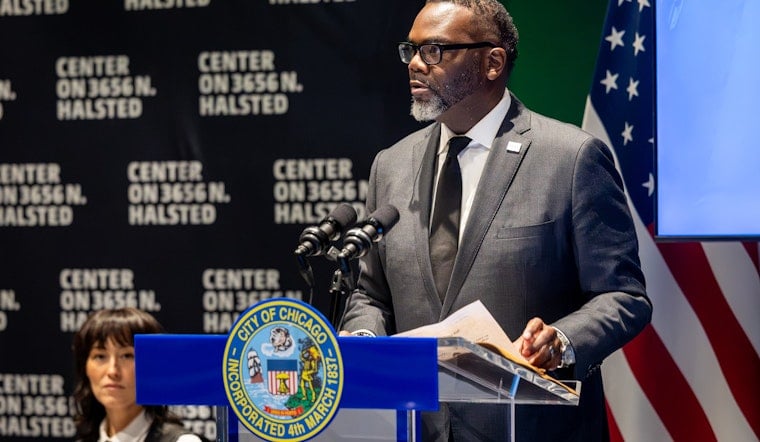
A Chicago nonprofit CEO leading a community violence intervention group went around the city's health department and appealed directly to Mayor Brandon Johnson after his organization ran into resistance over a multimillion-dollar anti-violence grant, according to records reviewed by reporters. Levon Stone, head of Acclivus Inc., sent Johnson a letter dated November 25, 2024, and followed up with two more letters to the mayor and other officials as the dispute dragged on.
The Chicago Department of Public Health had been searching for one organization to convene, develop, support and connect a network of community-based groups working to prevent violence, according to the Chicago Tribune. CDPH ultimately selected Acclivus as a recipient of the anti-violence grant, which the Tribune reports totals roughly $8.09 million, but the process that got there was contentious from the start. Acclivus had argued that the health department's request-for-proposal language would let a single lead grantee control the entire funding allocation, and the group scored higher than rival Metropolitan Family Services on the 2024 RFP, per the same account.
A CEO's Direct Line to City Hall
In his letter to Johnson, Stone raised concerns that echoed Acclivus's formal complaints, and Johnson responded that his concern was ensuring the city's violence-intervention work was fully supported. Then-CDPH Commissioner Dr. Olusimbo Ige told Stone in late November 2024 that she would circle back soon, but the friction did not end there. Stone went on to send Ige a formal notice of protest letter and, in February 2025, objected to CDPH's refusal to let Acclivus provide direct services in five neighborhoods where the group already operated: Grand Boulevard, Greater Grand Crossing, Washington Heights, Washington Park and West Pullman.
Johnson did not reply to that protest email thread, nor did Ald. Stephanie Coleman, according to the Tribune's review of records. Stone also requested advance payments instead of the city's standard reimbursement process that same month, and Acclivus more broadly asked for quarterly advance payments or comparable working capital to keep its programs running. Ige opposed giving Acclivus advance payments and ultimately prevailed over that request, though the city's chief procurement officer had sided with Acclivus's request for advance payment, according to Acclivus COO Sheila Regan.
Allegations, Denials and a Campaign Contribution
Ige documented allegations that Acclivus initially refused to apply for the RFP and, per her allegations, that the group sought funding directly from the mayor's office rather than through the competitive process. Regan denied those allegations, while Acclivus board member Allison Novelo said the organization followed the city's competitive RFP process in 2024. The mayor's office, for its part, said it did not intervene after Stone's calls to rescind the RFP, according to Novelo.
The dispute carries a political undercurrent. Johnson's campaign donated $25,000 to the community violence intervention group on November 20, 2024, according to the dossier of records reviewed for this story, and separately, per the Tribune's reporting, his 2023 mayoral runoff campaign paid $97,650 to Goshen Impact Services, a consulting firm run by Acclivus Community and Civic Engagement Director Bamani Obadele. Obadele, who was convicted of fraud in 2010, also contributed to Ald. Stephanie Coleman's campaigns in both 2023 and 2025 and has worked politically for Johnson and his allies.
City Hall Adviser Steps Into the Grant Fight
The controversy escalated further when a data-reporting audit dispute prompted Regan to bring the matter to Johnson senior adviser Jason Lee, who was involved in controversies over Acclivus's 2026 grant size and the audit itself. Lee requested a prompt response from CDPH and joined a subsequent meeting with department officials, a move that led an internal CDPH epidemiologist to raise concerns about political involvement in the process, according to the Tribune's reporting.
Ige's departure from CDPH added another layer to the story. She left her post as commissioner in May 2026 following months of internal administrative friction over grant management and staff turnover, according to the Chicago Sun-Times. She had served since November 2023 as the city's first Black female health commissioner. In a February 17, 2025 internal email, Ige formally questioned whether the city should continue contracting with Acclivus at all, citing ongoing operational challenges, per records described by the Tribune.
An Oversight Fight Rooted in Who Gets to Lead
The funding fight is layered on top of a longer-running turf battle. Metropolitan Family Services had won earlier rounds of competitive bidding under former Mayor Lori Lightfoot, and under a $6 million grant CDPH awarded that organization in April 2020 to convene and train street outreach groups, Acclivus served only as a sub-grantee operating in Greater Grand Crossing, according to the City of Chicago. Community organizer Lance Williams criticized the Lightfoot administration in 2021 for excluding Acclivus, and Metropolitan Family Services had a predominantly white board, a detail Acclivus supporters have pointed to in arguing the funding structure needed to change. Ald. Pat Dowell asked in October 2023 where the Black-led violence prevention organizations were, and she has since advocated for Acclivus. CDPH eventually split the anti-violence contract between Acclivus and Metropolitan Family Services.
City oversight officials have weighed in without going so far as to allege wrongdoing. Former Inspector General Joe Ferguson said direct communication to the mayor's office should be reserved for the procurement process, but he stopped short of saying there was evidence of ethical breaches. Ald. Brian Hopkins said his committee would take further action on the matter. The city's procurement handbook, published in 2022, requires that all bid protests be directed to the chief procurement officer rather than to elected officials.
State Dollars Keep Flowing Regardless
Whatever the outcome of the city-level dispute, Acclivus continues to draw substantial funding from state sources outside CDPH's control. The Illinois Criminal Justice Information Authority Budget Committee designated $7.5 million to Acclivus for state fiscal year 2027 to deliver community health and violence intervention services in Chicago, according to the Illinois Criminal Justice Information Authority. During fiscal year 2024, the Illinois Department of Human Services Office of Firearm Violence Prevention distributed more than $21.4 million in Reimagine Public Safety Act grant funding to the organization. That scale of state support underscores how much is riding on an organization whose city-level funding has become entangled in questions about political access and procurement process.
The episode also arrives against the backdrop of broader turbulence inside CDPH. An August 2025 internal spending report found the department was sitting on between $81.4 million and $94 million in unspent federal epidemiology grant funds, a situation that led Ige to sunset several COVID-era programs early by the end of that year, as Hoodline previously reported. Community violence intervention groups like Acclivus and Metropolitan Family Services also operate under a city framework linking them with the Chicago Police Department to coordinate shooting notifications and street de-escalation protocols, a structure meant to keep outreach workers embedded in the same neighborhoods where funding disputes like this one are now playing out.





