

























































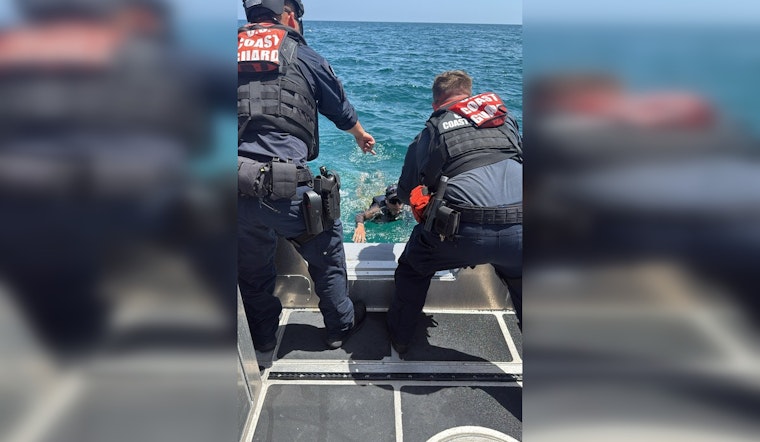
A green and white personal watercraft carrying two people began taking on water near Government Cut on Monday, prompting a Coast Guard rescue that pulled both riders from the bay unharmed. Coast Guard Sector Miami watchstanders were notified of the sinking craft near the busy shipping channel, setting off a swift response from crews based just across the water in Miami Beach.
According to WSVN, a Coast Guard Station Miami Beach crew responded aboard a 36-foot response boat and arrived alongside a Miami-Dade Fire Rescue boat. Crews pulled both people from the water near Government Cut, then placed the disabled personal watercraft in tow rather than leaving it adrift in the channel.
Government Cut is a man-made shipping channel opened in 1905 between South Beach and Fisher Island, and it remains the primary deep-water route connecting Biscayne Bay to the Atlantic Ocean, according to Wikipedia. The channel carries heavy commercial ship and cruise liner traffic, a combination that creates navigational hazards for smaller craft sharing the waterway.
Victims and Watercraft Brought to Key Biscayne Marina
The Coast Guard crew transported both victims and the personal watercraft to Crandon Park Marina, the report notes. The marina sits on Key Biscayne within Miami-Dade County's 800-acre Crandon Park near Bear Cut, and it features nearly 300 slips along with a 24-hour public boat ramp, per Greater Miami & Miami Beach. The facility regularly serves as a staging point for rescues across northern Biscayne Bay, including an earlier incident this month when a Coast Guard crew brought ten passengers there after pulling them from a sinking boat near the Rickenbacker Causeway, in a case Hoodline previously covered.
What caused the personal watercraft to begin taking on water — whether mechanical failure, hull damage, or swamping from wakes generated by larger vessels in Government Cut — remains unclear, and it is not known whether the craft was privately owned or rented. WSVN's report does not resolve either question.
A Busy Corridor for Marine Emergencies
The rescue unfolded in a stretch of water that ranks among the busiest and most accident-prone in the state. Miami-Dade County recorded 65 reportable boating crashes in 2025, placing it second among Florida counties after leading the state outright in 2024 with 75 incidents and eight fatalities, according to CBS News Miami. Personal watercraft made up a disproportionate share of the danger statewide, involved in 161 of Florida's 694 reportable boating accidents last year and linked to 12 deaths, even though they account for just 17 percent of the state's registered vessels.
Florida's waterways have only grown more crowded, with more than 1.03 million registered vessels on the water in 2025 alongside an estimated 1 million non-registered watercraft, the outlet reports. Nearly half of all personal watercraft accidents statewide last year involved a collision with another vessel, and roughly 51 percent of the personal watercraft involved in crashes were rental units, a factor officials tie to operator inexperience.
Safety Rules Coast Guard Officials Want Boaters to Follow
Following the rescue, USCG officials reminded people going on the water to wear a properly fitted life jacket and to make sure their vessels carry proper safety and communication equipment. Florida law already requires it: every person aboard or operating a personal watercraft must wear a Coast Guard-approved wearable life jacket at all times, and inflatable life jackets are explicitly banned, according to the Florida Fish and Wildlife Conservation Commission. Violators can face non-criminal infraction fines ranging from $50 to $80 depending on the county.
State rules also require operators to attach the engine cut-off switch lanyard to themselves or their life jacket, and they bar personal watercraft operation from a half-hour after sunset to a half-hour before sunrise. Separately, no one under 14 may operate a personal watercraft in Florida, and those under 18 cannot rent or lease one — restrictions meant to keep inexperienced or unsupervised riders off increasingly crowded waters like the corridor near Government Cut.




