

























































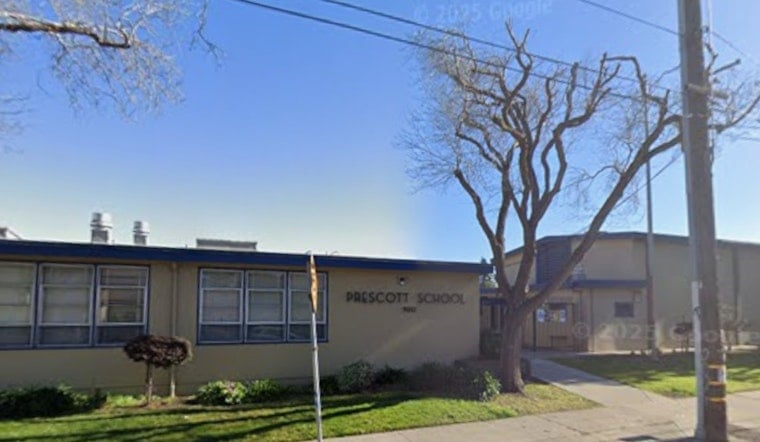
Stephen and Ayesha Curry's Eat. Learn. Play. Foundation has completed its 25th schoolyard transformation in Oakland, this time at Prescott Elementary in West Oakland, marking a milestone in a years-long push to replace cracked asphalt playgrounds across the district with student-designed play spaces. The foundation reached the milestone on Friday, turning a campus with deep roots in Oakland's civil rights history into the latest beneficiary of a fundraising effort that has already drawn tens of millions of dollars in private and philanthropic support.
The transformation was completed at the 920 Campbell Street campus, according to KTVU, which first reported the milestone. Prescott Elementary dates back to the late 1860s and holds particular significance in West Oakland, having been the school where Ida Louise Jackson became Oakland's first Black public school teacher in 1925, a legacy detailed by the Oakland Public Library. Jackson went on to teach in Oakland public schools for 28 years, breaking racial barriers that had kept Black educators out of the city's classrooms.
Today, Prescott serves a small but heavily disadvantaged student body. During the 2024-2025 school year, the K-5 campus enrolled 135 students, with 95% designated as socioeconomically disadvantaged and a population that is 55% African American and 34% Hispanic or Latino, according to data from the California Department of Education. The Title I campus is exactly the kind of school the Curry Foundation says it built its model around when it launched its $50 million fundraising campaign for Oakland Unified School District students in September 2023, an effort in which Stephen and Ayesha Curry personally fund 100% of the foundation's administrative and fundraising expenses, according to Beyond Sport.
Replacing Asphalt With Purpose-Built Play
The physical work at Prescott followed a model the foundation has repeated across the district: partnering with the nonprofit KABOOM! and contractor Court Builders Northern California to design student-driven play structures and install shock-absorbing Sport Court modular surfaces in place of aging, cracked asphalt, according to Court Builders Northern California. Many older East Bay schoolyards still feature the kind of unforgiving pavement that has long presented safety hazards during recess.
The approach traces back to June 2021, when the foundation completed its first schoolyard transformation at Oakland's Franklin Elementary, installing a student-designed playground, a multi-sport court, a sensory garden and a community mural with the help of local artists, agricultural designers and volunteer builders, according to KABOOM!. That build served as the blueprint that has now been replicated 25 times across the district.
Why Oakland's Schoolyards Became A Priority
The push to rebuild campus play spaces is grounded in physical activity and equity data that the Oakland Unified School District has cited to justify its Living Schoolyards initiative, launched in 2019. Only 14% of Oakland youth meet the CDC-recommended 60 minutes of daily physical activity, compared with a 23% national average, while residents of non-white majority neighborhoods have access to 66% less park space per person, per the district's own policy data.
That gap has drawn institutional funding beyond the Currys' own foundation. In December 2023, Kaiser Permanente awarded a $2.5 million grant through the East Bay Community Foundation to support the target of revitalizing 25 schoolyards districtwide and to help operationalize OUSD's Central Kitchen facility, which distributes meals to nearly 35,000 public school students across Oakland, according to Kaiser Permanente.
A Broader Bet On Oakland Youth
The schoolyard work sits alongside a wider athletic and academic investment. Since 2021, Eat. Learn. Play., Under Armour and Curry Brand have put more than $3.6 million into Oakland youth sports, a commitment the foundation says helped drive a 300% increase in middle school sports participation across the district through 2025. Separately, the foundation has committed $25 million over five years toward literacy initiatives, funding high-dosage tutoring at more than 20 elementary schools and backing over 2,000 teacher projects aimed at students reading two or more grade levels behind, according to Hinchilla.
The foundation has also worked to document its process publicly. In January, it released “Building Joy: A Movement to Reimagine Oakland's Schoolyards,” a 20-minute mini-documentary following the collaborative, student-centered design work alongside OUSD and KABOOM!, a project that went on to win a Bronze Telly Award in Advocacy and Causes in June.
West Oakland's Ongoing Challenges
Prescott's milestone arrives even as West Oakland schools continue to face pressures beyond the schoolyard itself. Hoodline has previously reported on gunfire near the campus that rattled the surrounding block, underscoring the community safety concerns that persist alongside academic recovery efforts and long-term district budget pressures in the neighborhood. The new play space does not resolve those broader issues, but it represents a tangible investment in a campus that has weathered them.
The Prescott build also builds on a string of recent Curry family initiatives tied to Oakland's schools. Stephen Curry was recently honored with the Muhammad Ali Sports Humanitarian Award for the foundation's schoolyard and meal work, and he separately partnered with Davidson College to establish full-ride scholarship pipelines for lower-income Oakland Unified students, efforts that together paint a picture of sustained, multi-front investment in the district well beyond a single playground rebuild.





