

























































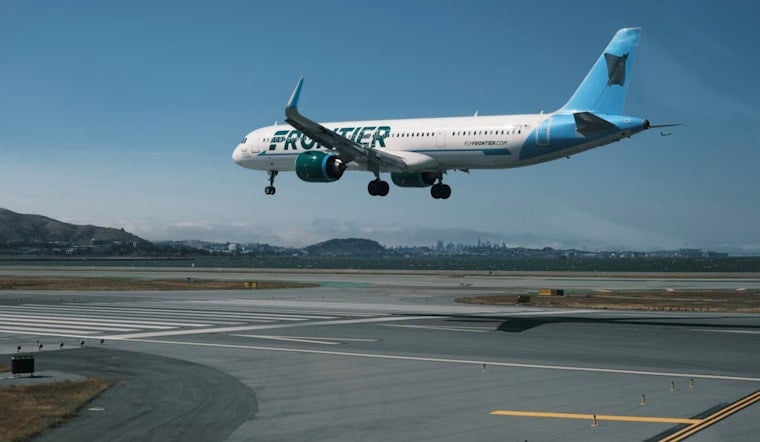
Four of the five flight attendants aboard a Frontier Airlines flight bound for Fort Lauderdale fell mysteriously ill midair on Thursday, developing headaches and nausea severe enough that the pilots radioed ahead for emergency medical responders to meet the jet at the gate. Two of the four sickened crew members were taken to a local hospital after the plane landed safely.
Flight F9-1046 departed Cleveland around 7:50 a.m. local time, according to the New York Post. As the Airbus A321 approached Fort Lauderdale, the pilots asked Miami air traffic controllers, who handle the airport's approach communications, to have responders waiting at the gate. Fort Lauderdale airport officials confirmed that two of the four sickened attendants were transported to a hospital upon landing, while the Federal Aviation Administration confirmed the aircraft landed safely after the crew reported an ill crew member during approach, according to CBS News.
The flight, which was carrying up to 230 passengers on the 10-year-old A321, taxied to the terminal in roughly three minutes, where paramedics were waiting, per a report from Paddle Your Own Kanoo. Cockpit radio transcripts cited in that report show the pilots relaying that all four flight attendants had developed severe headaches and nausea while airborne. Frontier subsequently canceled the aircraft's scheduled return trip to Cleveland, which had been set to depart around 11:30 a.m., as well as another round-trip flight scheduled for that afternoon, the outlet reported.
A Familiar Pattern in Aviation's ‘Fume Events’
The sudden, simultaneous incapacitation of an entire cabin crew fits a pattern aviation investigators call a fume event, in which vaporized engine oil or hydraulic fluid leaks into an aircraft's bleed air ventilation system. A May 2025 academic study analyzing four years of FAA Service Difficulty Reports found that Airbus A320-family aircraft — the family that includes the A321 involved in this incident — accounted for 80% of reported engine oil and hydraulic fume events among U.S. commercial airlines, despite making up only 20% of the active domestic fleet, according to research published in MDPI.
The technological gap behind these incidents is regulatory as much as mechanical. FAA air quality standards updated in September 2025 require commercial airliner ventilation systems to supply 0.55 pounds of fresh air per minute per occupant, but standard onboard HEPA filtration only removes particulate matter — it cannot strain out gaseous vapors or aerosolized engine oils, according to the Federal Aviation Administration. Most commercial jetliners mix roughly 50 percent recirculated cabin air with 50 percent compressed engine bleed air, leaving crews exposed when mechanical seals fail and contaminants go unfiltered.
Congress Renews Push for Cabin Air Sensors
The Cleveland incident landed the same day U.S. Senators Tammy Duckworth, Richard Blumenthal, and Edward Markey reintroduced the Cabin Air Safety Act, legislation that would compel the FAA to mandate onboard air quality sensors, require crew toxicity response training, and standardize public reporting of bleed air fume events, according to a statement from Senator Duckworth's office. The bill builds on cabin air provisions already passed in the 2024 FAA Reauthorization Act. Separately, a bipartisan bill in the House, the Safe Air on Airplanes Act (H.R. 4994), proposes a 30-year phased mandatory transition requiring commercial aircraft to eliminate engine bleed air systems entirely or install specialized gaseous filters, as reported by Safety+Health Magazine. That measure is backed by major aviation labor groups including the Association of Flight Attendants-CWA.
Existing FAA safety guidance already dictates how flight crews are supposed to respond in the moment. Rules updated in March 2021 require pilots to don emergency oxygen masks set to 100 percent oxygen at the first report of unisolated cabin or flight deck smoke or fumes, precisely to prevent crew incapacitation, as Hoodline previously reported. The guidelines also call for swift diversion or landing if air contaminants cannot be immediately isolated.
Not the First Time a Frontier Cabin Has Sickened at Once
While rare on any individual flight, cabin fume events happen often enough across the industry to have an established baseline. Internal airline data compiled by the International Air Transport Association points to roughly 800 cabin fume events per million commercial flight departures nationwide, meaning frequent fliers and cabin crew face higher cumulative exposure risk over time, per figures shared in a discussion citing the trade group's data. A two-year investigative review cited in congressional testimony found that nearly 400 pilots, flight attendants, and passengers sought medical attention following cabin air contamination incidents, with 48 pilots temporarily incapacitated, according to the Los Angeles Times.
Frontier has faced sudden multi-passenger illness before. In January 2019, a Frontier flight departing Cleveland Hopkins International Airport suffered an inflight medical emergency when multiple unrelated passengers experienced sudden, severe vomiting, requiring emergency medical teams upon arrival in Florida, CBS News reported at the time. Airport authorities noted then that the affected passengers were not traveling together, suggesting an environmental rather than personal cause. Frontier has also seen other operational scares this year, including an inflight emergency that forced a diversion to Nashville in April and a security disruption tied to a loaded gun magazine at Denver International Airport in May.
What exactly triggered Thursday's illness aboard Flight F9-1046 has not been determined, and neither Frontier nor federal investigators have publicly identified a cause. The flight landed successfully, and the extent of the two hospitalized attendants' conditions has not been disclosed.




