

























































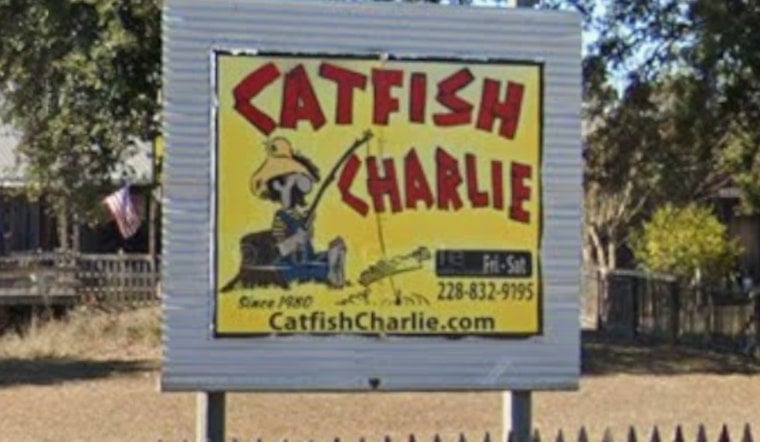
A new seafood restaurant just opened its doors in a building that fed Mississippi Gulf Coast families for 46 years, and it's serving all-you-can-eat catfish for $24.99 right next door to a 35-foot wooden rocking chair that locals have long called the largest in the world. Catfish Cuevas held its grand opening Thursday at 11419 Canal Road in Gulfport, taking over the space long occupied by Catfish Charlie.
According to the Sun Herald, the restaurant is a southern-style seafood spot rather than a buffet, offering whole catfish made with an original recipe, served broiled or fried, alongside seafood platters, sandwiches and side items. Chicken tenders are also on the menu for $20.99. The Sun Herald, a Biloxi-based news partner with NOLA.com and The Times-Picayune covering the Mississippi Gulf Coast, reported that the new owners previously ran Lloyd's Cabin, a seafood buffet on Highway 603 in Perkinston that closed in April as they made the transition to the Canal Road building.
Opening night proved so busy that the owners had to pause to-go orders altogether, according to a Facebook post the Sun Herald cited, and they thanked supporters for the turnout. Catfish Cuevas plans to serve dinner Thursday, Friday and Saturday from 2 p.m. to 9 p.m.
A Building With Four Decades of Family History
The building itself carries a story that stretches back to 1980, when Charlie Sinopoli opened Catfish Charlie with his brother Gary. The restaurant, which closed in March after more than 40 years, became known across the region for crispy fried catfish, coleslaw and buttermilk biscuits, according to the Sun Herald's reporting.
The restaurant's history took a personal turn when Michael Sinopoli met his wife Karen while working at Catfish Charlie on weekends alongside his full-time job. The couple moved to Washington state before returning to the restaurant in March 2005, the same period Gary Sinopoli had hoped to retire and just after Charlie Sinopoli had died, per the Sun Herald. Michael and Karen ended up keeping the restaurant going for another 21 years before it finally closed this year.
Separately, per Airial Food Guide, Catfish Charlie built its loyal following through family-style service, house-made tartar sauce and complimentary hot buttermilk biscuits served with jam throughout its run under the Sinopoli family.
The Landmark Chair Next Door
Catfish Cuevas sits adjacent to what is reportedly the largest rocking chair in the world, a fixture that has anchored the Canal Road site for decades. The 35-foot-tall wooden chair was built in 1995 by the Roy F. Dedeaux family out of Southern Pine as an oversized replica of their furniture company's signature Magnolia Rocker, according to New Orleans Magazine.
While the chair is promoted locally as the world's biggest, the official Guinness World Record for the title actually belongs to a 56-foot, 1-inch rocker built in Casey, Illinois in October 2015, according to Atlas Obscura, which notes the 46,200-pound Illinois structure eclipsed all previous record holders. Even so, the Gulfport chair has its own claim to fame locally: it became a symbol of endurance after surviving Hurricane Katrina in August 2005 with only minor paint stripping, according to The Inn at Long Beach.
A Bigger Moment for Mississippi Catfish
The restaurant's opening also lands at a notable moment for the state's catfish industry. Mississippi led the nation in farm-raised catfish production in 2025, generating $213.73 million in sales across 194.3 million pounds of food-size catfish, according to the USDA National Agricultural Statistics Service, which found the state accounts for nearly 60% of total U.S. farm-raised catfish value.
That industry has been under pressure, though. In August, the USDA approved targeted federal relief for Mississippi catfish growers, including $20 million in Section 32 surplus purchases and $600-per-acre payments for bird depredation losses, according to the Mississippi State University Extension Service. Growers have faced rising feed prices and competition from imported fish like Vietnamese swai, the same research notes. Mississippi State survey data also found that flavor remains the top reason consumers choose catfish, with 68% citing it as their main draw, even as per-capita consumption sits at 1.137 pounds nationally.
For now, the draw in Gulfport is more immediate than any market report: a $24.99 all-you-can-eat catfish deal, a building with four decades of memories, and a giant wooden rocking chair standing watch next door.


