

























































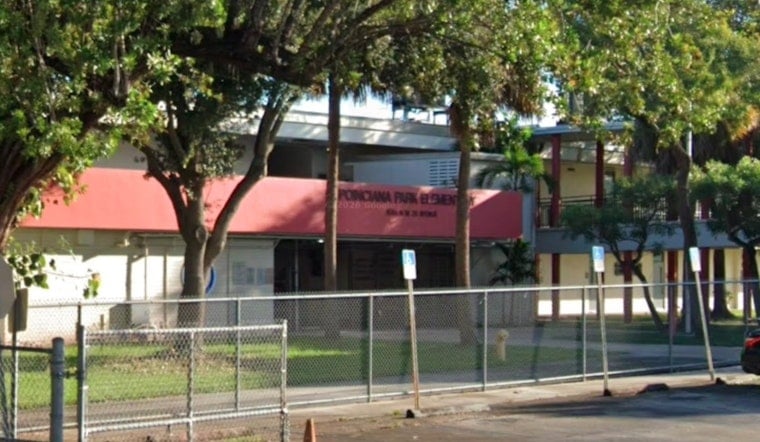
Ten days after opening inside the shuttered Poinciana Park Elementary building in Liberty City, KIPP Legacy School had enrolled 200 students in a campus built to hold nearly 800. The charter school leases the former Miami-Dade County Public Schools building for 13 years at a nominal $1 annual fee, making it the first Miami campus to operate in a onetime traditional public school under Florida's expanded Schools of Hope law.
The arrangement, reported by the Miami Herald, traces back to legislation that reshaped how Florida districts must handle underused campuses. Miami-Dade County Public Schools closed Poinciana Park Elementary last year after the building used just 20% of its available space in its final year, according to the Herald's reporting. Under Florida Statute 1002.333, as amended in 2025, designated Schools of Hope charter operators gained the statutory right to lease or co-locate in district facilities at no rental fee whenever a building's utilization rate falls below 50% or it carries a surplus of at least 500 student stations, according to the Florida House of Representatives.
KIPP, whose name stands for Knowledge Is Power Program, is the country's largest charter operator, per the Herald. The network filed its notice of intent to operate in the former Poinciana Park building in November 2025, and the Miami-Dade County School Board approved the lease that April, with terms beginning July 1, 2026. KIPP spent $2.4 million on renovations starting that same date, including repairing the roof and improving the cafeteria space, the Herald reported.
A Return to Familiar Ground in Liberty City
KIPP's presence at the Poinciana Park site is not entirely new. The network first co-located its inaugural South Florida campus, KIPP Sunrise Academy, inside the same elementary school in October 2018, under a district-charter partnership in which KIPP paid $1 a year in rent and offered professional development to district teachers, according to WLRN. That 2018 arrangement was backed by a state Department of Education grant meant to draw established national charter networks into high-need areas like Liberty City.
Liberty City's role as a proving ground for charter schools stretches back even further. The neighborhood hosted one of Florida's very first charter schools in the late 1990s, a partnership between Urban League executive director T. Willard Fair and future Governor Jeb Bush, according to NextSteps: Step Up For Students. That early school eventually closed, but state leaders have repeatedly targeted Liberty City for subsequent charter initiatives since.
Charlie Schmidt said KIPP wants to reopen the school in a way that reflects what the community wants, per the Herald's reporting. Schmidt added that the legislation benefits the community if it helps families obtain what they seek and produces good outcomes for children. Stacie Alvarez said KIPP Legacy will be a school that stays, according to the same report, and the school has described itself as committed to partnering with and remaining in the community.
Inside the Classroom Approach
KIPP Legacy School had not yet tested its students early in the school year, the Herald reported. Ny'Asiah Gordon uses the evidence-backed science of reading approach in third grade, which teaches children to sound out words phonetically rather than guess, per the Herald. The school also uses guided restorative conversations when conflicts arise, and emphasizes behavior and structure as culture rather than discipline — a shift the Herald notes reflects KIPP's broader move away from its former no-excuses style and the harsher disciplinary practices once associated with it.
At KIPP's Miami-Dade College campus, 99.8% of students were eligible for free or reduced-price lunch last year, and the student body is majority Black, according to the Herald. That campus outperformed Poinciana Park in third- and fourth-grade reading and math in 2025, though it has also received a C state grade in each of the last three years. Schools of Hope contracts require schools to absorb a certain amount of students from their local school zones, and the program is intended to operate in areas served by persistently low-performing schools, proponents say, giving parents in such districts more options. Critics counter that the program will siphon resources from district-run public schools.
Enrollment Declines Fuel a Statewide Push
The vacancy that made Poinciana Park available reflects a broader crunch across Miami-Dade. The district lost roughly 13,000 students between the 2024-25 and 2025-26 school years, a 4% drop from 326,279 to 313,220 enrolled students, more than double the district's projected decline of 5,000, according to K-12 Dive. District officials cited lower local birthrates and a sharp drop in incoming newcomer students as the primary drivers, rather than transfers to charter schools.
The Miami-Dade County School Board this year approved plans to close or consolidate nine additional campuses, the most approved by the board in a single year, per the Herald. The district projected saving approximately $10 million in operational costs through those closures and consolidations ahead of the 2026-27 school year, K-12 Dive reported. Public education advocates have criticized the school board for closing neighborhood public schools while approving new charter school agreements in the same meetings.
The demographic pressure extends beyond enrollment numbers. Only 121 of Miami-Dade's more than 500 public schools qualify to provide free breakfast and lunch to all students through the federal Community Eligibility Provision in 2026-27, a significant drop from previous districtwide meal coverage, according to K-12 Dive. District officials attributed the decline to fewer low-income and newcomer students enrolling in public benefits, pushing the district below federal eligibility thresholds.
Charter Expansion Beyond KIPP
KIPP is not the only network capitalizing on Florida's Schools of Hope framework. Success Academy plans to co-locate in five Miami-Dade schools starting next year, an expansion Hoodline previously reported included a mutual management agreement under which Success Academy agreed to reimburse the district $700 per student annually for shared custodial, food, nursing, and utility costs. Local billionaire hedge fund manager and philanthropist Ken Griffin supports Success Academy's Miami-Dade co-location venture, according to the Herald, after pledging $50 million in September 2025 to fund the network's Florida expansion under the Schools of Hope program, according to The Floridian.
Schools of Hope can operate in Florida opportunity zones, and Miami-Dade County has about 67 such zones, per the Herald. Alongside its elementary and middle school programs at the former Poinciana Park building, KIPP announced plans to open KIPP Miami Technical High School, offering career academies in Business, Digital Arts, and Technology/AI, according to Business Wire — an expansion meant to build a continuous kindergarten-through-career pathway for neighborhood students.
Not every KIPP market is expanding. KIPP Texas announced in December 2025 that it will close seven charter schools across Austin and San Antonio for the 2026-27 school year due to declining enrollment and regional demographic shifts, as Hoodline reported in December. The contrast underscores how the same enrollment volatility reshaping Miami-Dade's traditional public schools is also shaping charter networks' decisions elsewhere in the country.




