

























































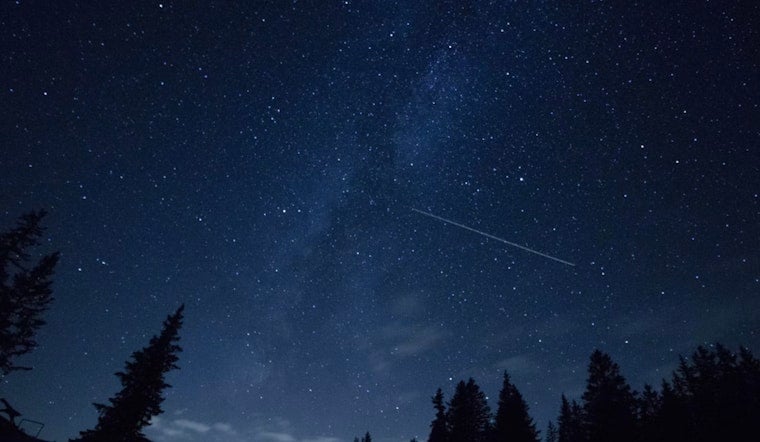
Streaks of light cut across the sky over South Florida before sunrise, caught live on air after a newscast director noticed the activity while working the morning broadcast. Temperatures at the time sat in the low to mid-80s, a brief cool spell before Miami-Dade and Broward counties baked under a heat advisory that stretched from noon until 7 p.m. the same day.
The meteors were spotted over Miami during the annual peak of the Perseid meteor shower, according to WPLG Local 10, which reported that newscast director Darby Patton noticed the meteor activity first and alerted the newsroom. Meteorologist Saira Anwer also noticed the meteors during her traffic report, and the station captured the streaks live as they lit up the sky before dawn. The timing lined up with the Perseids' natural peak window, which runs overnight from August 12 into August 13, according to Zendar Universe.
A New Moon Made the Show Brighter
This year's peak fell during a New Moon, meaning zero percent lunar illumination gave skywatchers exceptionally dark conditions to work with, per the same Zendar Universe report. That darkness matters more than usual in a place like Miami, where heavy urban light pollution typically cuts down on what's visible overhead. Under ideal dark-sky conditions the Perseids can produce 50 to 100 visible meteors an hour, but in lit-up metro areas like Miami that figure drops to roughly 15 to 25 per hour, according to WFTV. Local 10 separately noted that strong meteor showers can generally produce about 30 to 40 visible meteors per hour, and that actual visibility always depends on weather, light pollution and location.
The meteors themselves trace back to Comet 109P/Swift-Tuttle, a 16-mile-wide comet that swings through the inner solar system on a 133-year orbit and last passed by in 1992, according to NASA Science. Debris shed by the comet slams into Earth's atmosphere at roughly 37 miles per second. As that cometary dust hits the mesosphere, it compresses and superheats the air in front of it to thousands of degrees Celsius, vaporizing smaller fragments into glowing trails while larger chunks explode into fireballs, per Royal Museums Greenwich.
Why the Perseids Produce So Many Fireballs
NASA's Meteoroid Environment Office has tracked the Perseids producing more fireballs — meteors at least as bright as Venus — than any other annual shower, logging more than 500 confirmed fireballs since 2008 thanks to the larger particle size of Swift-Tuttle's debris. That helps explain why bright streaks were visible enough for television cameras to catch over a lit-up city like Miami. The link between annual meteor showers and comet orbits dates back to 1865, when Italian astronomer Giovanni Schiaparelli analyzed orbital data following Swift-Tuttle's 1862 passage and proved the Perseids trace directly to the comet's path, according to the Royal Museums Greenwich account.
The 2026 Perseid peak also landed on the same calendar day as a total solar eclipse visible in parts of the Northern Hemisphere, an alignment described as rare since solar eclipses and peak meteor showers seldom fall on the exact same date, per reporting cited by WFTV. For South Florida residents chasing fainter meteors away from Miami's coastal skyglow, local astronomy guides point to designated dark-sky locations such as Everglades National Park or Big Cypress National Preserve.
Heat Advisory Followed the Meteors by Hours
The same morning the meteors lit up the sky, heat indices across South Florida were already climbing into the 90s before sunrise, with feels-like temperatures expected to reach the triple digits later in the day. The National Weather Service issued a heat advisory for Miami-Dade and Broward counties running from noon until 7 p.m., part of a pattern in which the local forecast office applies a lower 105-degree heat-index threshold for those two counties compared to the 108-to-112-degree threshold used elsewhere in Florida, according to The Cool Down.
Meteorologists at WSVN 7News reported that a plume of Saharan dust moving across Florida in mid-August suppressed widespread rain while contributing to hazy daytime skies and elevated afternoon heat index values across the region. Areas near and east of Interstate 95 were expected to remain mostly dry, while storm activity was expected to focus on inland Broward and Miami-Dade counties. Local 10's Julie Durda said calmer winds were expected to concentrate that storm activity mainly over those inland areas, and she urged residents to take precautions as temperatures and humidity climb, warning that dangerous heat conditions are particularly likely during the afternoon when high heat combines with high humidity. Temperatures were expected to climb into the low 90s the following day.
Dangerous heat and rare celestial light shows made for an unusual pairing over Miami this week, one Hoodline detailed separately in its coverage of the day's forecast. For now, the meteors have faded with the dark skies that made them visible, but the heat advisory cycle they briefly interrupted shows no signs of easing.




