

























































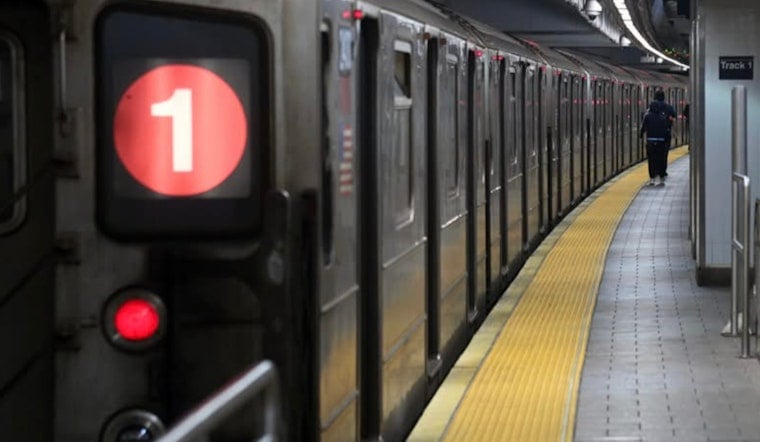
Riders sweating through their commute at the Brooklyn Bridge–City Hall and Chambers Street station complex may soon see that misery turned into something useful. New York City, the MTA, and the state are launching an $800,000 feasibility study to determine whether the punishing heat trapped underground on those platforms can be captured and reused to warm nearby municipal buildings during the winter.
Platform temperatures at Brooklyn Bridge–City Hall averaged 96 degrees Fahrenheit over the summer of 2025, according to CBS News. Mayor Zohran Mamdani said in a statement that some subway stations run up to 20 degrees hotter than the outside air, and argued that cooler platforms paired with reused heat could also lower energy costs, according to Spectrum News NY1. The study is a joint effort between the mayor, Governor Kathy Hochul, and the MTA, and city officials say the resulting project would be the first thermal energy network installed in a U.S. transit system, per the same report.
How the Heat-Trapping System Would Work
Under the proposed concept, radiant cooling technology installed on subway platforms would absorb excess heat and move it through pipes to geothermal boreholes for seasonal storage, as detailed by CBS News. Those boreholes would sit beneath the abandoned center platform at the Chambers Street station, a cavernous space that has not carried a single passenger since 1931, when ridership patterns shifted away from Lower Manhattan toward Midtown, according to Untapped New York. The station originally opened in 1913 as a sprawling four-track terminal, leaving behind exactly the kind of unused subterranean real estate engineers now want to repurpose.
During colder months, the stored heat would be drawn back out of the boreholes to warm nearby municipal buildings, the NY1 report notes. The study focuses specifically on the Chambers Street J/Z station and the Brooklyn Bridge–City Hall 4/5/6 complex, and the MTA and city will spend the coming months assessing whether radiant cooling technology is even feasible at that scale before any construction begins.
A System Built for Buildings That Already Use It
Thermal energy networks are not experimental technology in the abstract — they already heat and cool several hospitals and universities, per NY1's reporting. The broader push got its legal foundation in July 2022, when Governor Hochul signed the Utility Thermal Energy Network and Jobs Act, permitting public utilities to own and operate thermal energy networks across the state, according to the Sabin Center for Climate Change Law. Two years later, in July 2024, the state Public Service Commission adopted initial rules for those networks and advanced nine utility pilot projects into engineering, according to the New York State Department of Public Service. Officials describe thermal networks as a way to cut reliance on fossil fuels, and New York has backed the strategy with $200 million in executive budget funding for thermal projects across state-owned campuses and public facilities, according to Buro Happold.
The concept already has a foothold elsewhere in the city. Con Edison designated Chelsea as a pilot site to capture waste heat from a local data center and funnel it into heating and hot water for NYCHA's Fulton Houses, as Hoodline previously reported. That pilot is one of seven mandated across the state's major utilities.
Why Chambers Street, and Why Now
The subway system's heat problem is largely structural. Only seven of the MTA's 472 subway stations currently have cooling systems, since traditional air-conditioning retrofits are difficult to install in older, deep underground stations, according to Hoodline's earlier coverage of the MTA's geothermal push. That earlier effort, launched via a September 2025 request for information, examined the 167th Street and 181st Street stations on the No. 1 line, aiming to keep platform temperatures between 82 and 85 degrees Fahrenheit.
The Chambers Street complex adds another dimension: it happens to be in line for a separate, long-delayed overhaul anyway. The MTA issued a tender in May seeking contractors for a physical restoration of the 113-year-old station, a project expected to cost more than $100 million, according to Streetsblog New York City. The city announced plans to revitalize the station this month, and the thermal study is expected to inform how that broader rebuild proceeds.
Design work tied to the thermal network itself is not slated to begin until early 2027, and even that timeline depends on the feasibility study confirming the geothermal approach can work, per NY1. That means any actual heat-sharing system between the subway and nearby buildings remains years away, even as the study moves forward this year.




