

























































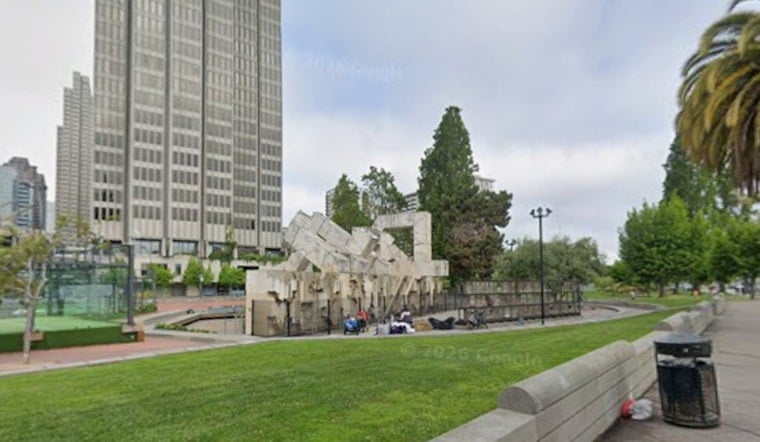
San Francisco's futuristic public toilet at Embarcadero Plaza was supposed to show off the city's cutting-edge answer to street hygiene. Instead, the 13-foot stainless steel structure has become a symbol of how hard it is to keep high-tech infrastructure running in a dense urban corridor, having racked up more than 200 complaints or maintenance requests since it opened in 2022.
The restroom, part sculpture and part utility, is one of the futuristic AmeniPOD units that French advertising company JCDecaux began rolling out as part of a planned 25-toilet expansion for downtown sidewalks and promenades, according to the San Francisco Chronicle. Reporter Rachel Swan detailed how the toilet has gotten stuck in its cleaning cycle and racked up about nine times as many complaints as the older JCDecaux models at Hallidie and United Nations plazas. Most of the maintenance incidents involved door malfunctions or cleaning-cycle stalls, though the unit has not been offline for long stretches at a time.
A Design Meant to Be a Showpiece
SmithGroup conceived the AmeniPOD design, which the city's Historic Preservation Commission selected in 2018 as San Francisco's hyper-modern bathroom experience. The Embarcadero Plaza unit operates from 9 AM to 5 PM, is staffed by an attendant during those hours, and enforces a 20-minute time limit, triggering a full cleaning cycle after every use, per the Chronicle's reporting.
Juan Marin, a jewelry vendor who manages a booth near the toilet, told the paper it's beneficial for tourists and people who work nearby. JCDecaux's existing toilets across the city handle about 2,000 flushes a day and see roughly 65,000 users during peak summer months, the outlet reported, underscoring just how much strain the aging technology is under even as the newer model struggles to keep pace.
JCDecaux Says It's Adapting the Design
J. Francois Nion, executive vice president of JCDecaux North America, said the company remains committed to the toilet system and has adapted the design based on the maintenance problems the Embarcadero unit has revealed. He expects the next batch of futuristic toilets to arrive in 2027, telling the Chronicle that the coming iteration will have more flexibility and let users operate it without touching anything.
Rachel Gordon, director of policy and communications for San Francisco Public Works, said the agency is confident in the next generation of toilets, which are expected to be more water- and energy-efficient than the older models. Public Works has pursued public restroom improvements for generations, and the data on the Embarcadero toilet's complaints and maintenance requests came from the agency itself, the Chronicle reported.
The Long Shadow of the $1.7 Million Toilet
San Francisco's restroom ambitions have collided with public skepticism before. In 2022, the Recreation and Park Department initially estimated that installing a single prefabricated toilet at Noe Valley Town Square would cost $1.7 million and take two years, a figure that sparked national and international scrutiny, according to The Guardian. After private manufacturers donated a modular unit and installation labor valued at $425,000, the final city cost dropped to about $200,000 when the restroom opened in April 2024.
That controversy pushed San Francisco to enact a cooperative purchasing law in July 2024, letting city agencies piggyback on pre-negotiated public contracts under $5 million to cut procurement red tape, as SFist reported. The reform has since lowered average playground renovation costs from $4 million to $1.4 million, the outlet noted, showing how one embarrassing toilet estimate reshaped the city's approach to small public projects more broadly.
Staffing Remains the Biggest Expense
Behind the sleek design sits an expensive staffing model. Under its 20-year agreement with the city, JCDecaux covers all design, manufacturing, installation, and daily maintenance costs for 25 public toilets and 114 advertising kiosks, while also contributing $2.2 million annually to staff attendants at roughly 11 locations, according to CBS News. Advertising revenue funding that system cratered during COVID shutdowns and has only started to rebound in the past year, per the Chronicle's account.
San Francisco Public Works' broader Pit Stop program, which began in the Tenderloin 12 years before publication, has since expanded to 16 staffed restroom locations across the city. Those sites, which also include needle disposal containers and dog waste stations, rely on attendants to protect the facilities against vandalism, drug use, or squatting. According to Smart Cities Dive, annual operating costs for Pit Stop restrooms range from $113,000 for a five-day portable unit open eight hours a day to nearly $632,000 for a 24/7 two-stall trailer — a cost structure driven almost entirely by staffing.
The financial weight of keeping a single overnight restroom running became especially clear during a 2019 pilot program, when overnight flushes between 11 p.m. and 7 a.m. cost the city roughly $28.50 to $30 each because two attendants had to staff each overnight shift, per Business Insider. That staffing math helps explain why San Francisco has leaned so heavily on the nonprofit Urban Alchemy, founded in 2018 to hire formerly incarcerated workers to staff public restrooms and monitor street-level safety.
For now, the Embarcadero Plaza toilet remains open on its regular schedule while the city and JCDecaux wait for the redesigned units slated for 2027. Hoodline first covered the AmeniPOD's futuristic design debut back in 2018, and the program's staffing model traces to Hoodline's earlier reporting on the Castro Pit Stop's return. Whether the next generation of sensor-driven, touchless toilets can finally break the city's cycle of high costs and stalled technology remains to be seen.





