

























































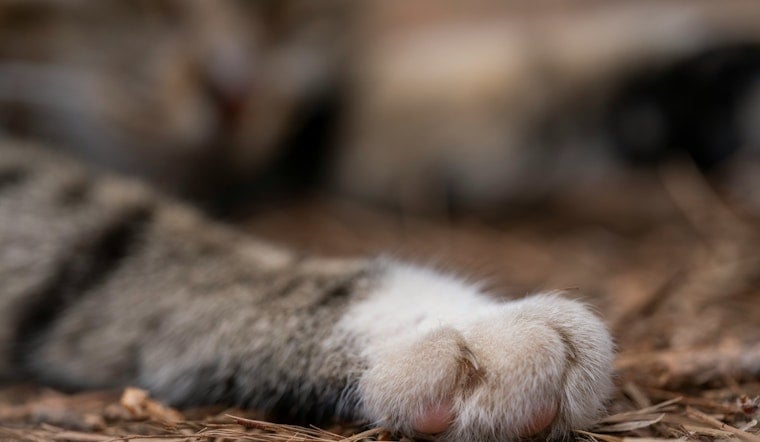
In Southeast Portland's Brooklyn neighborhood, a backyard has quietly turned into a scale model of the City of Bridges — except these spans are built for cats, not commuters. Debbie and David Dicks have four cats and a network of 2-foot-wide bridge replicas connecting catio towers around their property, complete with names borrowed from the real Willamette River crossings just a few miles away.
The idea began with Debbie Dicks, who conceived the bridge theme and wanted an outdoor space with flair, according to The Oregonian/OregonLive. She asked her son-in-law, Thom Arboren, to design the structures, and he worked with his father-in-law, David Dicks, to build them. Arboren is credited as the designer of what the family calls the Arboren Cathedrals, and the two men are still finishing two more bridges ahead of an upcoming public tour.
The centerpiece so far is the Pawthorne Bridge, a 14-foot-long span that traverses the side yard to an 8-foot catio tower, its name a nod to Portland's real Hawthorne Bridge. That 1910 vertical-lift span is the oldest operating structure of its kind in the country and the oldest bridge across the Willamette, according to the Oregon Historic Sites Database. The Pawthorne Bridge connects to another replica called the Taillikum Bridge, which will run along the fence toward the back of the property and end at a second catio tower.
A Backyard Loop Inspired by Real Willamette Crossings
The Taillikum name riffs on Tilikum Crossing, the car-free span that opened in 2015 as Portland's first new Willamette River bridge since 1973 and the first major U.S. bridge built exclusively for transit, cyclists, and pedestrians, per TriMet. A third replica, the Cathedral Bridge, will connect the second catio tower to a catio on the back porch, borrowing its name from St. Johns Bridge, the 1931 suspension span whose 400-foot Gothic towers rise above Cathedral Park, according to the Willamette Light Brigade.
Once finished, the full system will include 60 feet of skybridges forming a loop around the property, giving the Dicks' cats — Fezzik, a 14-year-old gray tabby; Adder and Puck, both 5-year-old black domestic shorthairs; and Earl Nimbus the Gray, a 4-month-old kitten — room to sunbathe and wander above the ground without ever leaving the yard. Debbie Dicks told OregonLive she wanted her cats to experience the outdoors safely while also protecting birds from the cats. Soft flap cat doors built into window inserts give the animals year-round access from the house, with entry points through a basement window or a staircase-landing window.
A Decade of Catio Building Started With One Cat's Move
Arboren has built catios of various sizes for his cats for the past decade, starting with a structure accessed through a basement-apartment window in 2016. He has said the inspiration traces back to his oldest cat, Princess Nell, whose move from 20 acres as an indoor-outdoor kitten to a Portland basement apartment pushed him to build his first enclosure. In 2020 he added another tower and tunnel connecting a bedroom, home office, and basement, and this year he and David Dicks built bridges that let the cats leave the home and survey the neighborhood without ever leaving the backyard.
The Dicks' backyard will make its debut this year as a stop on the 14th annual Catio Tour, a Portland fundraiser happening Saturday, Sept. 12 from 10 a.m. to 2 p.m. Tickets cost $15 and include a guidebook detailing cat patios and other enclosures around the city, along with the materials and costs behind them. It will be the first time Debbie and David Dicks have opened their yard to the tour, and the first Catio Tour that Arboren and his wife, Mea Arboren — the Dicks' daughter — will attend themselves.
Why Portland Pairs Cat Welfare With Bird Conservation
The tour supports the Cats Safe at Home campaign, a partnership between the Feral Cat Coalition of Oregon and the Bird Alliance of Oregon, formerly known as the Audubon Society of Portland before it dropped the Audubon name in 2024 to distance itself from John James Audubon's history as a slaveholder, according to OPB. The campaign represents a rare alliance between feline advocates and wild bird conservationists, groups that have historically clashed over how to manage outdoor cats, per HumanePro.
The stakes behind that partnership are significant: a 2013 study published in Nature Communications estimated that free-roaming domestic cats kill between 1.3 billion and 4 billion birds and up to 22.3 billion small mammals annually across the contiguous United States, according to Science News. Catios like the ones in the Dicks' backyard offer a middle ground, letting cats experience fresh air and sunlight without exposure to traffic, predators, or the birds conservationists are trying to protect.
Portland's own animal laws add another layer to that tension. Multnomah County Code exempts domestic cats from the county's animal-at-large prohibition, meaning outdoor cats can legally roam public property without a leash, according to Multnomah County Animal Services. The county's shelter also limits intake of outdoor cats to those that are sick, injured, abandoned, or in immediate danger, instead directing residents to leave healthy community cats where they are found. That policy leaves much of the responsibility for managing neighborhood cats to homeowners — and, increasingly, to catios like the ones the Dicks family and Arboren have spent years perfecting.
The Catio Tour itself has grown from a single Portland event launched in September 2013 — the first of its kind in the nation — into part of a broader national trend, with backyard cat enclosures now showing up in cities including Los Angeles, Dallas, and Nashville and even earning coverage in Martha Stewart Living, according to the National Audubon Society. In Southeast Portland, though, the appeal is distinctly local: a set of tiny bridges named after the city's own landmarks, built so four cats can survey the neighborhood from somewhere in between indoors and out.



