

























































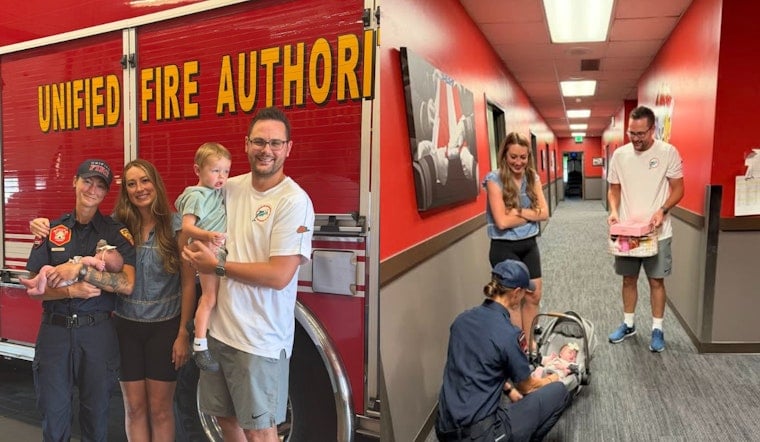
Unified Fire Authority paramedics delivered a baby girl during a field response in the West Jordan area, turning a routine 911 call into one of the rarest and most celebrated moments in fire service work. The agency released photos from the scene, credited to Unified Fire Authority itself, capturing the delivery team shortly after the birth.
The delivery, first reported by KMYU, comes from an agency that handles an enormous volume of medical calls across the region. Unified Fire Authority is Utah's largest fire-based emergency service agency, employing roughly 695 personnel to serve 473,921 residents across 15 municipalities and unincorporated Salt Lake County, according to the agency. Emergency medical calls make up the bulk of that work, with the department logging 29,225 medical responses in 2023 alone — 82 percent of all emergency calls that year — handled by a workforce of about 275 paramedics and 300 EMTs.
Field deliveries like this one remain uncommon compared to the department's daily call volume, but they carry outsized meaning within fire service culture. Paramedics who successfully deliver a baby during a response are traditionally awarded a specialized Stork Pin to wear on their uniform, a career honor recognized across fire and EMS agencies.
Why Field Births Happen More Often in Utah
Utah's out-of-hospital birth rate helps explain why paramedics occasionally find themselves catching newborns instead of racing them to an emergency room. More than 1,400 live births occurred outside hospital settings statewide in 2023, representing over 3 percent of all deliveries — roughly double the national average — with total out-of-hospital birth rates topping 4 percent by 2022, per the Utah Department of Health and Human Services. Salt Lake County sits at the center of that trend: a state public health study published in September 2024 found that Salt Lake County and Utah County combined accounted for 61.4 percent of all out-of-hospital births recorded statewide between 2016 and 2021.
Access to maternal care also plays a role in why paramedics are sometimes the first responders present for sudden labor. An October 2025 report from the Kem C. Gardner Policy Institute found that 22 of Utah's 29 counties face primary care maternal workforce shortages, a gap that increases community reliance on pre-hospital EMS crews when labor begins unexpectedly.
Jurisdiction and Mutual Aid in the West Jordan Area
West Jordan operates its own municipal fire department, which maintains four active stations and responded to 7,919 emergency calls in 2025, but the city relies on Unified Fire Authority for cross-border mutual aid and joint emergency responses, according to the City of West Jordan. That interagency coordination has been on display before: Hoodline previously reported on overnight blazes in Herriman and Millcreek that drew mutual aid between the two agencies, and on a 2024 carbon monoxide leak at a West Jordan meat-packing plant that also involved a joint response.
West Jordan has been expanding its own emergency capacity as call volume climbs. The city reported in April that emergency call volume has grown by 4 percent annually over the past 15 years, prompting officials to train five new paramedics and begin planning a new station, Fire Station #56, on the city's west side.
A Department Built on Paramedic Innovation
Unified Fire Authority's role in field medicine traces back decades. The agency was formed under a 50-year interlocal charter in September 2003, evolving from the Salt Lake County Fire Department, which helped pioneer Utah's paramedic program in the 1970s by sending nine firefighters to Los Angeles for advanced training. More recently, the department introduced specialized low-acuity EMS response units in 2025 specifically to preserve high-acuity paramedic availability for unpredictable field events such as deliveries and cardiac arrests.
That operational strategy reflects a broader pattern within the department, which continues to grow its ranks even as call demand rises. Hoodline reported last August on a new class of 23 UFA recruits beginning training, part of the agency's ongoing effort to keep pace with the region's emergency medical needs.



