

























































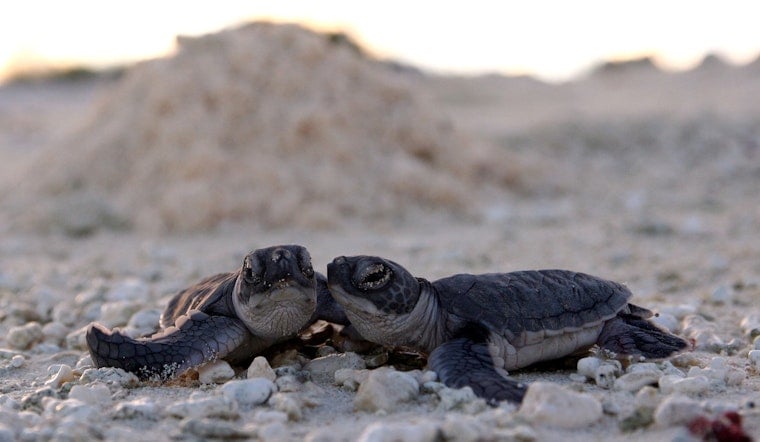
A video showing newly hatched sea turtles crawling toward a brightly lit Fort Lauderdale hotel instead of the ocean has stirred public backlash, capturing on camera the exact kind of disorientation that conservationists have warned about for years along Broward County's coastline.
The footage, published Monday, shows hatchlings drawn inland by artificial light rather than following their instinct toward the water, according to Local 10 News. The clip has drawn strong reaction online, reigniting concerns about beachfront lighting during a nesting season that runs through October 31.
Under Fort Lauderdale's own sea turtle ordinance, found in Chapter 6, Article III of the city code, beachfront property owners are required to shield, reposition, or turn off artificial lights visible from the beach for the entire March 1 through October 31 nesting window, according to the City of Fort Lauderdale. Hatchlings instinctively crawl toward the brightest open horizon, which under natural conditions is moonlight and starlight reflecting off the ocean. When hotel and resort lighting overpowers that signal, hatchlings turn the wrong way, a mechanism the Florida Fish and Wildlife Conservation Commission has documented as a leading cause of fatal dehydration, exhaustion, road strikes, and predation among newly emerged turtles.
A Widespread Compliance Problem
The video is not an isolated incident so much as a visible symptom of a much larger pattern. A 2025 survey of more than 767 coastal properties across eight Broward County municipalities found that only about 35% were in compliance with turtle-safe lighting standards, meaning roughly two-thirds of surveyed properties were still emitting light visible from nesting beaches, per Sea Turtle Oversight Protection. That 35% figure was reportedly the highest compliance rate recorded in the county since tracking began in 2012, underscoring how slow progress has been even as awareness has grown.
Since 2007, volunteer patrols with the Fort Lauderdale-based nonprofit, known as S.T.O.P., have rescued and bucketed more than 300,000 disoriented hatchlings along Broward County beaches. Volunteers conduct nightly patrols from May through October specifically to collect and release turtles that wander off course, the group notes on its website.
Legal Stakes for Beachfront Properties
The consequences for non-compliant properties extend well beyond a city warning. Florida Statute § 379.2431, the Marine Turtle Protection Act, classifies disturbing, harming, or possessing sea turtles, hatchlings, or their eggs as a third-degree felony carrying state criminal penalties and mandatory administrative fines, according to the Florida Fish and Wildlife Conservation Commission. All sea turtle species nesting along Florida's coast are also protected under the federal Endangered Species Act of 1973, which allows for civil penalties ranging from $25,000 to $100,000 and up to a year in prison for unauthorized disruption or harm to a listed species.
Fort Lauderdale code enforcement officers conduct regular inspections of beachfront properties during nesting season, issuing warnings and daily fines of up to $150 to properties found with non-compliant lighting, according to reporting by the South Florida Sun Sentinel. Other nearby South Florida municipalities have gone further, imposing fines of up to $1,000 per day for first-time lighting violations.
A Familiar Pattern for Fort Lauderdale Hotels
This is not the first time a Fort Lauderdale beachfront property has drawn scrutiny over turtle-disorienting lights. In August 2020, conservation groups issued a formal notice of intent to sue the Bahia Mar Resort on Fort Lauderdale Beach under the Endangered Species Act, after its facade lighting was linked to the disorientation of more than 3,000 hatchlings over four years, as reported by Courthouse News Service. City inspectors had reportedly issued multiple citations against that resort before the legal notice was ever filed.
The ecological stakes behind these disorientation incidents are steep. The Broward County Sea Turtle Conservation Program monitors 24 miles of local coastline daily during nesting season, documenting between 2,000 and 3,600-plus nests each year across loggerhead, green, and leatherback species, with loggerheads accounting for the vast majority of those nests, according to Nova Southeastern University. Marine scientists estimate that only about one in 1,000 sea turtle hatchlings survives to adulthood, a statistic that raises the stakes of every disorientation event caught on camera or otherwise.
Similar disorientation incidents have surfaced elsewhere in Florida this season. Hoodline previously reported that Volusia deputies rescued 75 hatchlings disoriented by artificial lighting near Atlantic Avenue earlier this month, part of a broader trend of hatchling disorientation tied to coastal lighting across the state.
It remains unclear whether Fort Lauderdale code enforcement has issued any citations or daily fines specifically tied to the hotel shown in the viral video, or whether volunteer groups intervened on-site to rescue the disoriented hatchlings captured on film. Any long-term lighting retrofits the property owner may be pursuing to come into compliance with state and local law have not been detailed publicly.





.jpg)