

























































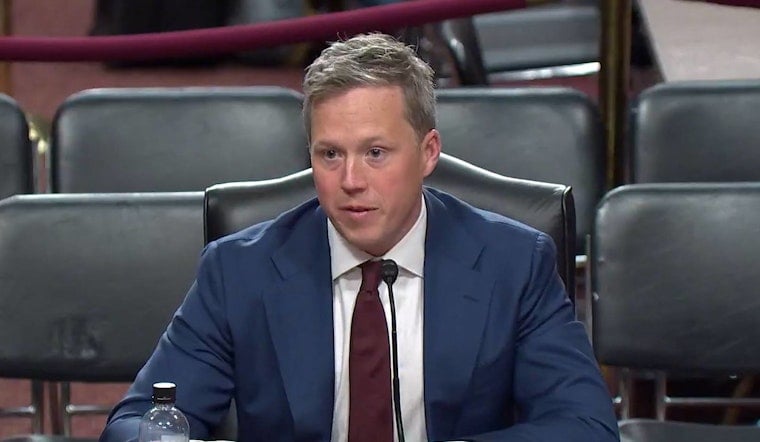
Army Secretary Dan Driscoll is stepping down after 18 months on the job, the White House announced, ending a tenure marked by reported tensions with Defense Secretary Pete Hegseth and capping a stretch of turnover at the top of the Army. Driscoll, a friend and former Yale Law School classmate of Vice President JD Vance, had pushed to reduce red tape for military contractors and restore what he described as an emphasis on readiness and lethality within the Army.
According to the Associated Press, the White House gave no reason for Driscoll's departure, and the Pentagon referred questions about it to the Army, which had not immediately responded to an email seeking comment. Driscoll's spokesman also had not responded to a text message, the outlet reported. White House deputy press secretary Anna Kelly said Driscoll advanced President Trump's agenda at the Department of the Army and that the United States Army is more powerful than ever because of his work.
A Rocky Relationship With Hegseth
The Senate confirmed Driscoll as Army secretary in February 2025 by a 66-28 vote, following a confirmation hearing that focused on Army modernization, recruiting, and strengthening the military industrial base. Trump had called him a disruptor and change agent when nominating him in 2024, according to the AP's reporting. But the relationship with Hegseth grew strained: in February 2026, Hegseth ordered Driscoll to fire chief Army spokesman Col. Dave Butler over news coverage that reflected unfavorably on the defense secretary, as reported by Hoodline's prior coverage of the episode; Butler ultimately chose to retire after Driscoll initially resisted the demand, per the Washington Post's account.
Driscoll was also an ally of Gen. Randy George, the Army's top uniformed officer, whom Hegseth ousted in April 2026 — the same month that made John Phelan's departure as Navy secretary the first military service chief exit of Trump's second term. Driscoll told Congress that he and his family hugged George after his resignation. In a farewell email to Driscoll and senior officers, George wrote that U.S. soldiers deserve tough training and courageous leaders of character, according to CBS News. Gen. Christopher LaNeve then became the Army's acting chief of staff.
Drone Program Reversal Follows Ally's Exit
The shakeup extended into the Army's drone modernization efforts. LaNeve directed a Europe-based Army unit — the Unmanned Assault Battalion, established in 2025 by George and Gen. Christopher Donahue — to end its drone-building efforts, and the unit reverted to a traditional infantry battalion, the Army is pulling the plug on the program LaNeve inherited. Hoodline previously reported on the shutdown of the drone battalion, which came shortly before Driscoll's own exit and shifted the service's focus toward distributing commercial off-the-shelf drones directly to regular squads. Donahue himself had stepped down as the Army's commander in Europe and Africa in June 2026 amid Hegseth's broader reshuffling of senior officers.
Driscoll had pushed in the opposite direction. Earlier in August, at Camp Grayling in Michigan, he launched an online marketplace called testrange.army.mil that gives commercial weapons developers 30-day access to five military proving grounds — in Utah, Arizona, Mississippi, Michigan, and Morocco — instead of the 12-to-18-month bureaucratic delays contractors previously faced for drone and counter-drone testing. Hoodline covered that initiative when the test-range portal opened to speed weapons development. Driscoll had said civilian leaders choose the military leaders they want, an acknowledgment of the boundaries Title 10 of the U.S. Code places on the Army secretary's authority, which operates subject to the direction of the defense secretary and the president.
Diplomacy, Recruiting, and What Comes Next
Driscoll's portfolio stretched beyond the Pentagon's internal politics. In February 2026 he was tapped for a key negotiating role in U.S.-brokered peace talks between Russia and Ukraine in Geneva, working alongside other American negotiators, and he brought insights from the Ukraine conflict to inform Army drone procurement reform, the Washington Times reported. He also signed a non-binding statement of principles with Hawaii Gov. Josh Green in September 2025 to negotiate new terms for nearly 30,000 acres of state-owned military training land set to expire in 2029, amid warnings that the federal government could invoke eminent domain — an agreement Hoodline referenced in its coverage of the Navy's land return on Oʻahu and Molokaʻi.
Driscoll's tenure also included a recruiting turnaround. Hegseth announced at West Point in May 2026 that the Army had met its fiscal year 2026 recruiting goal four months early, securing more than 61,500 new soldier contracts following the activation of a specialized recruiting division the previous August — a milestone Hoodline detailed in its report on the Army hitting its 2026 recruiting goal early. A tech investor and Iraq War veteran who served as an armor officer from August 2007 to March 2011 and deployed to Iraq from October 2009 to July 2010, Driscoll also ran unsuccessfully in the 2020 Republican primary for a North Carolina congressional seat, receiving about 8% of the vote, before later becoming an adviser to Vance. He had reportedly told close associates he intended to serve roughly two years as Army secretary before stepping down to support Vance's potential 2028 presidential campaign.
His exit adds to a pattern of senior military turnover under Hegseth, who has ousted or forced out more than a dozen top commanders, including Joint Chiefs Chairman Gen. Charles Q. Brown Jr., Chief of Naval Operations Adm. Lisa Franchetti, and Air Force Chief Gen. David Allvin. It remains unclear who will lead the Army in Driscoll's absence or how ongoing initiatives, including the Hawaii land negotiations and the commercial test-range program, will proceed under acting leadership.





