

























































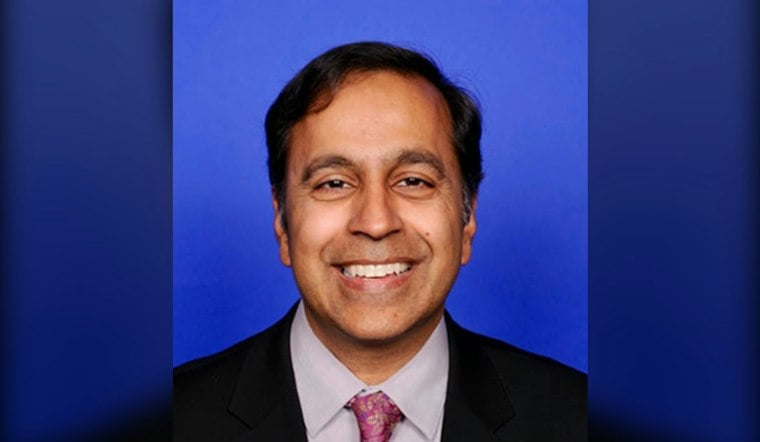
Two members of Congress from opposite parties introduced legislation Tuesday that would strip federal highway money from states that fail to rein in police use of automated license plate readers, the surveillance cameras that have quietly multiplied along roads nationwide over the past several years.
Representatives Raja Krishnamoorthi, an Illinois Democrat, and Michael Cloud, a Texas Republican, unveiled the bipartisan No FLOCK Act — short for the No Federal License-Plate Observation and Camera Keeping Act — according to a statement from Representative Raja Krishnamoorthi's office. The proposal emerged directly from mounting public backlash over officers misusing private camera databases, the release states. As NBC 5 Chicago reported, the bill would restrict funds for the license plate reader cameras that have become a fixture of local policing.
Under the proposed law, the U.S. Secretary of Transportation would be directed to withhold 10 percent of a state's annual federal highway, road, and bridge funding if that state fails to restrict license plate reader devices to five approved operational uses, according to Built In. Those permitted uses include toll collection, identifying stolen vehicles, locating missing persons, and investigating serious felonies, the outlet reports.
What The Bill Would — And Wouldn't — Do
The legislation stops short of banning Flock camera systems outright and does not prohibit local law enforcement agencies from sharing license plate tracking data with federal entities such as immigration authorities, according to WIRED. The bill's narrow use restrictions leave broader privacy and surveillance concerns unresolved.
Atlanta-based Flock Safety operates a network of roughly 120,000 AI-powered surveillance cameras across the country that capture vehicle license plates, make, model, color, and other physical characteristics, per CBS News. The cameras log passing vehicles automatically into a searchable central database, the network's core function and the one now under congressional scrutiny.
The push for federal restrictions followed a Washington Post investigation finding at least 69 police officials accused, charged, or convicted of abusing Flock or other license plate reader systems. The reporting also described more than 10,000 searches. Florida agencies have suspended or shut down Flock deployments, while Massachusetts sources document misuse cases and municipal exits from Flock networks.
Flock's Own Response To The Backlash
Flock Safety CEO Garrett Langley announced platform-wide security overhauls on August 13, cutting the default data retention period from 30 days to seven days and mandating automated search audit tools for law enforcement customers, according to Business Insider. Agencies can still preserve data longer under an “Evidence Mode” setting if it's tied to an active criminal case, the outlet reports.
That self-regulation came as U.S. Senator Josh Hawley, chairman of the Senate Judiciary Subcommittee on Crime and Counterterrorism, sent a formal inquiry to Flock Safety on August 26 demanding internal records on data collection, retention, biometric capabilities, and exposure to security breaches. Hawley questioned whether Flock data had ever been ingested or compromised in third-party data leaks, according to the U.S. Senate Judiciary Subcommittee on Crime and Counterterrorism.
States Already Moving Before Congress Acts
Florida's Department of Transportation issued a directive on August 31 revoking all license plate reader permits on State Highway System rights-of-way and ordering local agencies to remove or deactivate cameras within 30 days, according to WFTV.
Texas Governor Greg Abbott has blocked state spending on Flock networks, according to Claims Journal. These state-level actions underscore the ongoing debate over how cameras should be regulated as Washington considers its own fix.
A Boston Data Leak Adds Urgency
In Massachusetts, city officials confirmed this month that Boston abandoned its Flock camera trial after an internal surveillance report revealed a vendor configuration error had allowed outside law enforcement agencies nationwide to access local vehicle tracking data within just three days of deployment, according to WBUR. Boston has since launched alternative trials with Motorola and Axon, the station reports. Hoodline previously covered the Boston leak in detail.
The broader backdrop includes municipal privacy concerns, procurement disputes, and transparency complaints, layered on top of state-level crackdowns in Florida and Texas, as Krishnamoorthi and Cloud ask Congress to set a national floor for how these cameras can be used.





