

























































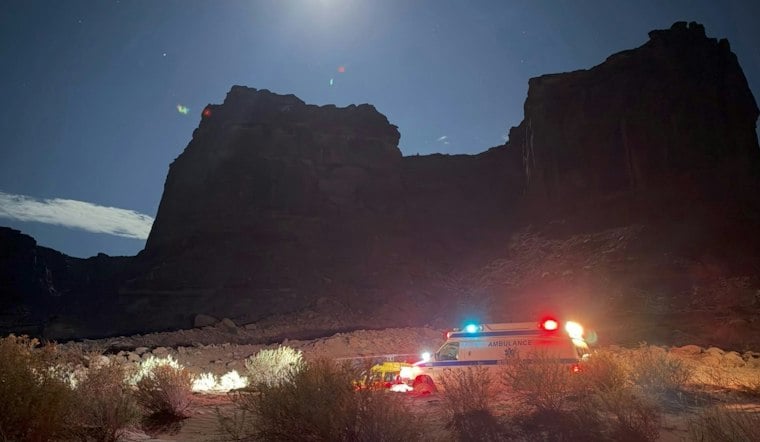
A hiker suffered a traumatic injury in the Mineral Bottom area of Grand County and was stabilized with a prehospital blood transfusion before being flown out by air medical crews, officials said. The injury's cause and extent were not disclosed, and the hiker has not been identified.
According to KUTV, Grand County Emergency Responders, Grand County Search and Rescue and the Grand County Sheriff's Office responded to the scene on Sunday evening. Gephardt Daily, however, reported that Grand County EMS, Search and Rescue and the Sheriff's Office responded Friday night to a traumatic injury in the Mineral Bottom area, west of Moab — leaving the exact date of the response unresolved between the two accounts.
Whichever night it happened, first responders reportedly stabilized the hiker and administered a prehospital blood transfusion at the scene before Intermountain Air Medical crews flew the patient to a hospital, the station's report notes. Officials did not release the hospital's location or the patient's condition upon arrival.
Third Field Transfusion Since July Launch
Grand County Emergency Services said the incident marked the third time crews have performed a prehospital blood transfusion since the program launched July 1, per the same account. The county's EMS system covers a sprawling 3,600-square-mile response area that includes national parks, highways and remote backcountry, according to Moab Sun News.
That outlet reported the program's first field transfusion came on July 19, when Grand County EMS administered blood to a motor-vehicle-crash victim — the first time crews had ever done so, even though their blood cooler had already been deployed on seven prior incidents without a patient actually receiving blood. Before the program existed, transfusions in Grand County were only available once a patient reached a hospital or through select air medical flights, Moab Times reported.
Why Bringing Blood to the Backcountry Matters
Officials told Gephardt Daily that bringing blood products directly to critically injured patients improves emergency care in Grand County, especially in remote areas where transport times can be significant. Moab Times reported that the field blood program is expected to expand over time as training and supply capacity grow.
The capability remains rare nationally. Prehospital blood transfusion is currently available in only about 1 to 2 percent of EMS agencies nationwide, according to the University of Michigan Medical School, which also noted that Genesee County, Michigan launched a similar effort on May 1, becoming the third EMS system in that state — after Saginaw and Macomb counties — to implement the capability.
Utah's own EMS protocol guidance calls for providers to document a full set of vital signs before initiating a transfusion and to use a dedicated IV or IO line for blood product administration, per the Utah Bureau of Emergency Medical Services and Preparedness. Details of this latest Grand County response, including the exact blood product used and whether it was given at the scene or during transport, have not been independently confirmed.





