

























































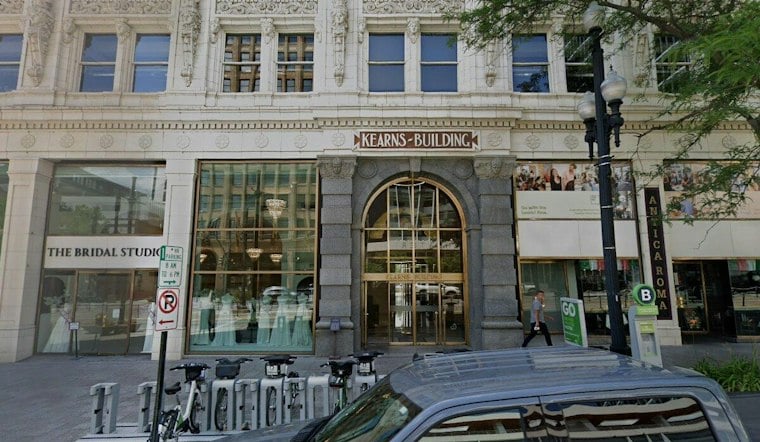
The Kearns Building, a 10-story Main Street landmark constructed from 1909 to 1911, is officially for sale. Developer Hines has listed the historic tower at 136 S. Main along with the adjacent Daynes Jewelry Building at 128 S. Main, putting two of the city's oldest office properties on the market just as downtown's office fundamentals show their strongest signs in years.
Reporter Taylor Anderson of Building Salt Lake broke the news that CBRE has brought both buildings to market together. The Kearns Building spans 166,939 square feet. Hines purchased the tower in 1988 and completed an extensive renovation in 2020.
A Landmark Building With Deep Utah Roots
The Kearns Building is associated with Thomas Kearns, a former U.S. senator from Utah and major stockholder in The Salt Lake Tribune, according to Wikipedia. Designed by Los Angeles architects John Parkinson and George Bergstrom in the Sullivanesque style with a white terracotta tile facade, the 10-story building was added to the National Register of Historic Places in 1982. It began taking occupancy in February 1911.
The adjacent Daynes Jewelry Building carries its own layered history. It was historically known as the Daft Block and is listed on the National Register of Historic Places, according to records from the National Park Service. The building is also associated with Daynes Jewelry Company. Hines has co-owned the Daynes Building alongside the Kearns tower, and both are included in the current sale.
Downtown Office Market Hits a Rare High Point
The timing of the listing lines up with a notably strong stretch for downtown Salt Lake City's office sector. The submarket is now in its seventh consecutive quarter of positive office absorption. The listing also puts future leasing conditions in view.
The 2020 renovation remains part of the Kearns Building's recent history. Brokers are marketing the property in Salt Lake City. Hines did not respond to a request for comment about the sale or its future plans in the city, the outlet's report noted.
An Unfinished Neighbor on Main Street
The sale also throws a spotlight on Hines' unresolved ambitions just south of the Kearns Building. The developer still owns the vacant lot where the Utah Theater once stood — Salt Lake City sold that parcel to Hines for $0 in 2019 on the condition that the eventual residential tower include 40 affordable housing units, according to Building Salt Lake's earlier coverage.
Hines demolished the 110-year-old Utah Pantages Theater in April 2022 after a contentious legal fight with local preservationists, but financing was hindered by unprecedented market changes and record inflation before construction could begin, as KSL has reported. Hines has not begun redevelopment at the vacant site. The seed reporting also discusses Hines's plans in the area.
A Contrasting Playbook a Few Blocks Away
The Main Street listing stands in sharp contrast to what Hines has been doing just blocks away on South Temple. The developer acquired the 25-story former University Club Tower at 136 E. South Temple in 2022 and finished retrofitting it into Seraph at South Temple, a 217-unit luxury residential project that opened leasing in January, as Hoodline previously reported. Hines calls it one of Utah's largest office-to-housing conversions, and the Seraph units came online around the same time as hundreds of competing apartments at the Astra and Worthington towers.
Architectural filings by Hickok Cole show that retrofitting the 1966 South Temple office structure for Seraph rather than building new achieved an estimated 74 percent reduction in embodied and operational carbon compared with new construction. That project fits into a broader trend of downtown office-to-residential conversions that Hoodline has covered elsewhere.
It leaves an open question about what comes next for the Kearns and Daynes buildings once they change hands, and whether Hines will finally act on its long-delayed Main Street residential tower or its still-vacant land holdings. For now, Hines' historic-preservation record on the Kearns Building runs deep: the firm purchased the property in 1988 and completed a major restoration in February 1991, covering facade work, fire-life safety upgrades and HVAC rehabilitation, according to Hines' own property history. Whether the building's next owner continues that stewardship, or pursues a conversion path like Seraph's, remains unresolved.




