

























































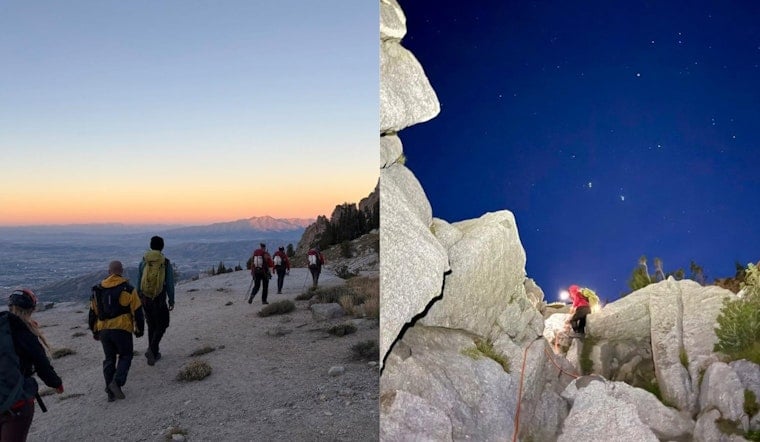
Two hikers stranded near the 11,253-foot summit of Lone Peak spent hours sheltering in a crevice between rocks to escape punishing winds before rescuers reached them, after the pair grew cold and began experiencing altitude sickness and called for help Saturday. Crews from Salt Lake County Search and Rescue worked through the night to get to them, and by Sunday, all responding personnel were off the mountain.
According to KUTV, the hikers called for help from the Lone Peak summit Saturday, and search and rescue crews were dispatched shortly after. Sustained winds prevented the Utah Department of Public Safety from attempting a helicopter hoist or shuttling rescuers into the area, forcing the mission onto foot power alone. Salt Lake County Search and Rescue moved its command post to the Peak View Trailhead in Draper to stage the operation, a shift the station's report ties to the location's road access for emergency vehicles.
A Long Climb Through Difficult Terrain
Ground crews reached the hikers, who by that point had wrapped themselves in a rock crevice to block the wind. Rescuers handed over extra layers, headlamps, food and water, and officials said good Samaritans on the mountain had already given the pair clothing, food and water of their own. A search and rescue team also set up a handline to help guide the hikers through the roughest sections of terrain on the way down, per the same account.
The route in question, known as Jacob's Ladder, is one of the most demanding day hikes in the Wasatch Front, gaining roughly 5,600 vertical feet across an 11- to 16-mile round trip over exposed granite, according to Carltonaut's Travel Tips. Acute mountain sickness can set in at altitudes as low as 8,000 feet, and the resulting hypoxia, headaches, and nausea can accelerate hypothermia risk when combined with sudden temperature drops near the summit, per the Global Summit Guide.
Getting Off the Mountain
Once the hikers were stable, search and rescue crews helped them begin the descent, and Draper Fire Department crews assisted by transporting search and rescue teams toward Jacob's Ladder before ultimately transporting the hikers themselves off the trail. The hikers arrived at the trailhead tired but otherwise in good condition, the article notes, closing out an overnight operation that stretched from Saturday's call into Sunday.
A Familiar Pattern on Lone Peak
This was not an isolated incident for the peak. Just over a week earlier, on August 29, Salt Lake County Search and Rescue used a helicopter to pull another stranded hiker off Lone Peak during a severe storm that produced more than 200 air-to-ground lightning strikes across the Wasatch Range, according to the Alpine-Highland-Lehi Tribune. Lone Peak's extreme exposure has made it a frequent site of high-elevation emergencies whenever late-summer weather shifts arrive without warning.
Helicopter hoists have not always been an option on this mountain. The Utah Department of Public Safety Aero Bureau added hoist capability to its Airbus H125 helicopters after a fatal 2015 incident on Lone Peak, when cliff terrain made landing or hover-deploying rescuers unsafe. Even with that upgrade, sustained winds still frequently prevent hoist operations at high elevations, as happened during this latest rescue.
Salt Lake County Search and Rescue is an all-volunteer, unpaid unit that handles between 100 and 140 emergency callouts a year across the county without charging those it rescues, according to a statement the team posted on Facebook. Volunteers supply their own gear, gas and food for missions that can stretch overnight, like this one on Lone Peak.
The mountain sits inside the 30,088-acre Lone Peak Wilderness, which Congress designated in 1978 under the American Wilderness Act as Utah's first federally protected wilderness area, according to background compiled by Save Our Canyons. Federal wilderness rules restrict permanent structures and motorized access in the area, which is part of why ground crews and handlines remain essential whenever aircraft are grounded by weather.




