

























































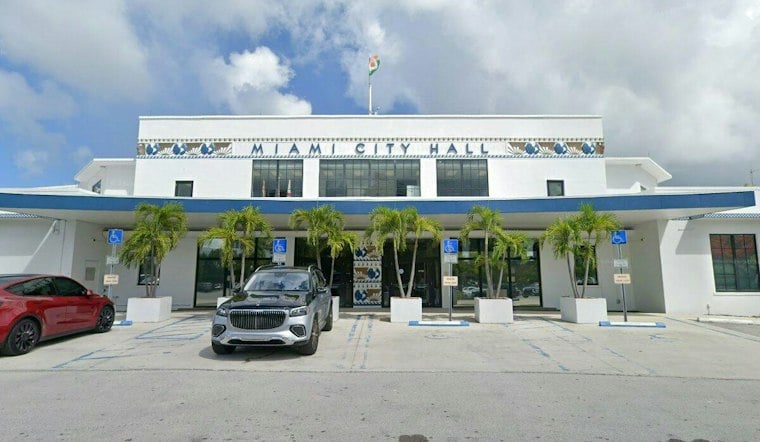
Miami has authorized legal action against Miami-Dade County over a redevelopment agency meant to funnel hundreds of millions of dollars into Allapattah, one of the city's poorest and most renter-heavy neighborhoods. The Miami City Commission voted unanimously to authorize the city attorney to pursue a lawsuit, escalating a fight that has simmered for more than two years over who controls the tax dollars flowing through the Allapattah Community Redevelopment Agency.
The commission's resolution found that the county's continued challenge significantly impairs the CRA and the city's ability to operate it, according to The Real Deal. Commissioners also authorized the city attorney to seek judicial review of the agency's creation and operation, bypassing the joint hearing that city-county disputes like this one typically trigger within 90 days.
District 1 Commissioner Miguel Angel Gabela, who has championed the Allapattah CRA since sponsoring its original creation, accused the county of trying to derail the agency after more than two years of work, per the same account. Gabela said the county was notified twice about the city's efforts and missed multiple 120-day deadlines to respond. He added that Miami remains willing to negotiate, but wants what he called a substantive discussion rather than continued delay.
Why the County Is Pushing Back
Miami-Dade County has argued that public funds could be directed toward Allapattah's growth through methods other than a CRA, according to a county letter dated September 11 cited in the same report. County officials have instead prioritized the Strategic Miami Area Rapid Transit program, a multibillion-dollar countywide mobility initiative. A Miami-Dade County spokesperson did not respond to a request for comment from the outlet.
Under Florida's Community Redevelopment Act of 1969, once a municipal CRA trust fund is established, generally 95 percent of ad valorem tax growth generated above the base year value must be allocated into that trust fund, according to guidance from the City of Tampa that mirrors the state statute. Counties meeting the statutory definition may set the contribution below 95 percent, down to 50 percent. The diversion of tax-increment revenue can affect the funds available for other county priorities. Miami-Dade's Board of County Commissioners also approves CRA budgets, and the county's interlocal agreement with Miami Gardens is one example of its involvement in redevelopment governance, per a Miami-Dade County memorandum.
A Neighborhood Built on Renters and Low Incomes
The stakes for Allapattah are steep. The district spans 1,661 acres, and the redevelopment plan behind the CRA calls for $243 million in investment over 30 years, funded through tax-increment financing on properties inside its boundaries, per The Real Deal. That plan allocates $90 million for infrastructure, $75 million for affordable housing, $45 million for economic development, and $33 million for community facilities. Gabela has said the agency is needed to address affordable housing, infrastructure, and security, pointing to homelessness and a large concentration of seniors among the neighborhood's challenges.
Planning data compiled by consultancy BusinessFlare shows why those needs run deep: Allapattah spans 4.7 square miles with roughly 45,000 residents, where the 2024 median household income was about $31,300, well below the countywide median, and about 80 percent of households are renters, according to Traded. That demographic profile has made anti-displacement measures and affordable housing the cornerstone of the neighborhood's redevelopment plan. Longer term, city records and the same BusinessFlare analysis put the CRA district's baseline taxable property valuation at $3.1 billion in 2026, with a projection of roughly $800 million in cumulative tax-increment revenue over the agency's 30-year lifespan, as reported by The Real Deal.
Seed Money and a Backup Plan
To get the agency moving while litigation plays out, the city commission approved $3.5 million in initial seed funding for the Allapattah CRA, down from an initial $8 million request. Gabela agreed to take the smaller amount upfront and may seek the remaining $4.5 million after Miami closes its fiscal year and assesses surplus funds. The seed money is expected to be repaid to the city once the CRA begins generating its own tax-increment revenue.
The city is also weighing a bigger financial cushion in case the county fight drags on. Miami officials considered establishing a separate $40 million Neighborhood Revitalization Fund for Allapattah, setting aside $8 million annually from general fund revenues across fiscal years 2026-27 through 2030-31 in a restricted account pending the lawsuit's outcome, according to Miami Today. For Allapattah, the dual-track approach addresses startup needs before tax collection under the new district begins.
Political Roots Going Back to 2025
In April 2025, Miami made a finding of necessity for the Allapattah CRA. Months before the lawsuit authorization, the Allapattah CRA's governing board approved an interlocal agreement with the city for temporary administrative support, per Citizen Portal.
Development Pressure Building on the Ground
Private capital is already reshaping Allapattah's edges regardless of how the county fight ends. The $425 million River Landing Shops & Residences project on the Miami River is among the nearby investments in the area. Allapattah's proximity to the Miami Health District, Wynwood, and Downtown Miami has only added to that pull.
Inside the CRA district, the city's largest publicly owned redevelopment target is the 18-acre General Services Administration site at 1950 NW 12th Ave. and 1970 NW 13th Ave., which currently houses municipal fleet and sanitation services. City planners have targeted the site for a possible mixed-income housing project of up to 2,500 units, and Miami officials have tried to redevelop the lot since 2019, easing procurement rules in July to restart competitive solicitations, according to Miami Today's reporting.
New residential projects have also been landing nearby: No. 17 Residences includes 192 units, The Julia Residences includes 323 units, and Fourteen Main Street Residences includes 237 units, all part of what The Real Deal describes as a growing wave of residential and mixed-use development in Allapattah. Developer Neology has also partnered with the Rubell family and Michael Simkins' Lion Development Group on a three-phase residential project near the Rubell Museum. Separately, Hoodline has reported that private developers are using Florida's Live Local Act to bypass industrial zoning altogether, including a 260-unit Ohio Allapattah proposal with 104 designated workforce units at 1368 NW 29th Street, a sign that state law is driving dense housing plans independent of the CRA fight.





