

























































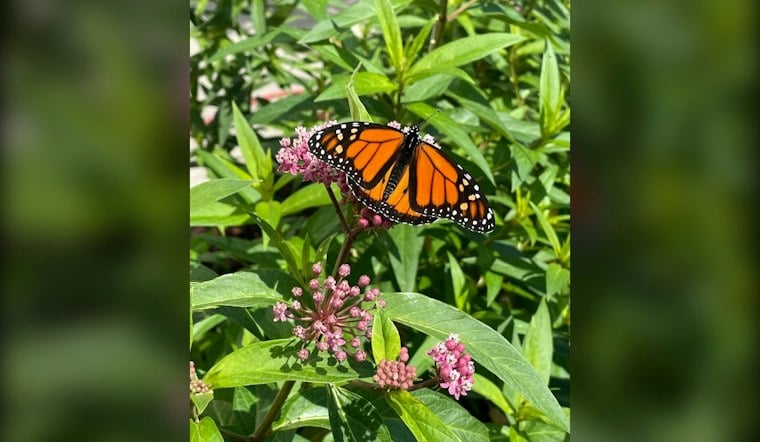
Monarch butterflies are moving through Central Illinois right now, and Edelstein has turned into a pit stop. Adult monarchs and their offspring have been spotted at the Tawny Oaks Visitors Center over the past few weeks, feeding up on prairie blooms before continuing an epic journey that will carry many of them all the way to Mexico.
The sightings come as the fall migration hits its stride across the region, according to 104.9 The Wolf, which reported that adult monarchs and their offspring have been spotted at Tawny Oaks Visitors Center the last few weeks in Edelstein. The Peoria Park District's Kristi Shoemaker says the prairies there are doing exactly what monarchs need them to do this time of year.
Tawny Oaks' prairies are providing the monarchs with milkweed, goldenrod and asters, according to the same report, and that mix matters more than it might seem. A variety of flower species needs to bloom throughout the season so the butterflies can have food for reproduction and their journey, per the report — a detail that lines up with research from the NPR Illinois archive noting that milkweed is the only plant on which female monarchs will lay their eggs.
A Multi-Generation Journey South
Not every monarch fluttering around Tawny Oaks right now is bound for Mexico this season. Some are still caterpillars or tucked inside chrysalises, and per the same report, they'll only move on to Mexico if they survive the rest of the season and a cold snap arrives to trigger that next leg. Those that do survive early fall in Central Illinois will join millions of other monarchs making the long journey to Mexico, where they winter before starting the migration to Canada all over again, the station reports.
It's a trip that can stretch up to 2,500 miles, according to the University of Illinois Extension, which also notes that monarchs in this part of the state can produce up to three generations of adults over a single summer. No single butterfly makes the entire round trip — it takes several generations to complete the migration cycle, with each new generation picking up where the last left off.
The fall journey typically begins in August, passing through the central United States in September and October, with monarchs expected to reach Mexico by late October to early November, per 104.9 The Wolf's report. Journey North notes that the whole migration is driven by environmental cues such as shortening day length and dropping temperature, which is why the butterflies' timing tends to track closely year after year.
How Central Illinois Fits the Bigger Picture
Central Illinois isn't unique in seeing monarchs pass through this month. The Farmers' Almanac pegs the approximate peak migration window for the Central U.S. and Mid-Atlantic at mid- to late September, with many eastern monarchs not settling into their wintering grounds in the mountains of central Mexico until late October and November. Farther north, NBC Chicago has reported that peak migration in that area typically falls between September 5 and September 10, with stragglers still visible into October as the migration winds down.
The steady flow of monarchs through prairies like Tawny Oaks matters beyond a single season's sightings. The migratory monarch population was added to the International Union for Conservation of Nature's Red List of threatened species on July 21, 2022, according to WCBU, which also cited a Center for Biological Diversity finding that the monarch population had dropped 85% over the prior 20 years. WCBU's reporting points to habitat loss, often driven by pesticide use that kills milkweed, along with climate change, as key factors behind that decline.
That backdrop is part of why healthy stopover habitat like the prairies at Tawny Oaks carries weight for the species' future, even as this year's travelers pass through Edelstein on their way toward a Mexican winter and, eventually, a return migration to Canada.




