

























































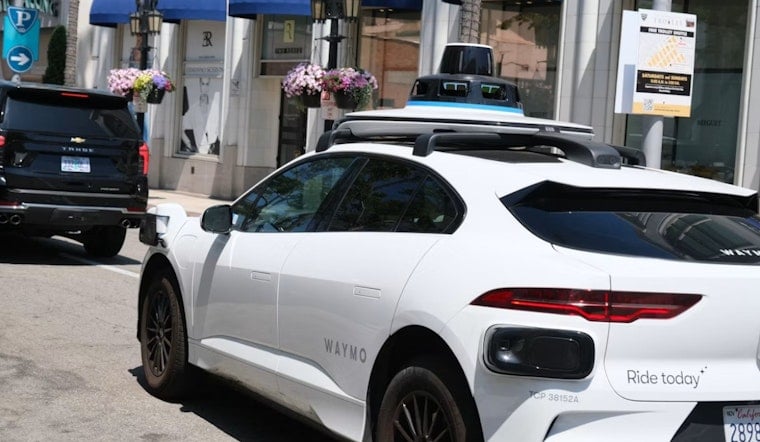
Ben Fisher was crossing Sanchez and Duncan streets with his 2-year-old daughter shortly after 9:30 a.m. last Friday when she tripped and fell in the crosswalk. As she went down, Fisher says, a Waymo robotaxi entered the intersection headed toward them, and he had to push his empty stroller into its path to make sure the vehicle would not reach his fallen child.
The self-driving car ultimately stopped about 13 feet from Fisher and his daughter, according to Fisher's account relayed to the San Francisco Chronicle, which first reported the incident. Fisher said the vehicle slowed and displayed a pedestrian yield signal from its lidar sensor after sensing both of them in the roadway, but he did not wait to find out whether it would stop in time. Waymo, for its part, told the Chronicle that the vehicle had already come to a stop before Fisher pushed the stroller in front of it, and the company denied that his daughter could have been struck.
“My child could have very easily been killed,” Fisher said, describing the moment his daughter fell and the robotaxi kept approaching. He said the vehicle had paused at a stop sign before climbing west up the hill toward the intersection where his daughter had fallen. His young daughter, for her part, reacted to the whole ordeal by declaring, “Bad rainbow!”
A Father's Paper Trail of Complaints
After the encounter, Fisher and his wife filed an incident report directly with Waymo and lodged a complaint through San Francisco's 311 system. Fisher also filed a police report and flagged the episode to the offices of both Mayor Daniel Lurie and Supervisor Rafael Mandelman, according to the Chronicle's reporting. He argued that state law is unambiguous on the matter: drivers, including autonomous ones, are required to yield to pedestrians in a crosswalk.
That legal standard is codified in California Vehicle Code Section 21950, which requires drivers to yield the right-of-way to pedestrians crossing within a marked or unmarked crosswalk at an intersection, according to Justia. The same statute also notes that pedestrians cannot abruptly step off a curb into traffic when a vehicle is too close to stop safely — a nuance that has fueled dueling narratives over exactly what happened on Sanchez Street.
Waymo maintains that its vehicle operated safely throughout the encounter and that the company works to communicate the vehicle's intent to nearby road users. The company did not confirm to the Chronicle whether it had received a separate incident report that a Waymo passenger says was submitted after the episode, per Fisher's account.
A Slow Street Built for Foot Traffic
The crosswalk where the fall happened sits on Sanchez Street, a corridor the San Francisco County Transportation Authority designated a permanent Slow Street to suppress vehicle traffic and prioritize pedestrians and cyclists. The stretch averages more than 1,000 pedestrian walks on a typical weekend day, according to the agency's October 2023 planning documents, making it one of the more heavily foot-trafficked residential streets in Noe Valley.
The incident lands amid a broader pattern of friction between San Franciscans and the growing robotaxi fleet on their streets. Some residents have taken to placing traffic cones in front of Waymo vehicles to immobilize them, a form of protest that has become something of a local ritual as the company's footprint has expanded. Separately, a Waymo vehicle ran over a cat in the Mission District last year, an incident that added to a running tally of local complaints about the company's road behavior.
Safety Data Versus Street-Level Anxiety
Waymo's own defenders point to a wide body of safety data. A July study by the Insurance Institute for Highway Safety found that Waymo vehicles were involved in 68% fewer police-reportable crashes per mile than human drivers across four cities, with a 35% lower crash rate specifically in San Francisco. The study drew on crash data collected in San Francisco, Phoenix, Los Angeles and Austin between 2021 and 2024. Waymo has separately reported that its driverless system was involved in 93% fewer injury-causing pedestrian crashes than human-driver benchmarks, based on more than 220 million fully autonomous miles tracked through June 2026.
But the numbers have not settled public unease, particularly when children are involved. In January, the National Highway Traffic Safety Administration opened a preliminary investigation after a Waymo vehicle made contact with a child near a Santa Monica elementary school after the child ran into the street from behind a double-parked SUV; Waymo reported that the vehicle hard-braked from 17 mph to under 6 mph before contact, resulting in minor injuries. NHTSA also expanded a separate investigation in December 2025 after school districts in Austin and Atlanta documented cases of Waymo vehicles failing to stop for school buses with extended stop arms, including 20 citations against the company during the fall 2025 semester in Austin alone, as reported by CBS News.
When Yielding Itself Causes Trouble
Waymo's pedestrian-yielding behavior has produced unintended consequences elsewhere, too. Last Thursday, an unoccupied Waymo robotaxi in Denver stopped completely at an intersection to yield to a pedestrian waiting at a curb cut, which triggered a chain-reaction rear-end collision among the human drivers behind it, according to Westword. Police cited the trailing human driver for following too closely; Colorado law requires drivers to yield to pedestrians at all intersections, marked or not. Hoodline previously covered the Denver pileup in detail.
The scrutiny in San Francisco carries extra weight given regulatory history. In October 2023, the California DMV suspended rival robotaxi operator Cruise's driverless permits in the city after one of its vehicles struck, dragged and severely injured a pedestrian who had been knocked into its path by a human-driven car, an incident detailed by SFGATE that also involved Cruise initially withholding onboard camera footage. That episode remains a reference point for how seriously local officials, including Lurie and Mandelman, tend to treat pedestrian complaints involving autonomous vehicles.
Expansion Continues Despite Local Pushback
None of this has slowed Waymo's growth in California. On August 14, state regulators approved the company to expand driverless commercial ride-hailing across 18 California counties, growing its legal service territory from 5,843 square miles to 47,493 square miles, a rollout Hoodline detailed in its statewide robotaxi expansion coverage. The approval required sign-off from both the California Public Utilities Commission and the California Department of Motor Vehicles.
Fisher's account, as told to reporter Rachel Swan — who covers transportation and enterprise stories for the Chronicle and is raising two daughters of her own in El Cerrito — adds to a growing list of close calls that have shadowed the company's expansion even as its safety statistics improve on paper. Whether the Sanchez Street encounter reflects a system working as designed or a near-miss that got too close for comfort remains a matter of dispute between Fisher and Waymo, with no independent resolution of the timeline offered by either side.





