

























































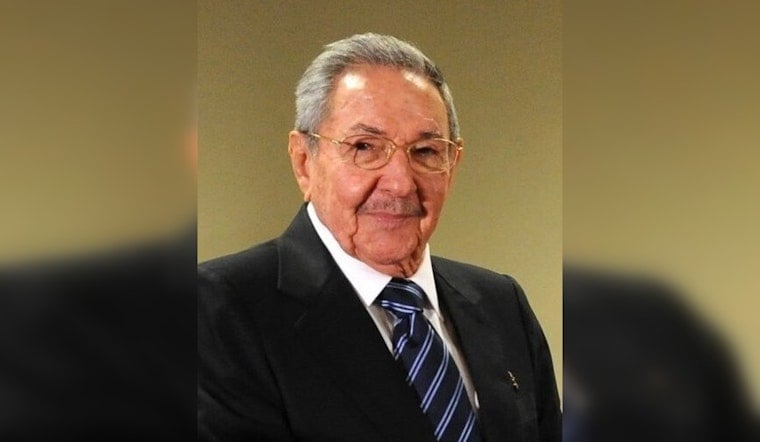
Raúl Castro, the 95-year-old former Cuban leader, is reportedly gravely ill and hospitalized after an apparent stroke, according to reports that have set off a wave of emotional reaction across South Florida's Cuban exile community. The Cuban government has not publicly confirmed the illness, and state-run Cuban television made no mention of Castro's health on its nightly newscast or on the program Mesa Redonda as of Tuesday.
Diario Las Américas reported that Castro was seriously ill, citing a confidential source inside Cuba, according to CBS News Miami. Ileana Lavastida, executive director of the outlet, said the newspaper received the report from what she described as a highly reliable confidential source inside Cuba with access to Castro's inner circle. Lavastida said Castro had apparently suffered a stroke and had been intubated, though she also said Castro was not dead but was seriously ill.
Reports of contacts between Raúl Guillermo Rodríguez Castro, a relative of the former leader, and the Trump administration have also surfaced, with the two sides reportedly discussing a possible economic and political opening in Cuba. Those discussions are currently stalled, according to the same report.
Exiles Voice Decades of Anger
For many in Miami's Cuban exile community, the news landed with a force shaped by decades of grievance. Hector Gonzalez said Castro took everything from his parents and put his father in jail, adding bluntly, “I wish he was dead.”
Fidel Vasquez said Raúl Castro and his brother Fidel Castro caused enormous suffering in Cuba, and Vasquez said he believes millions of Cubans were harmed and many died because of the Castro government. Not everyone framed Castro's possible death as consequential for Cuba's future, however. Griska Mena said Castro's death would not alter Cuba's political system, though she said it would carry enormous symbolic and emotional significance.
Miami-Dade County is home to more than 1.2 million Cuban Americans, representing over half of the nationwide Cuban immigrant population, according to U.S. Census Bureau figures — a concentration that helps explain why developments involving Cuba's leadership generate such immediate, widespread local interest. When Fidel Castro died in 2016, Cuban exiles gathered to celebrate at Versailles restaurant in Little Havana, an iconic gathering place for the community that would likely see a similar reaction if Raúl Castro's illness proves fatal.
A Legal Reckoning Predates the Reported Stroke
The reports of Castro's failing health arrive just months after the U.S. Department of Justice unsealed a superseding federal indictment charging Castro and five co-defendants with murder and conspiracy to kill U.S. nationals over the 1996 shoot-down of two Brothers to the Rescue aircraft, according to the U.S. Department of Justice. The indictment alleges Castro authorized the military chain of command that launched air-to-air missiles against two unarmed Cessna aircraft over international waters. The announcement was made in connection with events tied to Miami's Freedom Tower, and it left Castro facing the uncertain prospect of one day appearing in a U.S. courtroom.
That federal case was reactivated after Florida Attorney General James Uthmeier announced in March that state prosecutors had reopened a previously closed criminal case file against Castro, leading to a joint prosecution effort with the U.S. Attorney's Office for the Southern District of Florida, per the Office of the Florida Attorney General. State prosecutors alleged that Cuban operatives had violated Florida's sovereignty. Cuban fighter jets killed four people in the 1996 shoot-down over international waters — Carlos Costa, Armando Alejandre Jr., Mario de la Peña, and Pablo Morales, three of whom were U.S. citizens and one a permanent resident, as reported by the Associated Press. Brothers to the Rescue was a Miami-based humanitarian organization that flew missions over the Florida Straits searching for Cuban refugees stranded at sea.
A federal court in Miami awarded $187.6 million in civil damages against the Republic of Cuba and the Cuban Air Force in 1997 to the families of three of the shoot-down victims, in a landmark case handled by the law firm Podhurst Orseck. Declassified Federal Aviation Administration records published in May showed U.S. officials had warned as early as January 1996 of a worst-case scenario in which Cuban military forces would shoot down exile aircraft following repeated airspace incursions, according to the National Security Archive. Senior U.S. District Judge James Lawrence King, who presided over key civil litigation tied to the shoot-down and authored more than 1,000 judicial decisions across a legal career spanning five decades, died in Pinecrest at 98 earlier this year.
Timeline of a Long Political Life
Raúl Castro succeeded his brother Fidel as Cuba's president in 2008 and led the country until 2018, remaining an influential figure even after formally relinquishing his position as head of Cuba's Communist Party in 2021. He was diagnosed with colon cancer in 2021. Miguel Díaz-Canel, Castro's handpicked successor, assumed the presidency in 2018 and became First Secretary of the Communist Party in April 2021, formally ending six decades of executive leadership by the Castro family.
Castro was last seen publicly in Havana on August 13, during events commemorating what would have been his late brother's 100th birthday. That appearance came before the reports of his hospitalization emerged this week.
Cuba's economic crisis and fuel shortages under the current administration have contributed to an unprecedented emigration wave, with roughly one million people — nearly 10 percent of the island's population — leaving between 2022 and 2026, according to Planet Rulers. That backdrop leaves open a central question hanging over South Florida's exile community: whether Castro's eventual death would trigger real political change in Havana, or serve mainly as a symbolic close to the revolutionary era while Díaz-Canel's government continues managing the island's economic collapse and exodus.




(2).jpg)