

























































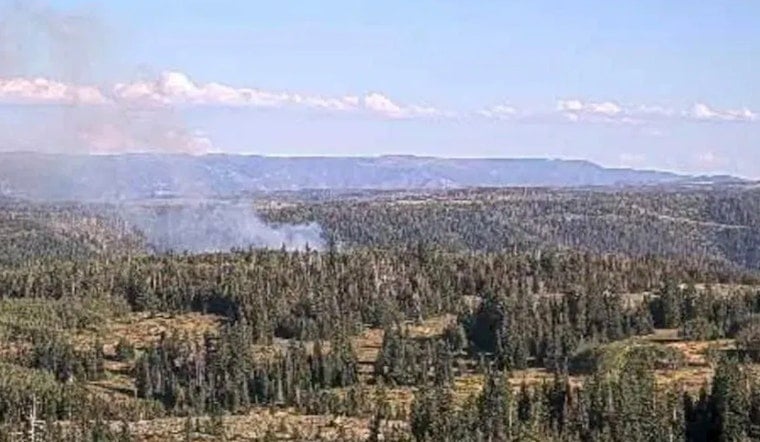
A wildfire is tearing through aspen and mixed-conifer forest in a remote stretch of Carbon County's Book Cliffs, growing to an estimated 10 to 15 acres as wind gusts push flames deeper into the rugged terrain southeast of Bruin Point. The blaze, known as the Range Valley Fire, was detected in the Range Creek area, and crews have scrambled aircraft and ground units to try to keep it from spreading further into the isolated backcountry.
According to KJZZ, the fire's estimated size comes from Utah Fire Info, and the flames have been making wind-driven runs through the area's aspen and mixed-conifer vegetation. One engine and one helicopter have been working to suppress the fire, and fire managers have since ordered an air attack platform, an additional helicopter, and single-engine air tankers to reinforce the response. Reporter Jonathan May notes that smoke from the fire may be visible from Highway 191 between Green River and Price, a roughly 55-mile stretch of high desert corridor that doubles as a key regional travel route, according to First Choice Inn at the Swell.
Rugged Terrain Forces Reliance on Aircraft
The location of the fire helps explain why so much of the response is happening from the air rather than the ground. Bruin Point itself climbs to 10,184 feet, with terrain that shifts from sagebrush at lower elevations to dense aspen, Douglas fir, and mixed-conifer forest closer to the summit, per WillhiteWeb. Nearby Range Valley Mountain sits on a high, gently rolling plateau elevated more than 2,200 vertical feet above the Range Creek Valley floor, with cliff approaches and limited road access spread across roughly 50,000 acres, according to Swan Land Co. That kind of terrain leaves fire engines with few ways in, which is why single-engine air tankers and helitack crews have become the primary initial-attack tools for the Bureau of Land Management and the Utah Division of Forestry, Fire and State Lands in backcountry fires like this one, per updated federal and state wildland fire guidelines shared by the Bureau of Land Management this month.
Cultural Stakes in Range Creek Canyon
The fire's location near Range Creek Canyon raises the stakes beyond the immediate flames. The canyon, southeast of Price, holds thousands of 1,000-year-old Fremont culture archaeological sites — including granaries, rock art, pit dwellings, and burial grounds — managed in part by the University of Utah and the Natural History Museum of Utah, according to the Salt Lake Tribune. The area's cultural sensitivity isn't hypothetical: in 2012, state fire officials determined that the Lighthouse Fire, which burned more than 800 acres in Range Creek Canyon, ignited when a refrigerator-sized boulder fell and struck another rock face, generating enough friction heat to spark dry brush, as reported by KSL. That blaze required extensive aerial drops to keep it away from ancient rock art.
Part of a Busy Fire Season in the Book Cliffs
The Range Valley Fire is the latest in a string of remote wildfires to hit the Book Cliffs region in recent seasons. Last month, wildland firefighters and smokejumpers were sent to extinguish the Zane Fire near Monument Ridge Road, and in July 2026, crews contained the 7.7-acre Arroyo Fire in Grand County using helitack and engine units to protect nearby oil and gas infrastructure, according to the Times-Independent. A year earlier, the lightning-ignited Diamond Canyon Fire burned 114 acres near Cisco before smokejumpers and targeted retardant drops boxed in its perimeter. Steep terrain across the region routinely forces fire managers to lean on aerial retardant rather than heavy ground machinery, a pattern this latest fire appears to be following.
Human-caused ignitions have also been a persistent concern in Utah's wildfire seasons. During the 2020 season, Utah Fire Info reported that more than 700 wildfires statewide were sparked by human activity, prompting state wildlife officials to temporarily close multiple Wildlife Management Areas to recreational target shooting because of elevated fire danger, per ETV News. It remains unclear what sparked the Range Valley Fire. For now, crews are focused on containing the wind-driven blaze before it can spread further into the canyon's steep drainages, with motorists along the Highway 191 corridor advised that smoke may reduce visibility in the area, according to KUTV.





