

























































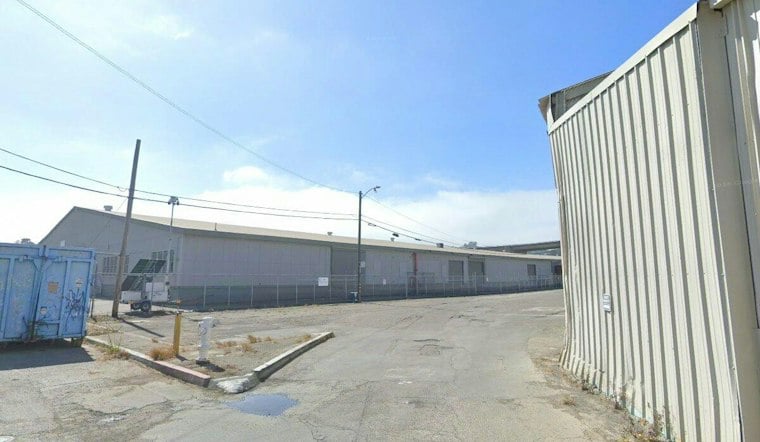
Long before most San Franciscans wake up, trucks are already rolling into a 23-acre campus in Bayview-Hunters Point, unloading produce that will end up on plates across the Bay Area by lunchtime. SF Market, the wholesale hub that has quietly fed the region's restaurants, grocers and corner stores for generations, is now moving toward its first new building in more than a decade.
A project application for a new campus building at 1900 Kirkwood Avenue was filed back in February 2023, according to sfyimby.com, which reported that the plan would create 67,220 square feet of space on a 72,000-square-foot parcel. Plant Construction, the local firm identified for the build, describes the same project on its own site as a new 67,000-square-foot, single-story warehouse and distribution center — a modest discrepancy in the publicly available figures that hasn't been reconciled. As reported by The San Francisco Standard, the market says its current complex is no longer large enough for its operations, which is why the proposed facility also includes an operations center, food recovery center, office and market space, and room for future tenants, per sfyimby.com's reporting on the filed plans. The site plan calls for 36 freight-loading spaces, eight bicycle spaces and a single automobile space.
A Market Older Than the City's Modern Skyline
SF Market traces its roots to the 1870s, according to thesfmarket.org, and it has occupied the same Bayview-Hunters Point footprint since 1963, per sfyimby.com's account of the site's history. The Standard reports that the market has operated on the city-owned land for 63 years, with San Francisco leasing the property to the nonprofit market for free. Nearly two dozen independent merchants work out of the campus, thesfmarket.org notes, supplying restaurants, grocers, caterers, hotels and other food-related businesses with fresh produce — a role the Standard describes as supplying thousands of restaurants, grocers and corner stores around the Bay Area, sourced from more than 350 regional farmers.
The rhythm of the place runs opposite most of the city's workday. Truckloads of produce arrive in the Bayview around 11 p.m. six nights a week, according to the Standard's reporting, with wholesale customers welcomed in by 3 a.m. to buy goods in bulk. One longtime tenant, Stanley Produce, was founded in 1941 and specializes in mushrooms, endive and radicchio, per the same account.
Space Pressures Have Built for Years
The push to expand isn't new. SF Market's own materials describe an ongoing reinvestment effort focused on roads, buildings and systems — securing the marshalling yard, improving or replacing original warehouses and expanding facilities, according to thesfmarket.org.
That reinvestment push has deep roots. In 2013, the San Francisco Board of Supervisors and then-Mayor Ed Lee renewed the market's lease for 60 years and approved plans for new facilities, thesfmarket.org notes. The market previously added a 55,000-square-foot warehouse at 2101 Jerrold Avenue in 2000 and an 82,000-square-foot, LEED Gold-certified warehouse at 901 Rankin Street by 2015 — but the Standard reports the market hasn't opened a new building since then, more than a decade ago.
Leadership Frames Expansion as Food Security
Michael Janis, executive director of the nonprofit SF Market, told the Standard the market is part of San Francisco's resilient fabric and said it needs to remain able to supply critical food infrastructure into the future. Janis also said the market is seeking complementary uses of the space that could create new revenue streams, and the Standard reports he is organizing conversations with real estate firms and philanthropists about future uses for the campus. He told the paper he hopes to eventually create a market that operates around the clock.
Under the current arrangement reported by the Standard, SF Market must reinvest any proceeds back into its own operations rather than distribute them elsewhere. The Standard's reporting states that the Board of Supervisors approved reinvestment plans and amendments to the market's lease, and that the market is working to secure financing for the project through a combination of profits, government funding and low-interest loans, with the Standard citing a $5 million state grant toward the effort. The market is expected to work with Plant Construction on the build, according to the Standard, and Janis reportedly expects construction to begin in the first half of 2027 and take about 15 months to complete, with plans to demolish an outdated, mostly vacant property on the site beforehand.
Food Recovery Remains Central to the Mission
Beyond moving produce for paying customers, the market runs a food recovery operation that has become a point of civic pride. The San Francisco Environment Department announced on October 24, 2025, that the program had recovered and donated 10 million pounds of fresh produce, working with 15 community-based partner organizations that distribute food across San Francisco and the greater Bay Area. The program recovers more than 4,000 pounds of fresh fruits and vegetables daily, the department says, donating them to nonprofits that get food to people in need. SF Market's own materials put its current footprint at more than 485,000 square feet of food-focused warehouse and logistics space, supporting more than 500 jobs among its merchants — numbers that underscore why the Bayview campus, even at 23 acres, has started to feel tight.





