

























































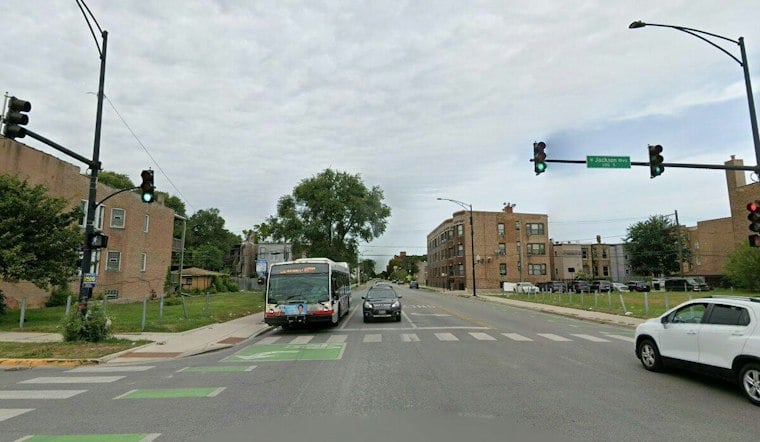
A CTA bus driver who was punched in the face, neck, ribs and stomach by a passenger on her route last year says the transit agency fired her while she was still recovering, denying her request for workplace accommodations months after the attack. Paige McCulloch-Burton, who became a CTA bus operator in February 2025, says she took pride in the job, following in the footsteps of her grandfather, who also worked as a CTA bus operator.
The attack happened on May 24, 2025, as McCulloch-Burton drove route 82 south on Homan Avenue toward Jackson Boulevard, according to WTTW News. She saw a man in a ski mask waiting to board, and because CTA policy requires operators not to pass up customers, she let him on. The man punched her repeatedly before fleeing, per the outlet's reporting. A passenger flagged down passing Chicago police officers, and McCulloch-Burton was taken by ambulance to Mount Sinai Hospital for treatment after notifying CTA control once she had secured the bus.
Broken Cameras Stalled the Police Investigation
When CTA returned the bus to an agency garage, records show the transit agency had failed to maintain its onboard security system. Emails cited in the WTTW report show CTA security services told a detective that the surveillance camera's hard drive was defective, and the detective closed the assault investigation after being told no video existed for the date and time of the attack. McCulloch-Burton said CTA was not following its own policies and procedures for bus checks, and the agency did not respond to a question about why the defective system was never flagged beforehand.
About a month after the attack, McCulloch-Burton began receiving workers' compensation payments. She said her injuries left her with chronic pain and post-traumatic stress disorder. In December 2025 she filed a reasonable accommodation request with CTA, but the agency did not respond for roughly six months, finally denying the request in June 2026 on the grounds that she was no longer a CTA employee. By her account, CTA had already terminated her in March 2026 — she said she learned of her firing only when a COBRA packet arrived in the mail. McCulloch-Burton said she had no demerits and had never been late to work.
Union Says Safety Concerns Go Unheard
McCulloch-Burton filed a grievance after contacting the union representing CTA bus operators, but she said nothing has come of it. She also said another operator on the same route was assaulted earlier the same day and that CTA never warned staff about it; the agency did not respond to a specific request for comment on that accusation. “CTA should stand by its employees and customers,” she said, adding that she hopes speaking out will improve conditions for other operators, even though she said CTA pushed her out after failing to properly accommodate and care for her following the attack.
Keith Hill, president of ATU Local 241, said CTA employee safety concerns are not adequately taken into account. The union's frustration has spilled into public view before: in March 2026, bus operators and mechanics protested a revamped CTA security plan outside CTA headquarters during a board meeting, and in that same month, WTTW News reported that ATU Local 241 members gathered with bullhorns and sirens outside CTA headquarters demanding physical driver barriers and better safety protocols. Nora Leerhsen, CTA's acting president, has called worker protection an incredibly important issue, telling the board that the agency has touted a decrease in crime across its system after rolling out new joint Chicago police and Cook County sheriff's police missions on buses, trains, at stations and at stops. CTA did not respond to detailed requests for comment on McCulloch-Burton's case or the agency's response to it.
A System Under Federal and Statistical Pressure
The dispute over McCulloch-Burton's firing comes as CTA faces mounting scrutiny over worker safety broadly. Chicago police recorded 469 aggravated assaults and batteries on the CTA system in 2025, a 24-year high following annual increases every year since 2021, according to a Chicago Sun-Times analysis reported by Hoodline. A March 2026 Chicago Tribune analysis found that CTA worker assault rates were two to six times those at peer agencies, per the Pantagraph.
That backdrop has drawn federal intervention. In 2024, the FTA issued General Directive 24-1 concerning actions to address assaults on transit workers. Then, in December 2025, the FTA issued a Special Directive ordering CTA specifically to implement a plan to measurably reduce worker and rider assaults or risk losing federal transit funding, according to Metro Magazine, which noted the directive followed a high-profile attack on a Blue Line passenger by a repeat offender. By July 2026, the FTA had published a mitigation fact sheet identifying physical operator barriers, de-escalation training, updated policies and targeted patrols as the four primary strategies transit agencies use to reduce worker assaults, per Passenger Transport.
CTA leadership has pointed to its own numbers as evidence of progress. CTA has reported a 19% decrease in crime through February, while its leaders have highlighted joint security details with police and sheriff's deputies, according to WTTW News. Even so, violence against CTA workers has continued to make headlines: CTA janitor Julian Mobley was fatally stabbed at the Damen Green Line station on Oct. 8, 2026, as Hoodline reported.
Statutory Protections and Open Legal Questions
Illinois employment law bars retaliation tied to workers' compensation claims: in Kelsay v. Motorola, Inc. (1978), the Illinois Supreme Court held that firing an employee for exercising rights under the state's Workers' Compensation Act constitutes retaliatory discharge, a civil tort violating public policy, according to the UIC Law Open Access Repository. Whether that precedent applies to McCulloch-Burton's termination has not been addressed by CTA, which has not responded to detailed requests for comment about her case.





