

























































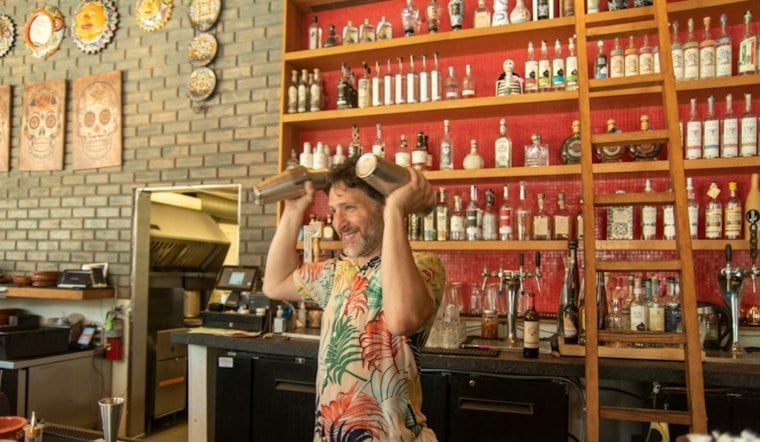
A new cocktail bar blending Arab and Japanese flavors is set to pour its first drinks in San Francisco's Mission District next week, taking over the old Nihon Whisky Lounge space at 1779 Folsom Street. Yabani, whose name means Japanese in Arabic, will open for Friday and Saturday service running 6 p.m. to 1 a.m. before building toward a fuller debut in the new year.
The bar comes from owner Khaled Dajani, who is Palestinian and also behind Bar 821, Tsunami Sushi, and the former Nihon tenant that long occupied the Folsom Street address, according to Eater San Francisco. Yabani occupies that same former Nihon Whisky Lounge footprint, a Mission fixture whose closure was reflected on the business's Yelp listing by October. Leading the drink program is beverage director Mohammed Zagha, who is half-Jordanian and says the goal is to bring an Arab bar to San Francisco while holding onto some of Nihon's character, per the same report.
Yabani’s customizable-drink format also extends an approach Dajani has used at Bar 821 on Divisadero Street. When that bar reopened in 2024 after a four-year closure, it offered more than 200 kinds of amaro and a bespoke cocktail program in which customers chose a spirit and flavor profile for bartenders to build around. Bar 821’s earlier menu suggests the made-to-order approach is already part of Dajani’s bar business, rather than a one-off feature at Yabani.
Customizable Flavors Meet Old-School Technique
Yabani's signature move is letting drinkers build their own cocktails almost from scratch. Guests can pair nearly any flavor mix with the spirit of their choice, or skip alcohol entirely with the bar's alcohol-free highball flavors on tap, Eater reports. Highballs themselves come in vodka, shochu, arak, or whiskey, with flavor profiles spanning floral, fruity, herbaceous, sour, nutty, and umami.
Yabani’s alcohol-free highballs arrive as nonalcoholic drinks gain a larger foothold in the U.S. beverage market. NielsenIQ reported that nonalcoholic beer, wine and spirits generated $925 million in off-premise sales, up 22% year over year, and projected the alcohol-free category would exceed $1 billion by the end of 2025. The company’s market analysis points to flavor-focused products as part of that growth.
The highball format has its own Japanese history: whisky mixed with soda became a popular everyday way to drink whisky, and a renewed highball boom around 2009 helped revive interest in the spirit among younger drinkers. Japan’s National Tax Agency’s whisky history traces that shift. Yabani’s versions broaden the familiar template beyond whisky and soda, using spirits such as shochu and arak alongside house-made flavors.
The floral option pairs damask rose hydrosol with toasted kombu, while the fruity mix combines watermelon, yuzu kosho, and vanilla, sharpened with malic acid to boost the watermelon. The sour profile leans on sumac and umeboshi, and the nitro-style nutty and umami drinks get more elaborate treatment: tahini, neroli hydrosol, and pistachio foam in one; tomato, mugicha, thyme hydrosol, and soy sauce in the other. Zagha also created a mineral CO2 blend and adds minerals and acids directly to kegs, a technical touch the outlet notes behind the bar's build.
Named Cocktails Lean Into the Crossover
Beyond the build-your-own system, Yabani has a roster of named drinks that fuse Arab and Japanese bar staples outright. The Hinajiku is a margarita-style pour made with arak, sake, spearmint, lemongrass, cardamom syrup, and shichimi togarashi salt, while the Habibioni reworks a negroni with mezcal, shochu, house date aperitivo, date puree, Granada-Vallet, and yuzu vermouth.
The Luisa O.F. takes the old fashioned format and swaps in Japanese whisky, sugar, banana-bergamot bitters, and tea ice, and the Bakanana turns the michelada on its head with sake, arak, house michelada mix, Japanese lager, and Barkume chamoy. There's also a simpler arak and water pour finished with cucumber and lemon peel, according to Eater's reporting.
Food and Décor Still Taking Shape
Food service isn't part of the initial launch but is expected to follow once the bar settles in, likely around February, per the outlet's reporting. Zagha plans to work with the chef at Tsunami Sushi on an Arab-Japanese themed menu that could include grilled cheese with halloumi and white miso, plus a Japanese hot dog finished with wasabi mayo and za'atar. Sake bottle service is also expected to arrive alongside the food rollout.
The room itself carries personal history. Zagha acquired about 50 movie posters from a defunct cinema during a 2019 trip to Jordan, and they're now collaged across a lounge wall alongside a mural and a peace sign. Zagha has said the mural expresses community, liberty, and togetherness, and DJs will round out the lounge atmosphere on weekend nights.
Yabani launches Friday, November 6, with weekend-only hours before expanding to a fuller grand opening in January 2027. The Dajani name has deep roots in the neighborhood's dining scene, tracing back to a Tsunami offshoot the Dajani Group debuted in Mission Bay in 2009, and to Nihon Whisky Lounge, which in its earlier years built a reputation as one of the city's notable spirit-focused bars.





