

























































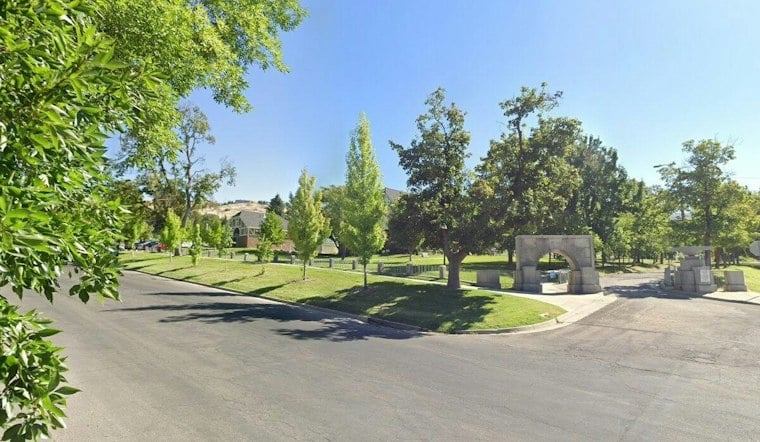
A Salt Lake City cemetery gravedigger accused of looting graves across the city was rowed out to a remote island in the Great Salt Lake in 1862 and simply disappeared, leaving behind one of Utah's oldest unsolved mysteries. Jean Baptiste, the gravedigger and local resident entrusted with burying the city's dead, was instead found to have been robbing them, and to this day no one knows what became of him after his exile to Fremont Island.
The scandal broke after Moroni Clawson was buried at the Salt Lake City Cemetery in 1862, according to ABC4 Utah. Salt Lake City police officer Henry Heath had paid for Clawson's burial clothes out of his own pocket after no one came forward to arrange a proper burial, but when Clawson's family later requested that his remains be exhumed and moved to a family plot, his coffin was opened to identify him and investigators discovered his grave had been robbed, his body stripped bare of everything he had been buried with.
A House Full Of The Dead's Belongings
Heath launched an investigation into the cemetery robberies, a probe that led straight to Baptiste's own home. What officers found there was staggering: boxes crammed with burial robes, men's suits, women's dresses, children's bonnets and shoes, all according to the same ABC4 Utah account. The Deseret News reported that investigators tallied roughly 60 pairs of children's shoes alone, along with about a dozen pairs of men's shoes, garments, and numerous items of women's apparel stuffed inside box after box.
The scale of what Baptiste had allegedly done became a matter of dispute almost immediately. An 1893 report from the Salt Lake Herald, cited by ABC4 Utah, said Baptiste confessed to robbing coffins after burials, taking everything but the bodies themselves. Utah Stories has reported that Baptiste confessed to a dozen grave robberies, while the Deseret News noted that officers at the time estimated he had robbed about 300 graves. The stolen personal effects pulled from his home were put on display at a local courthouse, cementing the case as a citywide scandal.
Jail, Then Banishment Instead Of The Gallows
Fearing what an outraged public might do to Baptiste, officials kept him held in the county jail for a time in the farthest recesses of the building to keep him safe, per the Deseret News. Utah leaders ultimately chose exile over execution. Brigham Young reportedly said that hanging Baptiste would not satisfy his feelings, and that he would instead make him, in Young's words, “a fugitive and a vagabond upon the Earth,” according to the Deseret News.
That sentence sent Baptiste out onto the Great Salt Lake itself. He was banished to Fremont Island, a remote stretch of land near Antelope Island used mainly for cattle ranching at the time. The Deseret News reported he was first taken to Antelope Island, then rowed roughly five miles north to Fremont Island, then known as Miller's Island, where a small shack and provisions, including a well of fresh water, awaited him.
A Deserted Shack And A Vanished Man
What happened next remains the heart of the mystery. The Deseret News reported that ranchers returned to Fremont Island three weeks after Baptiste's arrival only to find him gone, with the shack partially torn apart, its roof and sides dismantled. Utah Stories, however, placed that discovery six weeks after his exile, when shepherd brothers visited the island and found him missing. Some have speculated that Baptiste used the shack's wood to build a raft and escape, though no evidence confirms that theory, and as ABC4 Utah put it, there is to this day no official confirmation of what happened to the gravedigger turned robber.
Later accounts only deepened the strangeness surrounding the case. Some reports claimed Baptiste had been branded on the forehead with words before his exile, while other accounts suggested his ears were cropped, though these details are attributed to secondhand reporting and remain unconfirmed. Decades afterward, the Deseret News reported that around 1890, duck hunters near the mouth of the Jordan River found a human skull protruding from the mud, and ABC4 Utah noted additional reports describing other remains, including a leg bone attached to a ball and chain, though how accurate those reports are remains unclear.
The Cemetery's Lasting Place In Salt Lake History
The Salt Lake City Cemetery where Clawson was buried and where Baptiste once dug graves is recognized as Utah's oldest cemetery. Melissa Nelson, an instructor who teaches about the cemetery's history, said people still visit today for its peaceful atmosphere and to feel close to loved ones who are buried there. The case has not stayed buried in dusty archives alone, either; the Baptiste story was adapted into the film Redemption, filmed mostly on Antelope Island and shown in Utah theaters in April 2012, according to The Salt Lake Tribune.
Fremont Island itself has occasionally offered a strange echo of that era. A blog tracking Great Salt Lake conditions, Mystery of Utah History, noted that the island's sandbar was walkable in September 2008 when lake levels sat at 4,194.1 feet above sea level, a condition it says has occurred only 14 times in the past 167 years. More than a century and a half after Jean Baptiste vanished from that same shoreline, his fate remains exactly where the record leaves it: unresolved.





