

























































A San Leandro hot-sauce company is staking a very specific claim: not the hottest bottle in every contest, but the hottest sauce made without pepper extract. Dylan and Becky Keenen, who own Heat Hot Sauce Shop, say Mount Diablo, built around 7 Pot Primo chile, landed at 153,000 Scoville heat units after third-party testing.
The figure comes from Southwest Bio-Labs in Las Cruces, New Mexico, which SFGATE reports confirmed the rating after running the finished sauce twice. Keenen sent the final product there in October. The shop sells it as Mount Diablo 7-Pot Primo Hot Sauce.
A Number, Then a Second Look
The climb to 153,000 was not one dramatic reading. The first batch measured 109,000 Scoville heat units. The Keenens raised the pepper content while keeping the sauce pourable, and a later measurement hit 145,000 before final testing. Their co-packer tested a batch after that 145,000 mark. Southwest Bio-Labs, SFGATE reports, initially suspected a mistake and ran the sample again.
On its method page, the lab says it measures capsaicinoid concentration with high-performance liquid chromatography and follows ASTA Method 21.3 for the pungency of capsicums and their oleoresins. It also runs quality-control samples and duplicates of every sample "to minimize bias," then emails the customer a PDF of the report. In that setup, a Scoville figure is a lab count of those compounds, not a dare.
Three Contests, Not One Crown
The awkward neighbor to 153,000 is every bottle still advertising heat in the millions. Keenen told SFGATE that those claims often refer to a dried-pepper rating rather than the sauce in the bottle, or amount to a guess. Heat draws the line on its own site: "sauce with no extract at all, sauce with extract added, and pure extract are three different contests."
The shop also writes that "a sauce made only from peppers can never be hotter than the peppers in it," which is why, it says, "we had Mount Diablo tested as sold." SFGATE reports that the 7 Pot Primo powder averages 1 million Scoville heat units in dry form. Pepper breeder Troy Primeaux has put the pepper itself around 1.5 million, according to Pepper Geek. Vinegar, water, sea salt and avocado oil, the other ingredients SFGATE lists in the bottle, do not add heat. They dilute it.
Guinness World Records is playing a different game. Its hottest-chilli record "is based on the heat of a single chilli pepper grown," not a sauce. Pepper Geek describes the 7 Pot Primo and the Carolina Reaper as almost identical-looking varieties, both extremely hot. A comparable pepper is not a certificate for a bottle.
From a Berkeley Shelf to a Warehouse Bottle
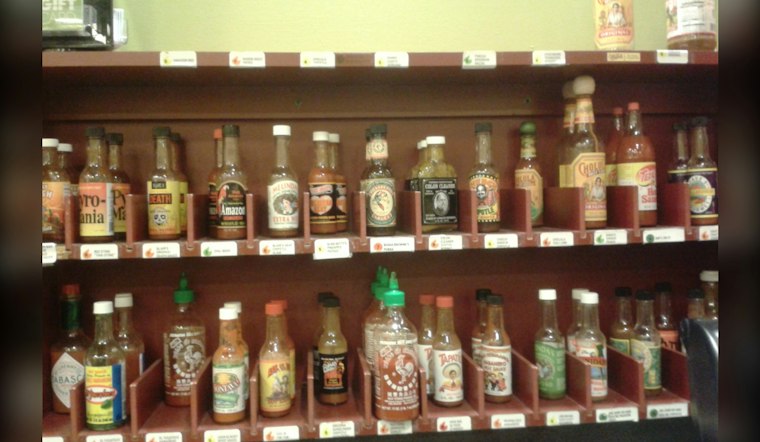
The Keenens launched the company in 2012 after meeting at UC Santa Cruz in the early 2000s, then opened a Berkeley shop in 2013 with about 200 small-production sauces. A 2014 Edible East Bay profile found more than 300 varieties there and about 40 superhot sauces, including Nothing Beyond, listed at 4 million Scoville units. They switched to online-only sales in 2016. SFGATE now puts the catalog at more than 700 sauces and 24 single-varietal pepper grinders, made at the warehouse.
They started Mount Diablo to see how hot a pourable sauce could get from 7 Pot Primo powder. The same operation also makes a Peruvian-inspired aji amarillo sauce with dragon's breath peppers and aji amarillos from Keenen's stepfather's farm. Dylan Keenen grew up in Ojai and has covered Bay Area food for 17 years. The superhot experiment is not the only thing leaving the warehouse.
Publish the Number
Keenen told SFGATE that Mount Diablo was the hottest sauce they had tested, and that he could not find a lab report for a hotter one. He has invited other makers to test their products and publish the results. He expects the rating to be somewhat controversial, and hopes the claim pushes sauce makers to put numbers on the record so buyers know what they are buying.
There is already a public exhibit for why the labels need a translator. A 2024 Howtown documentary, as reported by SFGATE, tested that period's Hot Ones lineup at the lab used by New Mexico State University Chile Pepper Institute researchers. The lineup received Scoville ratings far below advertised levels. Da Bomb Beyond Insanity, which contains added pepper extract, measured far higher than advertised.
Heat's version of a world record is narrower than the brag it invites: extract-free, tested as sold, 153,000 Scoville heat units, and an open challenge to anyone holding a hotter lab report in the same category. If other makers take the invitation, the contest is still waiting on their paperwork.





